Special Cell takes over Umar Khalid attack case
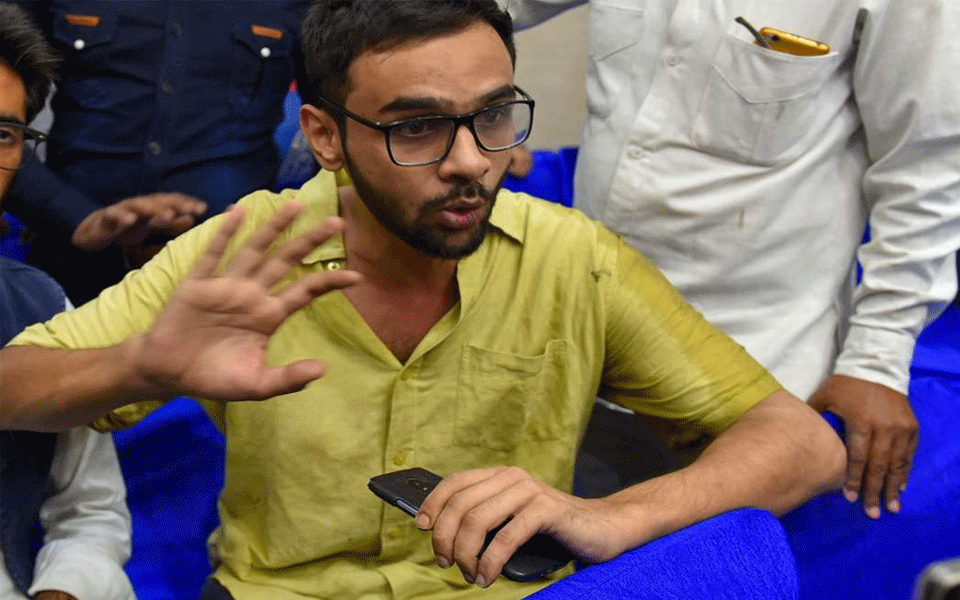
New Delhi, Aug 14 : Delhi Police Special cell on Tuesday took over the case of attack on JNU scholar Umar Khalid by an unknown assailant here and scanned the CCTV footage, which shows a man running away from the place of crime, said a police official.
Khalid, accused of raising anti-national slogans in 2016, was attacked in the heart of the capital outside the Constitution Club, 500 metres away from Parliament, on Monday. He survived the bid on life because of his friends, he said.
After scanning the footage of CCTVs installed near the place where the crime took place, the probe team suspect a man who is seen running away from the location.
"We have scanned over 50 CCTV footages and are trying to identify the suspect," Deputy Commissioner of Police P.S. Kushwah said, adding that the image of the suspect is yet to be shown to the victim and witnesses.
On checking the revolver, the police team found that there were six live cartridges in its magazine, implying that no shot was fired.
However, according to witnesses, the sound of a gunshot was heard, raising questions about the presence of another weapon or another attacker but the police felt it was "premature" to come down to this conclusion.
"We have just taken over the case from New Delhi district police and it would be premature to make such speculation," he said.
Earlier, the police officer said: "We have recorded Umar Khalid's statement afresh and are trying to know about the people that had threatened him earlier too. We have got some good leads."
"The statements of eyewitness have also been recorded by the team to know the sequence of incident," the officer said.
In the FIR, Khalid said that the attacker came from behind and hit his head.
When Khalid turned back, he dragged him and whipped out a revolver aiming to shoot. Khalid's friend Saddak Hussain in the meantime tried to overpower the accused.
"The accused managed to escape and we heard the shot. We informed the local police and later found a revolver lying on a road near NITI Aayog," Khalid said in the FIR.
Khalid had gone to the Constitution Club to attend a "United Against Hate" programme where the listed speakers included noted lawyer Prashant Bhushan, MP Manoj Jha and journalist Amit Sen Gup
Let the Truth be known. If you read VB and like VB, please be a VB Supporter and Help us deliver the Truth to one and all.
TN polls: TVK pushes DMK behind with leads in 83 seats, AIADMK ahead in 54
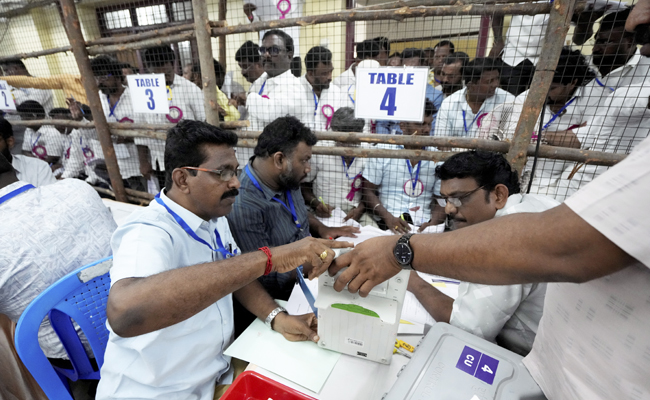
Chennai (PTI): New entrant TVK, led by actor-politician Vijay, was leading in as many as 83 constituencies on Monday when counting of votes polled in the April 23 Assembly polls was on across Tamil Nadu. The AIADMK was leading in 58 seats while the ruling DMK was ahead in 34, EC data showed.
About two hours after the postal ballots were counted and EVMs opened for multi-round counting, Vijay's Tamilaga Vettri Kazhagam surged ahead of its Dravidian rivals-- the DMK and the AIADMK, with the ruling party struggling to catch up.
If the trends maintain, Vijay could as well ensure the biggest electoral upset, something in lines with the "1967,1977" wins he had referred to in his campaign speeches.
While the Dravidian stalwart CN Annadurai brought the first non-Congress government in Tamil Nadu post-independence in 1967, the charismatic MG Ramachandran (MGR) installed the maiden AIADMK government 10 years later, unseating then DMK government under M Karunanidhi. TVK was leading in most Chennai segments, all considered DMK strongholds and currently represented by the party in the 234-member House.
A poor show by DMK could belie most exit polls giving an edge to it, riding on the number of populist measures Chief Minister M K Stalin had implemented in his five year "Dravidian model," inclusive governance.
According to EC and TV reports, 15 cabinet ministers, including Stalin were trailing. His son and deputy CM Udhayanidhi was also behind in his incumbent Chepauk-Tirvuvallikeni seat, according to a number of reports.
Stalin was trailing behind TVK's VS Babu by 1234 votes in Kolathur segment. Vijay was ahead in Tiruchirappalli East by over 3,000 votes at the end of two rounds of counting, according to EC data.
BJP is trailing in 26 constituencies and it is ahead in Thali segment alone. TVK is ahead in constituencies including Ponneri, Tiruvallur, Poonamalle, and Avadi.
AIADMK is leading in segments including Katpadi, and Guidyattam and party chief Edappadi K Palaniswami is ahead in Edappadi segment by 7003 votes.
DMK was leading in segments including Vellore, Anaikattu and Rishivandiyam.