Stable policy regime for e-mobility soon: PM Modi
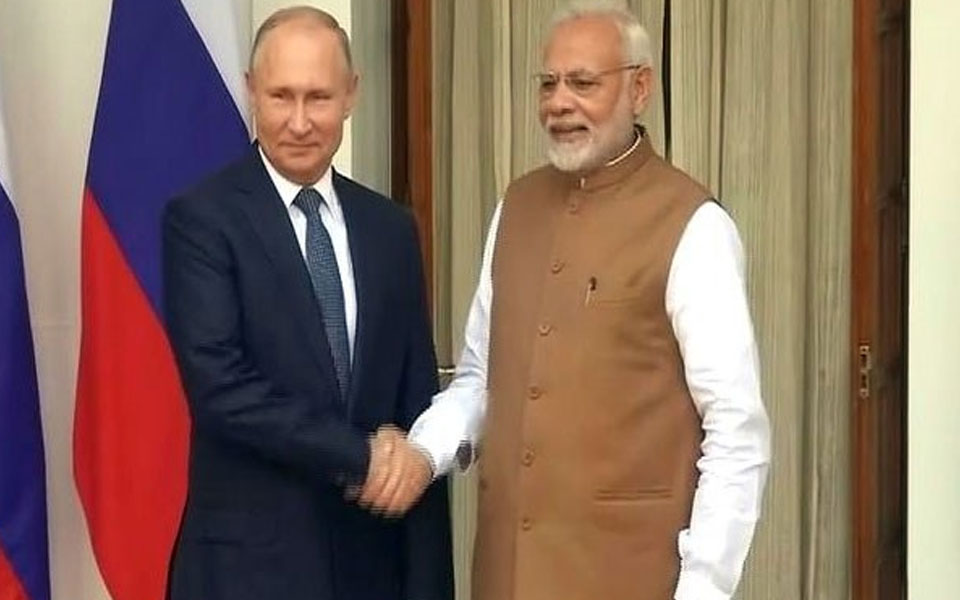
New Delhi, Sep 7 : Prime Minister Narendra Modi on Friday said that the government will soon put in place a new stable policy regime to promote the use of electric and other alternative-fuel vehicles in the country to fight climate change.
"We want to build India as a driver in electric vehicles. We will soon put in place a stable policy regime around electric and other alternative-fuel vehicles," Modi said at the launch of the two-day "Move: Global Mobility Summit" here.
"Clean mobility powered by clean energy is our most powerful weapon in our fight against climate change. This means a pollution-free, clean drive, leading to clean air and better living standards for our people," he said.
Modi said that in a rapidly transforming mobility paradigm, India had inherent strength and comparative advantages over other major economies.
"We have little of the legacy of resource-blind mobility. We have fewer vehicles per capita than other major economies. Thus, we do not carry much of the baggage of other economies that were built on the back of private car ownership. This gives us a window of opportunity to create an all new seamless mobility ecosystem," the Prime Minister said.
He added that not only did India have a strong Information Technology sector, but also its vast public digital infrastructure created by the unique identity programme Aadhaar.
"With digitally empowered 850 million Indian citizens, we can demonstrate how such digital infrastructure can be combined with new mobility business models.
"Our renewable energy boost will ensure that the environmental benefits of electric mobility can be fully realised. We plan to draw 175 GW of energy from renewables by 2022. We are already the fifth largest producer of solar energy and sixth largest of renewable energy in the world," Modi added.
He said that India also had a fast growing manufacturing base and a large digitally-literate young population.
"Therefore, I am convinced that India is the best place globally to be an early mover in the mobility economy... we will do whatever it takes, because this is our commitment to our heritage and our promise to future generations," he added.
Calling mobility similar to Internet in its early days, Modi said that the mobility revolution was an enabler of India's growth and development, which was capable of creating employment for those with doctorates and engineering degrees, to drivers and mechanics.
"We should embrace this revolution early and leverage ourselves to lead the mobility innovation ecosystem both for ourselves and others," he said.
"My vision for the future of mobility in India is based on 7 Cs -- common, connected, convenient, congestion-free, charged, clean, cutting-edge." Charged mobility, Modi said, was the way forward.
"We want to drive investments across the value chain from batteries to smart charging to electric vehicle manufacturing... India's entrepreneurs manufacturers are now poised to develop and deploy breakthrough battery technology," he said.
The Prime Minister also said that India's economy and reforms were on the move in this direction.
"Our economy is on the move. We are the world's fastest growing major economy. Our cities and towns are on the move. We are building 100 smart cities. Our infrastructure is on the move. We are speedily building roads, airports, rail lines and ports...
"Our goods are on the move. Goods and Services Tax has helped rationalise supply chains and warehouse networks... our reforms are on the move. We have made India an easier place to do business. Our lives are on the move. Families are getting homes, toilets, LPG cylinders, bank accounts and loans... we are fast emerging as the start-up hub of the world," he said
Let the Truth be known. If you read VB and like VB, please be a VB Supporter and Help us deliver the Truth to one and all.
BJP councillor dies by suicide after being threatened by youths following party's bypoll win

Agartala (PTI): A BJP councillor of Dharmanagar Municipal Council (DMC) in North Tripura died by suicide on Tuesday after he was allegedly threatened and humiliated by a group of youth following the saffron party's victory in the Dharmanagar bypoll, police said.
Rahul Kishore Roy, who was also the BJP's Yuva Morcha mandal president, took the extreme step a day after BJP candidate Jahar Chakraborti won the bypoll for the Dharmagar Assembly constituency by a massive margin.
Chief Minister Manik Saha expressed shock over the youth leader's death and assured an impartial inquiry into the allegations brought by the deceased’s wife, Ananya Bhattacharjee.
"I am shocked by the untimely death of Rahul Kishore Roy. May his soul rest in peace, and also offer my sympathy to the bereaved family. I also assured that an impartial inquiry will be conducted following the complaint of the deceased's wife", the CM wrote on Facebook.
Roy's wife has lodged a complaint with the local police station, holding seven persons responsible for her husband's death.
"Soon after the announcement of the results of the bypoll to the Dharmagnar Assembly bypoll, six to seven youths attacked our residence at Chandrapur at 3 pm and started hurling abuses at my husband. They also assaulted me to hand over my husband to them," she stated in the complaint.
Ananya said, "The same gang returned late at night again, attacked our house and hurled two or three bombs. They also threatened to eliminate my husband whenever he is found at Dharmanagar."
Deeply upset by the attacks and threats, my husband committed suicide by hanging from the ceiling early Tuesday morning. I urge the Officer in Charge (OC), Dharmanagar police station, to investigate against these people for justice, she said.
"Based on a specific complaint, we have registered a case, and an investigation is underway. No one has been arrested yet," SP, North Tripura, Avinash Kumar Rai said.
(Assistance for overcoming suicidal thoughts is available on the state’s health helpline 104, Tele-MANAS 14416.)