Stalin asks why Centre has not set up institution to teach Tamil in northern states
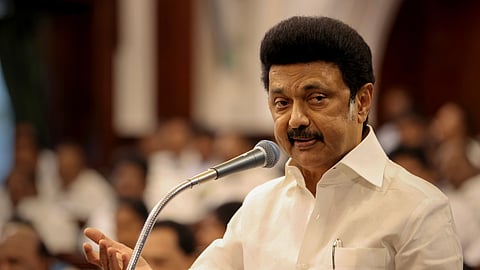
Chennai (PTI): Targeting the BJP-led Centre over alleged Hindi imposition, Tamil Nadu Chief Minister and DMK President M K Stalin on Tuesday wondered why the union government has not facilitated setting up of an institution to teach Tamil or other south Indian languages to people of states in north India.
Writing to party workers as part of his series on the theme of "all-time opposition to Hindi imposition" Stalin said, Google Translate, Chat GPT and Artificial Intelligence help people overcome language issues and it would be beneficial for students to learn only necessary technology and imposing a language shall only be a burden to them.
The DMK chief said Gandhiji believed that people of southern states learning Hindi and those in northern states learning one of the southern languages would pave the way for national unity and the Dakshina Bharat Hindi Prachar Sabha was founded to fulfil the wish of Father of the nation. "Gandhi himself had taken part in programmes in the sabha's headquarters in Chennai. Now, the sabha is operational across southern states with 6,000 centres," Stalin said.
Further, the chief minister, refraining from specifically naming anyone, posed whether an organisation like "Uttar Bharat Tamil Prachar Sabha or Dravida Basha Sabha" was established in north India to facilitate people of northern states to learn one of the languages of southern states.
Hitting out at BJP without naming it directly, the chief minister alleged that those who claimed to get installed a statue of saint poet Thiruvalluvar on the banks of River Ganga had it dumped on a garbage heap and wondered whether such people would set up an institution to propagate Tamil. "Those who follow the path of Godse will never fulfil the objectives of Gandhi." Even during the bygone times of Madras province, Gandhiji was instrumental in the christening of provincial Congress party unit as Tamil Nadu Congress. "Even for trains being operated in Tamil Nadu, the BJP-led union government gave Hindi-Sanskrit names. It is their secret plan to destroy Tamil and other languages. It is the Dravidian movement that has the strength to openly oppose it."
Dakshina Bharat Hindi Prachar Sabha, declared by Parliament as an institution of national importance in 1964, was established in 1918 by Mahatma Gandhi with the aim of propagating Hindi in southern states and the first Pracharak was his son Devadoss Gandhi.
According to the DBHPS website, Gandhiji desired that the 'Hindi Prachar' in the south should be carried on by involving the local people of the respective area. Till 1920, the sabha had its office at George Town in the then Madras and after some years it was shifted to Mylapore and from there to Triplicane where it functioned till 1936. Now, the DBHPS functions from downtown T Nagar in Chennai.
Let the Truth be known. If you read VB and like VB, please be a VB Supporter and Help us deliver the Truth to one and all.
Sujit Nair raises concerns over speculation of DMK-AIADMK understanding to block TVK
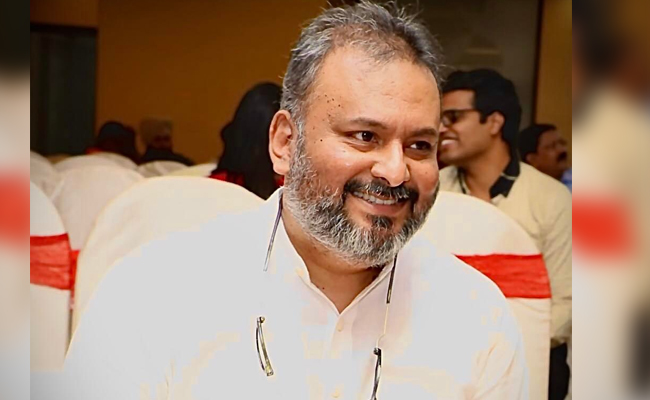
Chennai: Journalist and political commentator Sujit Nair has expressed concern over speculation that the Dravida Munnetra Kazhagam and the All India Anna Dravida Munnetra Kazhagam could explore a post-poll understanding to prevent Vijay-led Tamilaga Vettri Kazhagam from forming the government in Tamil Nadu.
In a social media post, Sujit Nair said the election verdict in Tamil Nadu reflected a clear public demand for political change and argued that the mandate should be respected irrespective of political preferences.
Referring to reports and political discussions surrounding a possible understanding between the DMK and AIADMK, he said he hoped such developments remained only speculative conversations and did not turn into reality.
Nair stated that if such an alliance were to take shape, it would raise serious questions about ideological politics in the country. He said TVK had emerged through a democratic electoral process and that the legitimacy to govern in a parliamentary democracy comes from the people’s verdict.
According to him, attempts to prevent an electoral winner from forming the government through unexpected political arrangements may be constitutionally valid, but many people could view them as politically opportunistic.
He further said that such a move could particularly affect the political image of the DMK, which has historically projected itself around ideology, social justice and opposition politics. Nair said that in ideological terms, the DMK appeared closer to TVK than to the AIADMK, and joining hands with its long-time political rival only to remain in power could weaken its broader political narrative.
He added that the same questions would apply to the AIADMK as well, as the party had spent decades positioning itself against the DMK and such an arrangement could create discomfort among its cadre and supporters.
Drawing a comparison with Maharashtra politics in 2019, Nair said he had expressed similar views when the Shiv Sena formed an alliance with the Indian National Congress and the Nationalist Congress Party after the Assembly elections.
He said post-poll alliances between long-standing political rivals often create a public perception that ideology and electoral mandates become secondary when political power equations come into play.
Nair also said such developments increase public cynicism towards politics and reinforce the belief among voters that ideology is often sidelined after elections.
He maintained that the Tamil Nadu verdict was emphatic and said respecting both the spirit and substance of the mandate was important for the credibility of democratic politics.