‘Stands as grand edifice’: President Murmu praises Ram Temple in R-Day eve speech
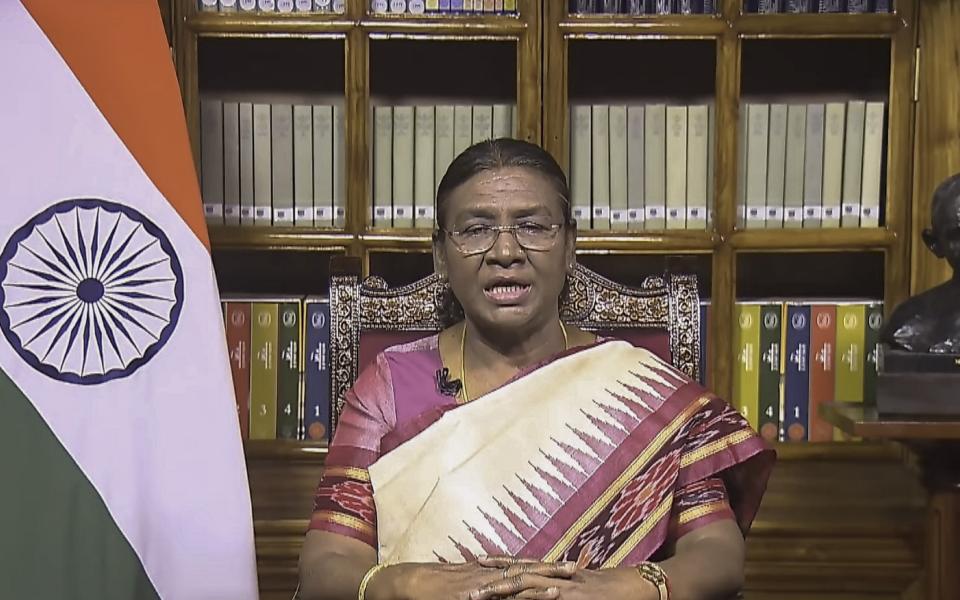
New Delhi, Jan 25: President Droupadi Murmu on Thursday said the Ram temple will be marked in history as "India's continued re-discovery of its civilisational heritage" and as a grand edifice, giving a befitting expression not only of people's faith but also as a testament to people's enormous trust in judicial process.
In her address to the nation on the eve of the 75th Republic Day, the president spoke on various issues including the welfare schemes initiated by the government and said it will be a proud day for the nation when it will be among those countries where homelessness "is a rarity".
She also touched on the conflicts that have emerged in several parts of the world and stressed at finding a way out in the light of reason.
"When each of the two conflicting sides believes that it is right and the other is wrong, the way out should be found in the light of reason. Unfortunately, instead of reason, fears and prejudices have fuelled passions, leading to relentless violence. There have been a series of humanitarian tragedies on a large scale, and we feel aggrieved over the human suffering," she said.
Citing the teachings of Vardhaman Mahavir, Samrat Ashoka and Mahatma Gandhi, the president said let's hope that the regions embroiled in conflicts will find a peaceful way to resolve conflicts and bring about peace.
Referring to the recent consecration rituals of Lord Ram at the newly-constructed temple at Ayodhya, she said when this event will be seen in the wider perspective, the future historians will consider it a landmark in India's continued re-discovery of its civilisational heritage.
"The construction of the temple commenced after the due judicial process and the decision of the highest court of the land. Now it stands as a grand edifice, giving a befitting expression not only of people's faith but also as a testament to people's enormous trust in the judicial process," she said.
Murmu said the "magnificent" G20 Summit hosted by India provided lessons for all in making citizens participants in strategic and diplomatic matters that are, in the final analysis, going to shape their own future.
"The G20 Summit also boosted India's emergence as the voice of the Global South, adding a necessary element to the international discourse," she said.
Talking about the economy of the country, she said India is moving ahead with confidence, which comes from and is also reflected by the robust health of the economy.
Emphasising that the nation is in the early years of Amrit Kaal, the period leading to the centenary of Independence, which is also the time of an epochal transformation, Murmu asked citizens to abide by fundamental duties enshrined in the Constitution.
"These duties are essential obligations of every citizen towards making Bharat a developed nation when it completes 100 years of independence. Here, I think of Mahatma Gandhi who had rightly said, 'No people have risen who thought only of rights. Only those did so who thought of duties'."
She said the period of Amrit Kaal is also going to be the period of unprecedented technological changes.
"Technological advances like Artificial Intelligence and machine learning have moved from headlines into our daily lives at a breathtaking speed. There are numerous areas of concern in the foreseeable future, but there are also exciting opportunities ahead, especially for the youth. They are exploring new frontiers," she said.
The president said we have to remove hurdles from the path of youth and let them unleash their full potential.
"What they want is equality of opportunity. What they want is not the same old rhetoric of equality, but the realisation of our cherished ideal of equality," she said.
Underlining the welfare schemes launched by the government, Murmu said the government has not only expanded and enhanced the welfare schemes, but it has also redefined the idea of welfare itself.
She said there are reasons to believe that the extraordinary performance of the economy which recorded highest GDP growth among major economies will continue in the year 2024 and beyond.
Murmu said the same farsighted planning that fuels the economy has also given a push to the welfare drive to make the development inclusive in every sense of the term.
"The government had increased the scope of schemes to provide free food to the weaker sections of society during the pandemic days. These measures were later continued to extend a helping hand to the vulnerable population to come out of that crisis," she said.
Murmu said expanding the scope of that initiative, the government has decided to provide free food grains to over 81 crore people for five years which may be the biggest welfare initiative of its kind in history.
She said from the availability of safe and adequate drinking water at home to the security of having one's own home, there have been a number of mission-mode schemes to increase the ease of living for all citizens by catering to their basic minimum requirements, not privileges.
"These matters are beyond any political or economic ideology and must be seen from a humanitarian perspective. The government has not only expanded and enhanced the welfare schemes, but it has also redefined the idea of welfare itself," she said.
The president said it will be a proud day for us all when India becomes one of those few countries where homelessness is a rarity.
She said there have been a series of humanitarian tragedies on a large scale, and we feel aggrieved over the human suffering.
"Let us hope that the regions embroiled in conflicts will find a peaceful way to resolve conflicts and bring about peace," she said.
Murmu said the National Education Policy gives adequate thrust to bridge the digital divide and create a uniform educational structure for the benefit of the underprivileged students.
"The expanding insurance cover of the Ayushman Bharat scheme aims to bring together all beneficiaries under its umbrella and provides a great reassurance to the poor and the vulnerable," she said.
Invoking BR Ambedkar and his role in framing the Constitution, she said democracy implies diversity of culture, beliefs and practices. Celebrating diversity implies equality, which is upheld by justice.
"Freedom is what makes it all possible. The totality of these values and principles is what makes us Indian," Murmu said.
Calling former Bihar chief minister Karpoori Thakur, who was awarded the Bharat Ratna, a tireless champion of social justice, she said he was one of the greatest advocates of backward classes who dedicated his life for their welfare.
The president also lauded India's quest in space through Moon mission, Solar explorer Aditya L1, deep space probe X-ray Polarimeter Satellite called XPoSat, under preparation man-mission Gaganyaan and other technological milestones.
"We have always been proud of our scientists and technology experts, but now they are aiming far higher than before and delivering too. India's space programme is aimed at expanding and deepening the role of science and technology for the benefit of the entire humanity," she said.
Murmu said the nation has progressed further towards the ideal of gender equality, when the Parliament passed the historic Women's Reservation Bill.
"I believe the Nari Shakti Vandan Adhiniyam will prove to be a revolutionary tool of women's empowerment. It will also go a long way in improving the processes of our governance.
"When more women will be involved in matters of collective importance, our administrative priorities will be more in tune with the needs of the masses," she said.
Let the Truth be known. If you read VB and like VB, please be a VB Supporter and Help us deliver the Truth to one and all.
Trump says he ‘hasn’t even thought about’ continuing Iran ceasefire
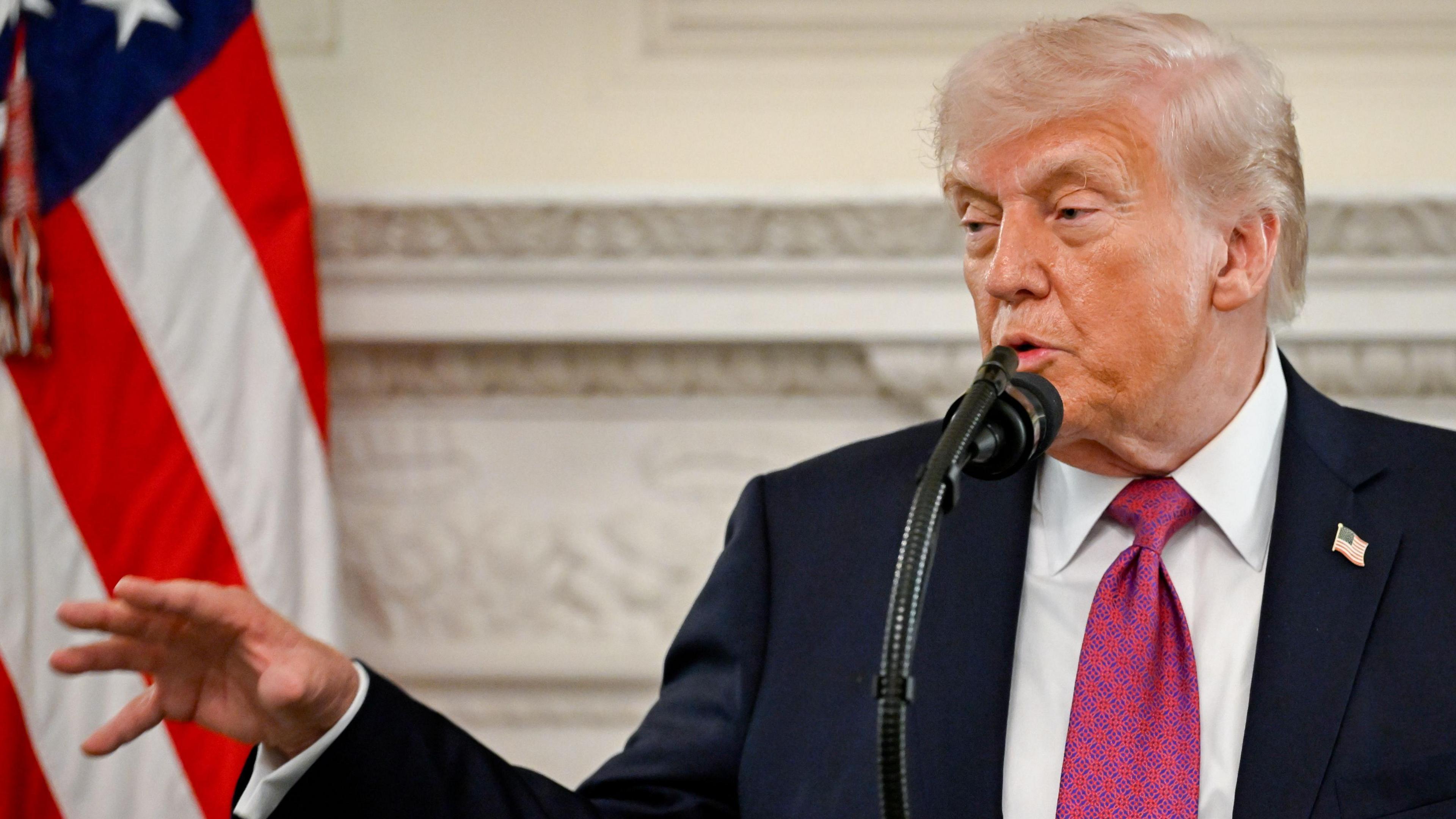
Washington: US President Donald Trump has said he has not yet considered whether he would continue the ceasefire involving Iran, while also claiming the United States holds the advantage in negotiations.
Speaking to reporters, Trump said he was prepared to make a deal with “whoever is running the show” in Iran.
“They are fighting with each other, there’s tremendous infighting. They’re probably fighting for leadership in many cases. I think they’re fighting not to be leader because we knocked out two levels of leaders,” he said.
Trump added, “When they want they can call me. We have all the cards, we’ve won everything.”
Referring to ongoing negotiations, he said, “They gave us a paper that should’ve been better. And, interestingly, immediately when I cancelled it [envoy trip to Pakistan], within 10 minutes we got a new paper that was much better.”
“We talked about they will not have a nuclear weapon, very simple … They offered a lot, but not enough,” he added.
When asked whether he would continue the ceasefire, Trump replied, “I haven’t even thought about it.”
The remarks come as uncertainty remains over the future of the temporary truce and broader negotiations between Washington and Tehran.