Starlink gets licence to start India services

New Delhi, Jun 6 (PTI): Elon Musk's Starlink has received a licence from the telecom department for providing satellite internet services in India, a key milestone that will take it closer towards launching commercial operations in the country.
Starlink is the third company after Eutelsat OneWeb and Jio Satellite Communications to get a licence from the Department of Telecommunications to provide satellite internet services in the country.
A fourth applicant, Amazon's Kuiper is still waiting for approvals.
DoT sources confirmed on Friday that Starlink has indeed received the licence, and said the company will be granted trial spectrum in 15-20 days of applying for it.
Starlink will now have to comply with the security norms such as providing access for lawful interception, before starting services.
The licence came hours after a huge public spat between Musk and US President Donald Trump. The falling-out between the world's richest man and the world's most powerful person began when Musk, who left his role as head of the Department of Government Efficiency a week ago, denounced Trump's sweeping tax-cut and spending bill.
On Thursday, it erupted in the verbal duel after Trump criticised Musk in the Oval Office. Musk responded saying "Trump would have lost" without his help, prompting the US President to end US contracts.
The licence from DoT came nearly a month after the Starlink was issued a letter of intent (LoI) by the telecom department.
The companies that have received the licence would, however, have to a wait a tad longer for commercial satcom spectrum as the Trai just recently sent its recommendations on pricing, and terms and conditions, to the government for its consideration.
The players will be able to start their services after the allocation of radio wave frequencies.
Typically, even before the commercial spectrum, the trial spectrum is required to test, and verify the systems and processes on security parameters to demonstrate that all norms and requirements, are being complied with.
The status of the Starlink's final nod from the Indian space regulator, In-SPACe could not be immediately ascertained.
Starlink is a satellite internet service developed by SpaceX -- the American aerospace manufacturer and space transportation company founded in 2002 by the world's richest man Musk. It provides high-speed, low-latency broadband internet worldwide using satellite technology and is aptly described by some as broadband beamed from the skies.
Unlike conventional satellite services that rely on distant geostationary satellites, Starlink utilises the world's largest low Earth orbit or LEO constellation (550 km above Earth).
This constellation of LEO satellites (7,000 now but eventually set to grow to over 40,000) and its mesh delivers broadband internet capable of supporting streaming, online gaming, and video calls.
Starlink, which had been vying for an India licence for some time now, recently signed pacts with Ambani's Reliance Jio and Mittal's Bharti Airtel, which together control more than 70 per cent of the country's telecom market, to bring the US satellite internet giant's services to India.
The nod for the satcom offering -- known for its resilience in harsh conditions and conflict zones -- coincides with escalation of Donald Trump-Elon Musk feud in the US.
Early last month, the government had issued stringent security norms mandating legal interception of satellite communication services and barred companies from linking connection of users in any form with any terminal or facility located outside the country's border as well as processing of their data overseas.
The tighter security rules also mandate service providers to indigenise at least 20 per cent of their ground segment of the satellite network within years of their establishment in the country. The satcom service licence holders will require security clearances for specific gateway and hub locations in India and compliance to monitoring, interception facilities and equipment requirements.
India's rules mandate satcom firms to demonstrate system capabilities with respect to security aspects, including monitoring, to the Department of Telecom (DoT) or its authorised representatives before starting operations in India.
It is pertinent to mention that Telecom regulator TRAI last month recommended that satellite communication companies like Starlink pay 4 per cent of their adjusted gross revenue (AGR) as spectrum charges to the government -- a rate steeper than what these firms had been lobbying for.
Operators offering satellite-based broadband internet services in urban areas would have to shell out an additional Rs 500 per subscribers annually, TRAI recommended. No additional levy would be applicable for services in rural areas.
COAI, whose members include Reliance Jio and Airtel, recently approached the telecom department to raise concerns over TRAI recommendations on the satcom spectrum.
The industry body argued that "incorrect assumptions" have led to unjustifiably low spectrum charges for satellite services relative to terrestrial networks -- a claim strongly rejected by Trai, which has ruled out any review of recommendations at this stage, based on industry body COAI's charges.
Let the Truth be known. If you read VB and like VB, please be a VB Supporter and Help us deliver the Truth to one and all.
Ruckus outside counting centre in Mamata's constituency, TMC claims entry of car with BJP flag
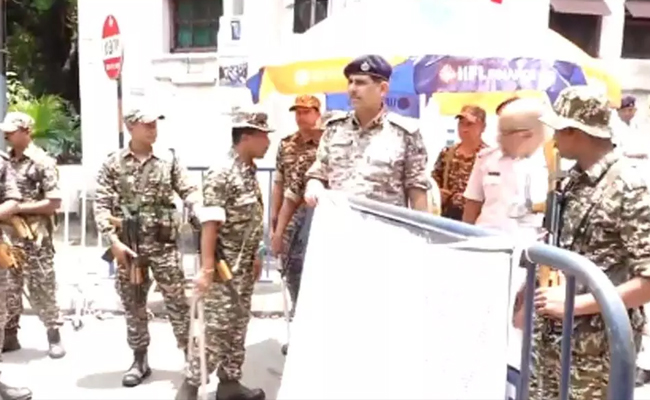
Kolkata (PTI): The counting centre at West Bengal Chief Minister Mamata Banerjee's Bhabanipur assembly constituency witnessed a ruckus a day ahead of the counting of votes, with TMC workers alleging two cars bearing the BJP's flag were allowed entry to the compound where EVMs are kept.
The incident comes close on the heels of a four-hour-long sit-in by Banerjee in front of the same counting centre at the Sakhawat Memorial Girls School on Thursday night, alleging unauthorised entry of persons into the strongroom.
With the polling now over, the wrangling for power in West Bengal has turned into a battle of nerves between the incumbent TMC and the BJP. Workers and leaders of both parties have been keeping a steely gaze on the security of strongrooms across the state where the electoral fate of the candidates is sealed.
Despite expressing her confidence in a "landslide victory", Banerjee has repeatedly aired her apprehensions of "counting malpractice and EVM tampering ahead of the day of results".
On Sunday morning, TMC workers camping 100 metres from the counting centre alleged that two cars with BJP flags entered the premises and went near the strongroom.
"The CAPF personnel at the spot are not allowing any vehicle or person to enter the premises of the counting centre without valid identity proof. Then how come this car, which we have not seen in the past few days, was allowed entry? Once we protested, the central forces asked us to move 100 metres away," a TMC activist said.
The TMC claimed that while the police personnel posted there promised the vehicle would be removed from the spot, it remained there for some time.
A senior Election Commission official said the car was passing by the Harish Mukherjee Road, and after checking by security forces and police, it was allowed to leave as nothing objectionable was found in it.
On Thursday night, two counting centres, including one at Sakhawat Memorial Girls School in the city, witnessed high drama after TMC leaders alleged a lack of transparency and possible malpractice at the strongrooms housing sealed EVMs of the assembly polls, which concluded on April 29.
TMC leaders and candidates, Sashi Panja and Kunal Ghosh, held a sit-in outside the Khudiram Anushilan Kendra counting centre on Thursday evening, alleging unauthorised activities inside the strongroom amid the absence of TMC agents
In Howrah, TMC protested renovation work by the public works department at a place adjacent to the strongroom, and the EC stopped the work temporarily.
On Saturday, the ruling party filed a complaint with the poll panel, alleging unauthorised sorting of postal ballot covers at the EVM strongroom in Khudiram Anushilan Kendra.
Similar scenes were witnessed on Saturday outside the strongrooms at Asansol College in Paschim Bardhaman and the Barasat Government College in North 24 Parganas districts, where TMC workers held protests, alleging that CCTV cameras were switched off for several minutes.
The EC turned down all allegations, saying the surveillance cameras were working in an uninterrupted manner.
BJP spokesperson Sajal Ghosh told reporters that the people of Bengal were finding it "hilarious" that the TMC, "which used to win elections through unfair means and strongarm tactics" were now coming up with all sorts of "frivolous charges".
"Are they scared of losing?" he posed.