States can't file writ petitions in SC against actions of Prez, Guv in dealing with bills: Centre
_vb_37.gif)
New Delhi (PTI): The Centre on Thursday told the Supreme Court that state governments cannot invoke writ jurisdiction in moving the apex court against the actions of the President and the governor in dealing with the bills passed by assemblies for violation of fundamental rights.
A five-judge bench Constitution bench headed by Chief Justice BR Gavai was told by Solicitor General Tushar Mehta, appearing for the Centre, that the President would like to have an opinion of the apex court on whether states can file writ petition under Article 32 of the Constitution for violation of fundamental rights.
He said the President would also like to have an opinion on the scope of Article 361 of the Constitution which says the President, or the Governor will not be answerable to any court for the exercise and performance of the powers and duties of his office or for any act done.
Mehta told the bench also comprising Justices Surya Kant, Vikram Nath, PS Narasimha and AS Chandurkar that they have debated over these questions in the reference but the President is of the opinion that she would like to have the view of the court to know the exact legal position as issue may arise in the future.
He submitted that Article 32 petition on behalf of the state against the action of the governor and the President cannot be filed as it is not maintainable, no direction can be issued to them and thirdly the action of the governor and the President in dealing with the bills is not justiciable.
"Article 32 lies when there is violation of fundamental rights and state government in the constitutional scheme does not in itself have the fundamental right. It is a repository of functions which is to protect fundamental rights of its people," Mehta said.
The solicitor general referred to the April 8 Tamil Nadu verdict in which states were given liberty to approach the apex court directly in case timeline is not adhered by the governor in clearing the bills passed by the assembly.
CJI Gavai said it will not say any words with regard to the two-judge verdict of April 8 but the Governor would not be justified in sitting over the bill for six months
Mehta submitted that one constitutional organ not discharging his duties, does not entitle the court to direct another constitutional organ.
The CJI said, "Yes. We know what your argument is? If this court does not decide the matter for 10 years, would it be justified for the President to issue an order."
The hearing is underway.
On August 26, the top court wondered whether the court should sit powerless if a Governor delays assent to bills indefinitely and if the constitutional functionary's independent power to withhold a bill would mean that even money bills could be blocked.
The court raised the questions after some BJP-ruled states defended the autonomy of Governors and President in assenting to bills passed by a legislature, submitting that "assent to a law cannot be given by court". The state governments also contended that judiciary cannot be a pill for every disease.
The top court is hearing the Presidential reference on whether the court could impose timelines for governors and President to deal with bills passed by state assemblies.
In May, President Droupadi Murmu exercised powers under Article 143(1) to know from the top court whether judicial orders could impose timelines for the exercise of discretion by the president while dealing with bills passed by state assemblies.
Let the Truth be known. If you read VB and like VB, please be a VB Supporter and Help us deliver the Truth to one and all.
6 women dead, 8 persons injured as bus rams into van in Gujarat's Sabarkantha
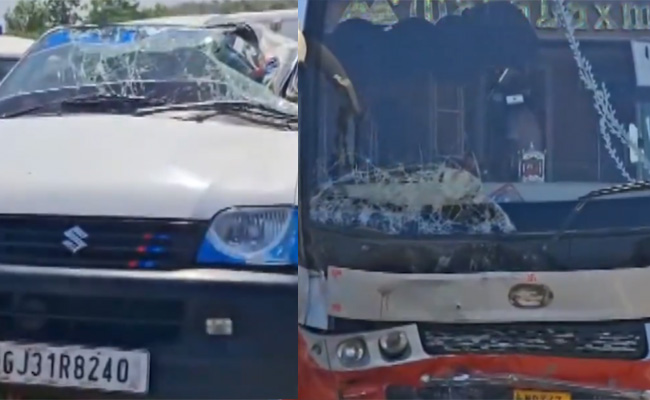
Sabarkantha (Gujarat) (PTI): Six women were killed and eight other persons injured after a private bus crashed into a van on a highway in Gujarat's Sabarkantha district on Wednesday, police said.
The van was ferrying women from Modasa in Aravalli district when a speeding bus hit it from behind on National Highway 48 connecting Shamlaji to Himmatnagar in the district, Deputy Superintendent of Police A K Patel said.
According to police, the women were part of a catering team for social events. They were travelling from Modasa in the neighbouring Aravalli district to Hunj village in Himmatnagar to attend a function when they met with the accident.
Six women passengers of the van were killed, Patel said.
Seven other women and the van driver suffered injuries, according to police.
The injured persons were rushed to the Himmatnagar civil hospital. The condition of two of them was critical, the hospital's medical officer, Dr Dhrupad Chauhan, said.
The bodies were sent to a government hospital for a postmortem.
VIDEO | Gujarat: Six persons were killed and four others injured after a private bus rammed into a van on a highway in Sabarkantha district on Wednesday, police said.
— Press Trust of India (@PTI_News) April 29, 2026
The van carrying passengers was on its way from Shamlaji to Himmatnagar when the speeding bus hit it from… pic.twitter.com/Gvr79LfCvi