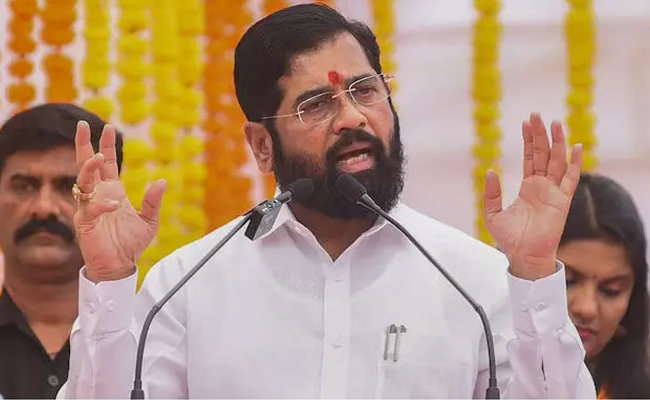
Pune (PTI): Maharashtra Deputy Chief Minister Eknath Shinde on Friday decried the alleged incident of stone pelting on Shiv Sena candidates campaigning for the January 15 Pune civic polls and said he and his workers are not scared of such cowardly politics.

Shinde's party colleague Pramod Nana Bhangire had alleged that stones were thrown at him and Sarika Pawar, both candidates from ward number 41, in Kale Padal in Hadapsar late Wednesday evening. Pawar sustained a minor injury in the incident, while the windscreen of their car was damaged, Bhangire had claimed.

Addressing a rally in Katraj here, Shinde, mentioning the incident, said, "I warn the opposition parties to not indulge in such cowardly acts. Shiv Sainiks will not get scared. We are Balasaheb Thackeray's sainiks. The Shiv Sena does not leave its workers to fend for themselves."

Shinde also mentioned an incident in Mumbai, where BJP workers allegedly used the '50 khokhe' (Rs 50 crore) slogan to target the Shiv Sena. The slogan was coined by the Uddhav Thackeray faction following the split in the Bal Thackeray-founded party in June 2022.

The Shiv Sena (UBT) has routinely alleged that Shinde and his rebels got Rs 50 crore each to break the party.

Underplaying the slogan episode, Shinde said his party and the BJP are contesting the Mumbai civic polls jointly and putting up a strong united fight.

Shinde exuded confidence that the Shiv Sena will show its might in Pune.

"Do not take Shiv Sena lightly just because it is contesting polls on its own. Shiv Sena runs on the ideology of Balasaheb Thackeray. It is Hindutva ideology," he added.

The BJP and Shiv Sena are fighting polls in Pune and Pimpri Chinchwad separately, while Ajit Pawar's Nationalist Congress Party has tied up with Sharad Pawar-led NCP (SP).

Speaking at the rally, Shinde took a swipe at former chief minister Uddhav Thackeray.

"Some people consider themselves as owners but the real owners are citizens. It is the people who decide who to take up and who to bring down," he said.

Let the Truth be known. If you read VB and like VB, please be a VB Supporter and Help us deliver the Truth to one and all.


Bengaluru: Across Karnataka, a serious discussion has begun after the violence in Ballari and the swift action taken against police officers who were on the ground that day. The core question being asked is simple: when law and order fails, why are police officers the first to be shown the door, while political responsibility is quietly pushed aside?

The January 1 clash in Ballari was not a sudden street fight. It was a political confrontation involving supporters of two sitting MLAs. A banner related to the unveiling of a Valmiki statue became the flashpoint. What followed was stone-pelting, firing, and the death of a Congress worker. The situation spiralled within hours.

Within a day, Ballari SP Pavan Nejjur was suspended. Soon after, senior officers were reshuffled. Deputy Inspector General of Police Vartika Katiyar was transferred. No official reason was cited in the notification. But the timing made one thing clear: accountability, at least on paper, had been fixed.

Since then, there has been unease within police circles and political debate outside it.

Unconfirmed reports that Nejjur attempted suicide after his suspension were firmly denied by senior officers and the home minister. They said he was safe, resting, and under stress. Still, the very fact that such reports gained traction says something about the pressure officers feel when action is taken overnight, without public clarity.

Opposition leaders have called Nejjur a scapegoat, pointing out that he had taken charge only hours before the violence. They have asked how an officer can be blamed for a political clash he barely had time to assess. They have also drawn parallels with earlier incidents where police leadership was suspended after tragedies, while political decision-making remained untouched.

However, responding to this criticism, Home Minister G Parameshwara rejected the argument that the suspension was unfair because Nejjur had assumed charge only hours earlier. “It is not important whether he reported to duty on the same day (of incident) or one hour back. Duty is duty. He is not new to the department. IPS officers are trained to handle such situations any time. If he had acted swiftly and promptly, he could have prevented the situation from escalating.” He had said adding that Nejjur did not discharge his duties properly and that this was the reason for his suspension.

Now, fresh and unconfirmed reports suggest that Vartika Katiyar may have met a senior cabinet minister, questioning why she was made to pay the price for a situation that was political in nature. There is no official confirmation of this meeting. But the talk itself has added fuel to the debate.

What is being discussed in the state is not whether the police made mistakes. Many acknowledge that the situation on January 1 was mishandled. A clash earlier in the day was allowed to cool down without strong preventive action. Later, a banner came up near a politically sensitive location. The crowd should not have been allowed to build up. Better anticipation was needed.

At the same time, critics are asking whether the entire burden can be placed on officers when the trigger itself was political rivalry. Who installed the banner? Who mobilised supporters? Who had armed private gunmen present at the spot? These are questions that are still part of the investigation, yet administrative punishment moved faster than political accountability.

This has led to a wider comparison with past incidents, including the Bengaluru stampede after the RCB victory celebrations. There too, police officers were suspended after lives were lost, while decisions taken at higher levels were defended as unavoidable. Many are now saying Ballari fits into the same pattern.

The argument being made is not that the police are blameless. The argument is that responsibility appears to stop at the uniform. When things go wrong, officers are transferred or suspended to send a message. But when the violence is rooted in political rivalry, that message feels incomplete.

Within police ranks, there is also quiet concern about working conditions. Officers say they are expected to manage volatile political situations overnight, often with little room to push back against powerful interests. When things hold, they are invisible. When they collapse, they stand alone.

The Ballari episode has once again exposed this fault line.

For the government, the challenge is larger than one suspension or transfer. The real test is whether it is willing to publicly acknowledge political failures when law and order breaks down, instead of letting the system suggest that the police alone dropped the ball.

For now, what remains is a growing feeling across Karnataka that accountability is selective. And that whenever politics turns violent, the easiest answer is to change the officers, not the decisions that led to the violence in the first place.