Stop beef export to prove commitment as Hindu sympathiser: Avimukteshwaranand to Adityanath
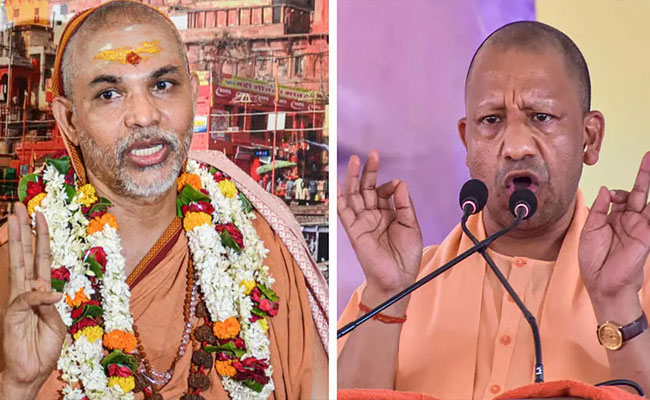
Varanasi (UP) (PTI): Swami Avimukteshwaranand Saraswati, who was allegedly prevented from taking a holy dip at the Sangam in Parayagraj, on Friday told Uttar Pradesh Chief Minister Adityanath to stop beef export from the state and declare cow as "Rashtra Mata" to prove his commitment as a "Hindu sympathiser".
The seer had left the Magh Mela ground last Wednesday "with a heavy heart", ending his sit-in protest outside the Shankaracharya camp since January 18 over the issue of not being able to take the dip at Sangam -- the confluence of the Ganga, Yamuna and the mythical Saraswati river.
Speaking to reporters in Varanasi on Friday, the seer said, "When I sat there for 11 days, no official asked me to take a dip. Now it is too late. I will go to the Magh Mela next year and take a respectful bath."
He also issued a challenge to Uttar Pradesh Chief Minister Adityanath, asking him to stop cow slaughter within 40 days to prove his commitment as a "Hindu sympathiser".
"Our credentials were asked for, and we submitted them. Now you have to give proof of being a Hindu sympathiser," Avimukteshwaranand said.
"The first step of being a Hindu is love for cows. Declare the cow as 'Rashtra Mata' and stop the export of cow meat from Uttar Pradesh. Then we will accept that you are a Hindu sympathiser," he added.
On January 18, Swami Avimukteshwaranand was riding a palanquin to the Sangam on the occasion of Mauni Amavasya, when a dispute broke out as administrative and police officials asked him to dismount and proceed for the ritual bath on foot, citing heavy crowds.
The Mela administration alleged that the Shankaracharya and his supporters broke a barricade on a pontoon bridge and moved towards the ghats, creating serious difficulties for the police in managing the situation.
Amid the row, the mela administration issued a notice asking him to explain how he was using the title of Shankaracharya of the Jyotish Peeth. The notice referred to a civil appeal pending before the Supreme Court, in which the court had ordered that until the appeal is disposed of, no religious leader can be consecrated as the Shankaracharya of Jyotish Peeth.
Hitting back, the seer had questioned how camps of two Shankaracharyas from Puri were allowed at the same mela. He had asked why the mela administration failed to notice a board claiming the presence of another Shankaracharya of Puri at the fair ground.
Let the Truth be known. If you read VB and like VB, please be a VB Supporter and Help us deliver the Truth to one and all.
Indian-origin translator Padma Viswanathan shortlisted for International Booker Prize 2026

New Delhi (PTI): Padma Viswanathan, a Canadian-American writer of Indian-origin, has made it to the 2026 International Booker Prize shortlist as the English translator of a Portuguese language novella.
"On Earth As It Is Beneath" by Brazilian author Ana Paula Maia, described by judges as a "brutal, haunting and hypnotic novella set in a remote Brazilian penal colony, where the boundaries between justice and cruelty collapse", is among the six worldwide contenders for the coveted literary honour.
The annual prize worth GBP 50,000, divided equally between the author and translator, was won last year by Kannada writer-activist Banu Mushtaq and translator Deepa Bhasthi for the short story collection "Heart Lamp". Each shortlisted title guarantees a prize of GBP 5,000 -- also split 50-50 between the book’s author and English translator.
"What struck us most is how spare, unflinching, uncompromising and relentless it is. Maia builds an entire moral universe out of very little: a remote prison, a handful of men, and the rituals of punishment that govern their lives.
"The novel reads almost like a dark fable about power, where brutality is ordinary and civilisation feels frighteningly thin," the judging panel, which also include award-winning Indian novelist and columnist Nilanjana S. Roy, said of the work translated by US-based Viswanathan.
The 58-year-old professor of creative writing at the University of Arkansas-Fayetteville is an accomplished playwright and author, whose novels have been published in eight countries.
The list, announced on Tuesday, is dominated by women, with five of the six authors and four of the six translators being female. The authors and translators represent eight countries -- Brazil, Bulgaria, Canada, France, Germany, Taiwan, the UK and the United States.
"With narratives that capture moments from across the past century, these books reverberate with history. While there’s heartbreak, brutality and isolation among these stories, their lasting effect is energising," said author Natasha Brown, chair of this year’s judging panel.
The other books include "The Nights Are Quiet in Tehran" by Shida Bazyar and translated from German by Ruth Martin; "She Who Remains" by Rene Karabash and translated from Bulgarian by Izidora Angel; "The Director" by Daniel Kehlmann and translated from German by Ross Benjamin; "Taiwan Travelogue" by Yáng Shuāng-zi and translated from Taiwanese by Lin King; and "The Witch" by Marie Ndiaye and translated from French by Jordan Stump.
The announcement of the winning book will take place on May 19 at a ceremony at Tate Modern in London.
The International Booker Prize is awarded annually for a single work of fiction -- either a novel or a collection of short stories -- written in another language, translated into English and published in the UK and/or Ireland.
According to the organisers, the 2025 winner "Heart Lamp" –- the first collection of short stories to win the prize and the first translated from Kannada –- rapidly sold out in the UK in the subsequent days, with the UK publisher, And Other Stories, immediately reprinting 40,000 copies.