Strong defence posture being maintained at LAC, says Army Chief
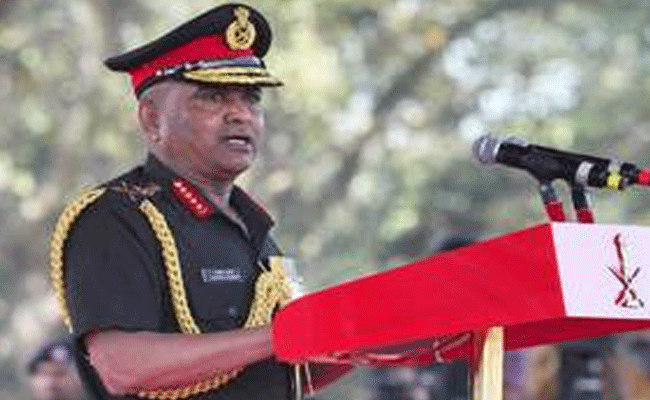
Bengaluru (PTI): The Indian army is maintaining a strong defence posture along the Line of Actual Control (LAC), and is ready to deal with any contingency, Chief of Army Staff, General Manoj Pande said on Sunday.
In his address at the Army Day celebrations here, which is happening for the first time outside the national capital, he said the northern border region has been peaceful and steps have been taken to maintain peace through established protocol and existing mechanism.
Referring to the situation along the western border, the Army Chief said the ceasefire continues at LOC and there has been a substantial reduction in violations. However, the terror infrastructure still remains on other side of border.
"Our counter insurgency mechanism is effectively foiling the infiltration bid from Pakistan," he added.
Pointing to the attempts to smuggle arms and drugs into Jammu and Punjab border regions using drones, General Pande said counter drone jammers were being used against such activities.
The Indian Army with other security forces is committed to foiling these attempts, he told the gathering.
"Our focuses are also on building goodwill and carry out developmental projects through which we can bring the local population into the mainstream. As part of it, the influential youth are being given opportunities to fulfill their dreams in their profession field of their choice and sports," General Pande said.
Alluding to the security situation in the North East, he said there is improvement in the situation. The army has played a significant role in minimising violence. Many insurgent groups have entered into peace agreement with the government or dialogues in that direction are underway.
According to him, there is an increase in development in these regions and the Army will continue its efforts to empower people and help them prosper in the remote areas.
On reforms in the Indian Army in light of the geo-political situation, Pande said last year, changes were visible in the global security environment. The Russia-Ukraine conflict has clearly proved the importance of disruptive and dual use technologies.
"Information warfare, cyber and space war have emerged as the new domain of warfare. The gray zone warfare too has proved that in the future war and conflict, non-kinetic warfare will be equally important as the kinetic warfare. Because of this, the battle field is becoming more complicated, fierce and dangerous," he underlined.
Being an important component of the comprehensive national power, it is the responsibility of the Indian Army to be ready, General Pande said.
In line with Prime Minister Narendra Modi's call for 'Atma-Nirbhar Bharat', the Army chief too emphasised upon indigenization.
General Pande said that India is standing at the threshold of a new era where one can see the country's increasing dominance in the international forums, economic development and progress.
Accordingly, the country is witnessing the growing aspirations of Indians and expectations of the world community. Because of this, it is essential that the Indian Army be aligned and integrated to meet the national goal and objectives, he pointed out.
Averring that there should be no hurdle in the national progress in terms of security, Pande said the Indian Army has initiated a major process of transformation to promote its operational preparedness.
"We are planning to convert our battle contingents into integrated battle groups, which will contribute significantly in our future wars. Old establishments and units are being disbanded or are being given new shape through appropriate transformation," he said.
According to the Chief of Army Staff, the primary focus will be to ensure that the soldiers are completely ready and equipped to face the challenges in future.
Provisions of modern weapons and equipment are the inseparable part of it, for which the army is committed for indigenous solutions, General Pande said.
"Development through self-reliance will be our new Mantra," he added.
Referring to the 'Make in India' model, he said the army has complete faith in the strength and operational capabilities of Made In India' weapons and equipment. The indigenisation of niche technologies such as artificial intelligence, block-chain, quantum communications, unmanned systems and other directed energy weapons are being done.
"We are confident that the Indian Army will fight and win the future wars with Indian Solutions," he added.
General Pande also told the gathering that the India Army was either terminating or changing those traditions, which are losing significance in order to make its processes and systems more effective and efficient.
Army is also integrating and coordinating with the National Logistic Policies for infrastructure development for the operational preparedness, the Chief of Army staff remarked.
Terming the Agnipath scheme a 'historic' and 'progressive' step in the human resources development, General Pande said, "We have automated the recruitment process. During the recruitment, we got good response from the youth across the country."
The army is using simulators and modern training mechanism to make the training of Agniveers more effective.
He further said a strong, transparent and automated process has been developed to select Agniveers.
"After four years of service, the Agniveer will be empowered with desired skills, values and characters, educational qualifications and financial support, which will enhance their capabilities in the society and will make them capable to be good citizens," he observed.
Regarding recruitment of women agniveer, he said the training for the candidates will commence from March this year.
"The Indian Army will continue to empower women. Some important steps have been taken in this direction, which includes opening feeder institutions, permanent commission of women, and increasing the deployment and promotional avenues.
Today our women officers and personnel are serving with pride and confidence at all the operational theatres including Siachen," the Army chief said.
Also, the Indian Army is playing a significant role in the International Defence Cooperation, which includes our training institutes where more than 3,000 officers and personnel of our friendly nations have been benefited, he pointed out.
"Our 11 Indian military training teams are strengthening ties with friendly nations. More than 5,800 UN Peace Keepers are being deployed in eight peace keeping missions."
Earlier, the Army Chief was given a parade salute which was followed by an impressive military drill, horse mounted parade, a daredevil motorcycle display by the ASC Tornadoes, sky-diving by paratroopers, fly past by the Army Aviation Helicopters and Sukhoi Aeroplanes.
Let the Truth be known. If you read VB and like VB, please be a VB Supporter and Help us deliver the Truth to one and all.
Real Madrid fines Valverde and Tchouaméni half a million euros each for altercation

Barcelona (AP): Real Madrid slapped players Federico Valverde and Aurélien Tchouaméni with half-a-million-euro ($588,000) fines on Friday for their altercation during practice.
The massive fines came a day after the midfielders tussled when the team trained. Valverde said in a post on social media on Thursday that no punches were thrown. But Valverde knocked his head on a table and he suffered a small cut that required a brief hospital visit.
On social media, Valverde initially called it a “meaningless fight” with a teammate and said “everything has been blown out of proportion."
His employers, however, considered it a significant enough breach of team discipline to nail both Valverde and Tchouaméni with fines that bite even the bank account of a top soccer player. The half-a-million euro penalties reflect the reputational damage the club was enduring in a chaotic end to a disappointing season.
In a statement, the 15-time European champion said its disciplinary action was concluded after both players expressed to the club “their complete remorse for what happened and apologized to one another.”
Madrid added they also apologized to their teammates, the coaching staff and club supporters, as well as showing their willingness to accept whatever disciplinary action the club deemed “opportune.”
Tchouaméni was back training with Madrid on Friday, two days before they play at Barcelona in a clasico. Madrid has to win otherwise Barcelona will be crowned La Liga champion.
After being notified of the fine, he posted a public apology to the club and its fans on social media.
“What happened this week in training is unacceptable,” Tchouaméni wrote. "I say this while thinking about the example we are expected to set for young people, whether in football or at school.
“Above all, I am sorry for the image we projected of the club.”
Valverde was not at practice due to the head knock.
Both players are set to play in the World Cup next month, with Tchouaméni playing for France and Valverde for Uruguay.
Chaotic end to a poor season
===================
The run-in between the players, who for seasons have played side by side in Madrid's midfield, came after they argued this week in previous training sessions. But tempers boiled over on Thursday. Spanish media was rife with reports that the players previously disagreed over the club's decision to let coach Xabi Alonso go after just months on the job.
It was not the only altercation involving Madrid players during training this week. Álvaro Carreras confirmed he was in a “minor” incident with a teammate. Spanish media said he and fellow defender Antonio Rüdiger got into a scuffle.
Álvaro Arbeloa, the coach who was promoted from Madrid's reserve team when Alonso was fired in January, will face tough questions on what went wrong inside the changing room when he gives a press conference on Saturday ahead of the clasico at Camp Nou.
Madrid is facing a second consecutive campaign without a major trophy amid rumors in the Spanish media that club president Florentino Pérez is considering bringing back Jose Mourinho to straighten out his underperforming team.