Submit report on Hapur lynching, SC tells UP IGP
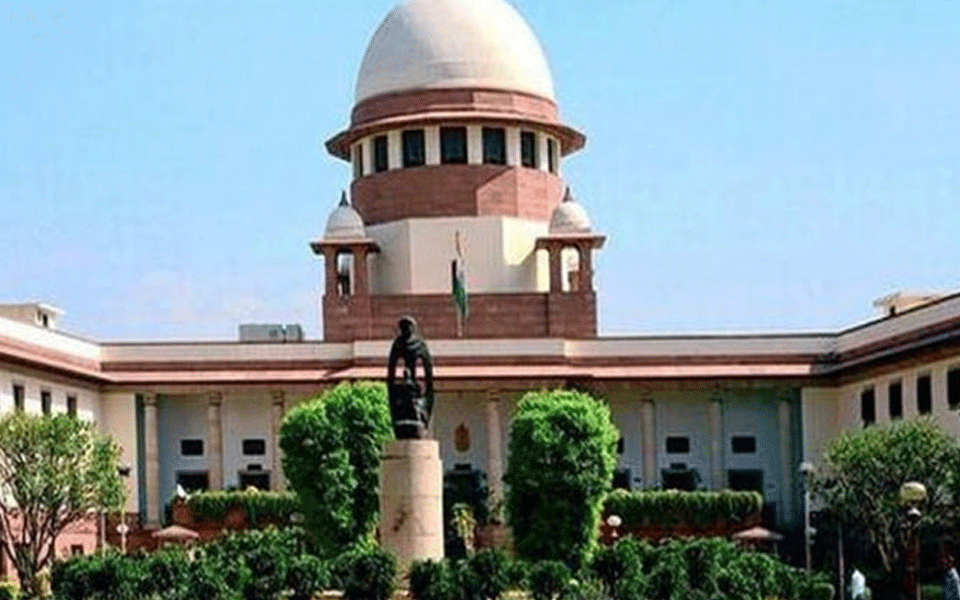
New Delhi, Aug 13 : The Supreme Court on Monday directed the IGP (Meerut Range) to submit a report on the lynching of a man in Hapur in Uttar Pradesh by a mob of alleged cow vigilantes.
It also directed the state government's response within two weeks on a plea for a court-monitored Special Investigation Team probe into the lynching of Qasim, a cattle trader, in Hapur on June 18.
"... the Inspector General of Police of Meerut Range shall submit a report with regard to the incident in question. We have so directed in view of serious allegations/assertions made in the writ petition," a bench of Chief Justice Dipak Misra, Justice A.M. Khanwilkar and Justice D.Y. Chandrachud said.
The court directions came as senior counsel K.V. Vishwanathan said that an act of mob lynching was being projected as road-rage violence.
As Vishwanathan questioned the manner in which the case was handled by the police, the court said: "The IGP (Meerut Range) shall issue directions to a suitable competent authority to move the Magistrate concerned for recording of statement by the sole witness under Section 164 of the Code of Criminal Procedure."
In response to submissions on the safety of petitioners Samayudeen and other, the court further directed that if the petitioners harboured a feeling of insecurity they shall bring it to the notice of Hapur Superintendent of Police, "who shall provide them adequate security and do the needful so that they do not remain in a state of fear."
Samayuddin was beaten up mercilessly during the lynching of Qasim at Bajhera village in Hapur district on June 18.
He has pleaded for cancellation of bail granted to the accused, contending also that the Uttar Pradesh Police had ignored the top court's direction to curb lynchings.
The court fixed August 28 for further hearing.
On July 17, the Supreme Court issued 22 guidelines to the central and state governments to put an end to the "horrendous acts" of vigilantism, lynching and mobocracy and directed them to work in tandem to take "preventive, remedial and punitive measures".
The top court had said that it was the duty of the State to "ensure that the machinery of law and order functions efficiently and effectively in maintaining peace so as to preserve our quintessentially secular ethos and pluralistic social fabric in a democratic set-up governed by the rule of law."
Of the 22 guidelines, 12 dealt with preventive steps, nine with remedial measures and one punitive action against police officers found wanting at any stage -- prevention, investigation and expeditious trial.
The departmental action "shall be taken to its logical conclusion preferably within six months", the court had said.
The court had also suggested that Parliament enact a law categorising lynching and other forms of vigilantism as a distinct offence and providing for adequate punishment.
Let the Truth be known. If you read VB and like VB, please be a VB Supporter and Help us deliver the Truth to one and all.
Kerala Assembly polls: Trends after 9 am show UDF continues to lead
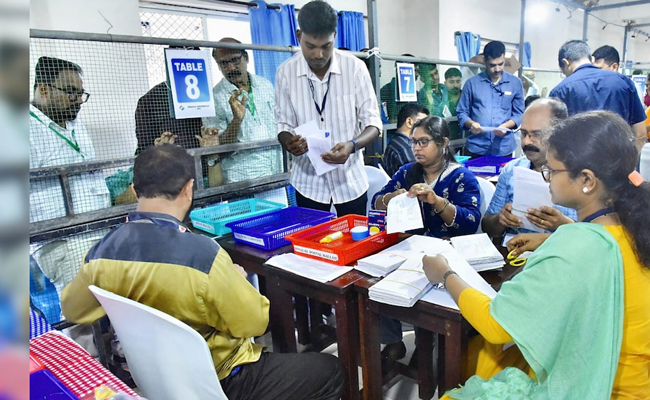
Thiruvananthapuram (PTI): As counting of EVM votes polled in the April 9 Kerala Assembly elections commenced, trends after 9 am show the Congress-led UDF leading in the state.
The UDF was ahead in close to 90 seats, while the CPI(M)-led LDF was leading in over 40 seats with the BJP-headed NDA in the front in around 5 assembly constituencies as EVM votes began to be counted, according to news reports.
As per Election Commission figures, Congress is ahead in 10 seats, CPI(M) in 5, CPI in 2, Revolutionary Socialist Party (RSP) 2 and IUML, RJD and Kerala Congress (KEC) with one each, among others.
The trends appear to support the UDF claim that it would get a huge majority. PTI
If the situation continues, the UDF stand to claim power in the state.