Subramanian Swamy makes explosive claims about former PM Vajpayee’s personal life in podcast
Says Vajpayee had romantic relationship with many including air hostesses
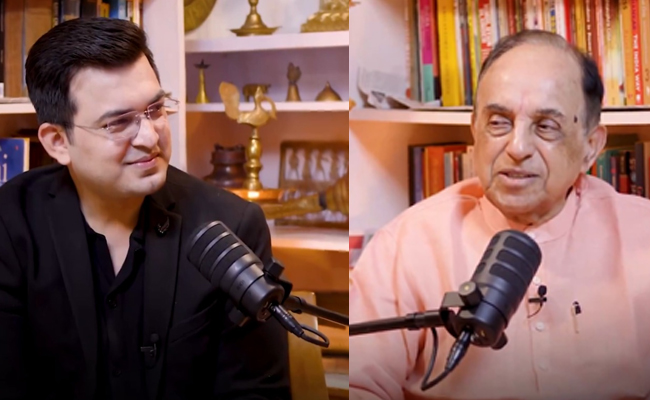
New Delhi: In a startling revelation, veteran BJP leader Dr. Subramanian Swamy has made sensational claims about the personal life of former Prime Minister Atal Bihari Vajpayee during a recent podcast interview with ex-Aaj Tak anchor Shubhankar Mishra. The podcast, titled Unplugged with Shubhankar, has already generated significant controversy due to Swamy’s explosive remarks.
During the interview, Swamy shed light on what he described as the "dark secrets" of Vajpayee’s life, particularly his relationships and personal affairs. Swamy, known for his outspoken nature, accused Vajpayee of leading a questionable personal life, alleging that despite his public image, he was involved in several relationships, including one with a Kashmiri woman during his student days in Gwalior.
Swamy claimed that Vajpayee’s father disapproved of his relationship with the Kashmiri woman, forcing him to relocate to Kanpur, where he was assigned as a Pracharak for the Rashtriya Swayamsevak Sangh (RSS). The woman's life, according to Swamy, was “ruined” as her parents married her off to an elderly man.
Swamy went on to narrate that Vajpayee reconnected with the same woman years later when he was an MP, inviting her and her husband to live in his residence on Feroz Shah Road in Delhi. According to Swamy, Vajpayee kept her husband in the servant quarters while she lived with him. The woman, Mrs. Kaul, became a well-known figure in Vajpayee’s life, and Swamy alleged that Vajpayee’s daughter, Gunnu, was not actually the biological daughter of Mrs. Kaul’s husband.
In another shocking statement, Swamy also spoke about Vajpayee's romantic relationships with air hostesses, insinuating that the former prime minister had multiple affairs. “He had to say he was unmarried but not a virgin,” Swamy remarked, further adding, “He had it with so many people.”
Swamy’s remarks have stirred a hornet's nest, with many questioning the timing and veracity of these claims. While Vajpayee has long been revered as a towering figure in Indian politics, Swamy’s allegations about his personal life are likely to spark debate and controversy.
Mishra, the host of the podcast, briefly intervened during the interview, acknowledging that the stories about Vajpayee and Mrs. Kaul were well-known but left Swamy to continue sharing his account. Swamy even humorously suggested that the more sensitive parts of his revelations could be edited out of the podcast.
This is not the first time that Swamy has made bold claims about public figures, but the nature of these allegations about one of India’s most respected political leaders has left many in shock. Vajpayee, a key architect of modern Indian politics and the Bharatiya Janata Party, served as Prime Minister three times and remains a beloved figure across political lines.
सुब्रमण्यन स्वामी ने इस पॉडकास्ट में अटल बिहारी वाजपेयी की सारी कलई खोल के रख दी है।
— Priyanshu Kushwaha (@PriyanshuVoice) September 5, 2024
pic.twitter.com/pHzrq7XR89
Let the Truth be known. If you read VB and like VB, please be a VB Supporter and Help us deliver the Truth to one and all.
Bengaluru airport introduces AI-based system to enhance safety at vehicle-aircraft intersections
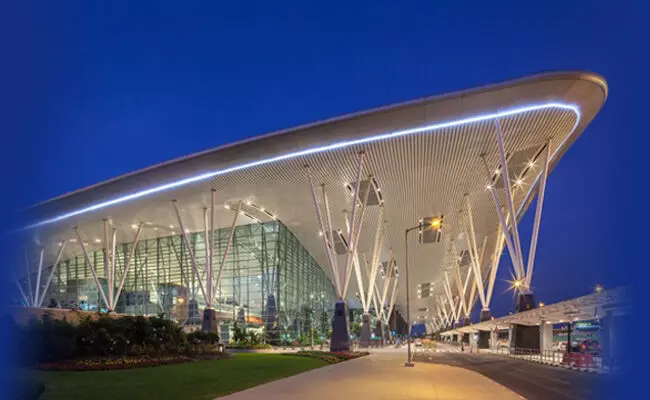
Bengaluru: Bangalore International Airport Limited (BIAL) has introduced an integrated smart airside safety system at Kempegowda International Airport to improve operational safety at key intersection zones.
According to The Hindu, the system has been designed to enhance safety at Cross Service Roads (CSRs), where aircraft and ground vehicle movements intersect.
According to BIAL, the system integrates AI-based computer vision, automation, and centralised monitoring to manage right-of-way movements and reduce the risk of human error.
“CRSs are among the most sensitive areas within airport operations, requiring precise and seamless coordination between aircraft and ground vehicles. Traditionally, right of way protection at these intersections relied on manual or semi-manual inset light activation, creating dependencies on human intervention, increasing the risk of delays and limiting operational visibility,” TH quoted BIAL as saying.
The new system uses real-time detection of vehicle movement, risk assessment, and automated signalling. AI-enabled cameras identify potential conflicts and trigger automated inset light signals to ensure aircraft priority. Normal operations resume once the area is confirmed clear.
“Based on these detections, the system triggers automated inset light activation to protect aircraft right‑of‑way and restores normal signalling once the intersection is confirmed clear. A centralised monitoring and analytics platform digitally logs all events, strengthening governance, compliance, and operational control,” BIAL said.
By embedding technology into operations, the system creates a data-driven separation layer between aircraft and ground vehicles, significantly reducing human error, especially during night and low-visibility conditions.
“Precision-led signal activation improves traffic flow, minimises unnecessary stoppage and enhances turnaround efficiency. It also establishes a scalable foundation for predictive safety analytics, enabling trend analysis, peak-hour optimisation, compliance mapping and risk forecasting to support continuous improvement and stronger airside governance,” BIAL said.