Supreme Court allows Air India to fly for ten days with middle seats filled in scheduled aircraft
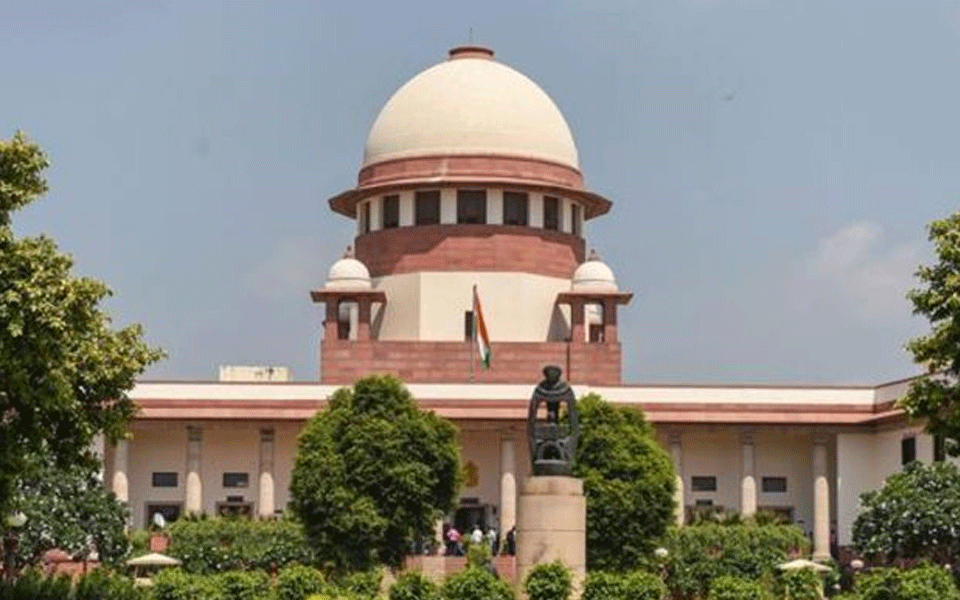
New Delhi: The Supreme Court on Monday allowed the Centre and national carrier Air India to keep operating its scheduled flights with the middle seats filled for the next ten days while observing that the government should be more worried about the health of citizens rather than the health of commercial airlines.
The top court asked the Bombay High Court to decide the plea against DGCA circulars expeditiously and said Air India and other airlines will have to follow the order given by the HC with regard to safety measures including maintaining of social distancing inside aircraft by keeping middle seats vacant between two passengers in a row.
A bench headed by Chief Justice S A Bobde conducted an urgent hearing on Eid holiday through video conferencing to hear the appeals of the Central government and Air India against the Bombay High Court order.
You should be worried about the health of citizens, not about the health of commercial airlines, the bench, also comprising AS Bopanna and Hirshikesh Roy, told Solicitor General Tushar Mehta who appeared for the Centre.
The high court had on May 22 sought response from Air India and the Directorate General of Civil Aviation (DGCA) on a petition of an AI pilot claiming that the airline was not following safety measures for COVID-19 while bringing back Indians stranded abroad.
The High Court had directed Air India and DGCA to file affidavits clarifying their stand and posted the petition for further hearing on June 2.
The pilot, Deven Kanani, in his plea claimed that a circular issued by the Government of India on March 23, 2020 laid some conditions to prevent the spread of COVID-19 while bringing back Indians stranded abroad due to the pandemic.
However, the condition pertaining to keeping the middle seat between two passengers empty was not being followed by the Air India, he said in the plea.
Kanani submitted photographs of an Air India flight operated between San Francisco and Mumbai where all seats were occupied.
Air India, however, opposed the plea of the pilot and told the high court that the circular of March 23 has been now superseded with a new circular issued by the Government of India on May 22, 2020 that permitted domestic flights to operate from May 25.
The new circular does not say that the middle seat needs to be kept empty, Air India told the court.
The High Court had directed Air India and DGCA to file affidavits clarifying their stand and posted the petition for further hearing on June 2. The court had also allowed Kanani to amend his petition to challenge the circular of May 22.
Let the Truth be known. If you read VB and like VB, please be a VB Supporter and Help us deliver the Truth to one and all.
Rupee falls 11 paise to 94.27 against US dollar in early trade

Mumbai (PTI): The rupee depreciated 11 paise to 94.27 against US dollar in early trade on Monday driven by persistent dollar demand and a broader shift toward safe-haven assets.
Forex traders said the Indian rupee has hit a rough patch, falling for five consecutive sessions, weighed down by a combination of factors such as the RBI loosening its grip on currency rules and rising oil prices caused by global tensions.
Moreover, investors are becoming cautious again, with foreign institutions pulling money out of the market after a brief period of buying amid rising geopolitical uncertainty.
At the interbank foreign exchange market the rupee opened at 94.25 against the US dollar, then lost some ground and touched 94.27 against the US dollar in initial trade, registering a fall of 11 paise over its previous close. On Friday, the rupee had settled at 94.16 against the American currency.
ALSO READ: Death toll in Mundathikode fireworks explosion rises to 16
Meanwhile, the dollar index, which gauges the greenback's strength against a basket of six currencies, was down 0.09 per cent at 98.44.
Brent crude, the global oil benchmark, was trading higher by 1.16 per cent at USD 106.55 per barrel in futures trade.
A mix of softer economic signals and renewed, even if fragile, hopes of diplomacy pulled the dollar lower again, CR Forex Advisors MD Amit Pabari said, adding that for Rupee, on one hand, a softer dollar offers relief. On the other, uncertainty remains the dominant force.
Meanwhile, India’s forex reserves have crossed USD 703 billion as of April 17, reflecting a consistent build-up of buffers.
"For now, the rupee continues to lean toward gradual weakness. Uncertainty remains the dominant force, shaping both global flows and local reactions," Pabari said.
He further noted that any dips are likely to be bought into, with the 92.80–93.20 zone acting as a strong support. On the upside, 93.50 to 94.50 is expected to define the near-term range.
On the domestic equity market front, the 30-share benchmark index Sensex was trading 518.96 points or 0.68 per cent higher at 77,183.17, while the broader Nifty was trading up 131.30 points or 0.55 per cent at 24,029.25.
Foreign Institutional Investors offloaded equities worth Rs 8,827.87 crore on Friday, according to exchange data.