Supreme Court asks Centre to clarify stand on interest waiver during moratorium
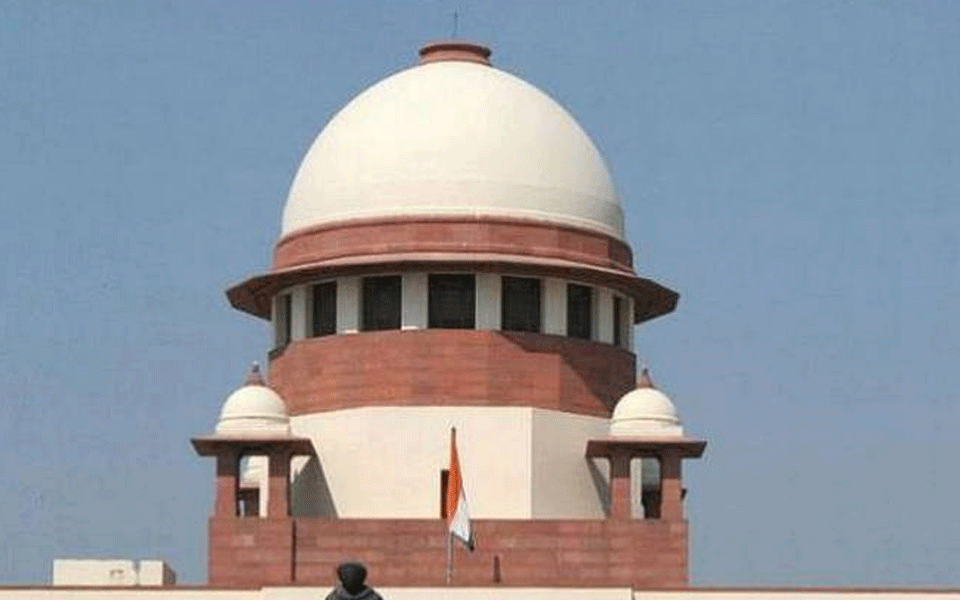
New Delhi: The Supreme Court on Wednesday took note of the Centre's alleged inaction and asked it to clarify its stand within a week on the waiver of interest on interest for deferred payments of instalments for loans during the moratorium period announced due to the coronavirus lockdown.
A bench headed by Justice Ashok Bhushan said the Centre had not made its stand clear on the issue despite the fact that ample powers were available with it under the Disaster Management Act and was "hiding behind the RBI".
The apex court granted time to the government after Solicitor General Tushar Mehta sought a week's time to file a response.
"My Lordships may not say that. We are working in coordination with RBI," Mehta said.
The bench, also comprising Justices R Subhash Reddy and Justice M R Shah, asked the solicitor general to clarify stand on the Disaster Management Act and whether additional interest on existing interest could be accrued.
Mehta argued that there cannot be a common solution for all the problems.
Senior advocate Kapil Sibal, appearing for the petitioner, informed the bench that the loan moratorium's deadline would end on August 31 and sought its extension.
"I am only saying that till these pleas are decided, the extension should not end," Sibal said. The apex court has now posted the matter for hearing on September 1.
The top court had earlier said there was "no merit in charging interest on interest" for deferred loan payment installments during the moratorium period announced in wake of the COVID-19 pandemic.
The bench was hearing a plea filed by Agra resident Gajendra Sharma, who has sought a direction to declare the portion of the RBI's March 27 notification "as ultra vires to the extent it charges interest on the loan amount during the moratorium period, which create hardship to the petitioner being borrower and creates hindrance and obstruction in 'right to life' guaranteed by Article 21 of the Constitution of India".
Sharma has also sought a direction to the government and the Reserve Bank of India (RBI) to provide relief in repayment of loan by not charging interest during the moratorium period.
On June 4, the top court had sought the Finance Ministry's reply on the waiver of interest on loans during the moratorium period after the RBI said it would not be prudent to go for a forced waiver of interest risking financial viability of the banks.
The top court had said there were two aspects under consideration in this matter - no interest payment on loans during the moratorium period and no interest to be charged on interest.
It said these were challenging times and it was a serious issue as on one hand, moratorium was granted and on the other, interest was charged on loans
Let the Truth be known. If you read VB and like VB, please be a VB Supporter and Help us deliver the Truth to one and all.
Rickelton's ton in vain as SRH beat MI by 6 wickets
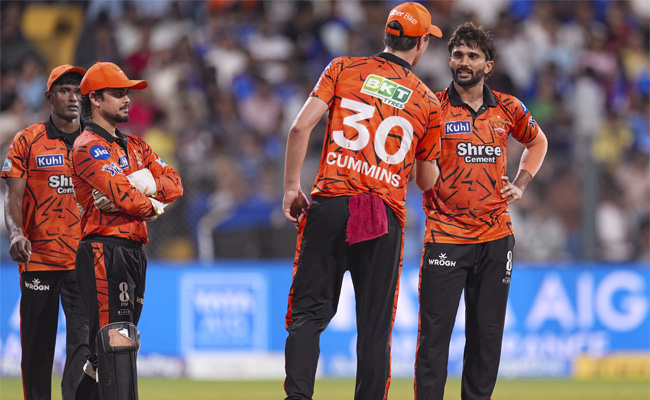
Mumbai (PTI): Ryan Rickelton's whirlwind unbeaten ton was overshadowed by Heinrich Klaasen's unbeaten 65 as Sunrisers Hyderabad defeated Mumbai Indians by six wickets in an IPL match here on Wednesday.
Chasing an imposing 244-run target, Travis Head (76 off 30) and Abhishek Sharma (45 off 24) shared 129 runs for the opening wicket to set the platform for SRH.
Klaasen (65 not out off 30 balls) then displayed his all-round hitting abilities to guide SRH home with the help of Nitish Kumar Reddy (21) and Salil Arora (30 not out off 10) in 18.4 overs.
Earlier, Rickelton's knock powered MI to 243 for five.
MI rode on a 93-run stand between Rickelton (123 not out off 55 balls) and Will Jacks (46 off 22) in 7.1 overs for the opening stand to power the side.
MI skipper Hardik Pandya scored a valuable 31 off 15 balls before being dismissed.
Praful Hinge (2/54), Eshan Malinga (1/29), Sakib Hasan (1/39) and Nitish Kumar Reddy (1/31) were the wicket-takers for SRH.
Brief Scores:
Mumbai Indian: 243 for 5 in 20 overs (Ryan Rickelton 123 not out; Praful Hinge 2/54).
Sunrisers Hyderabad: 249 for 4 in 18.4 overs (Travis Head 76, Heinrich Klaasen 65 not out; AM Ghazanfar 2/51).