Supreme Court condemns 'bulldozer justice,' says executive cannot replace judiciary
Issues guidelines against demolition of properties over criminal allegations
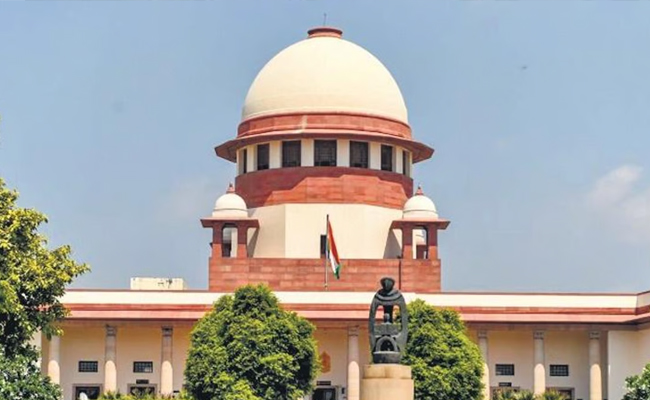
New Delhi: In a significant judgement on Wednesday, 13 November, the Supreme Court emphasised that properties cannot be demolished solely based on criminal accusations or convictions. The Court asserted that such actions contravene the rule of law and infringe upon the principle of separation of powers, as only the judiciary has the authority to determine a person's guilt.
"The executive cannot pronounce a person guilty. If the executive demolishes the property of the person merely on the basis of accusation, it will strike at the rule of law. The chilling sight of a bulldozer demolishing a building reminds one of lawlessness, where might was right. Such high-handed and arbitrary actions have no place in a constitutional democracy. Our constitutional ethos do not permit such a course of action," the Court stated.
The judgement, delivered by a bench comprising Justices BR Gavai and KV Viswanathan, came in response to a series of petitions, including one filed by Jamiat Ulema-i-Hind, seeking to halt the use of demolitions as a punitive measure against those accused of crimes. The Court directed that public officials who engage in such actions be held accountable.
"Public officials who take the law into their own hands and act in a high-handed manner must be held accountable," the Court observed, underlining the importance of respecting due process.
Further, the Court noted that demolitions often impose "collective punishment" on the families of the accused or convicted, and therefore outlined specific guidelines to prevent misuse of such actions. Key directives included:
Authorities must issue a show-cause notice before proceeding with demolitions, giving owners at least 15 days to respond.
Property owners should be notified via registered post, and the notice must detail the nature of the unauthorised construction and grounds for demolition.
The designated authority must allow for a personal hearing, with proceedings duly recorded.
Demolition actions should be videographed, with reports sent to the Municipal Commissioner.
Even after issuing a demolition order, affected parties should be given time to challenge it legally. In cases where individuals do not wish to contest, adequate time must be allowed for vacating the premises.
The Court highlighted the adverse impact of such demolitions on vulnerable groups, observing, "It is not a happy sight to see women, children, and aged persons dragged to the street overnight. Heavens will not fall on the authorities if they hold their hands for some period."
However, the Court clarified that these guidelines would not apply to cases of unauthorised structures on public land, such as roads, footpaths, railway lines, or water bodies, or where a Court order for demolition exists.
This judgement builds upon previous stays on demolitions, including an interim order on 17 September, which prohibited demolitions across the country without Court permission except in cases of public encroachments.
Let the Truth be known. If you read VB and like VB, please be a VB Supporter and Help us deliver the Truth to one and all.
Questioning religious practices will break religion, civilisation: SC in Dawoodi Bohras case
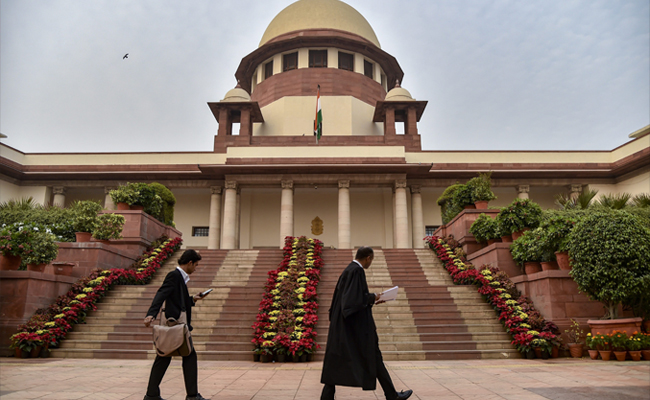
New Delhi (PTI): The Supreme Court on Thursday remarked that if individuals start questioning certain religious practices or matters of religion before a constitutional court then there will be hundreds of petitions questioning different rituals, leading to the breaking of religions and the civilisation.
The nine-judge Constitution bench is hearing petitions related to discrimination against women at religious places, including the Sabarimala temple in Kerala, and on the ambit and scope of the religious freedom practised by multiple faiths, including Dawoodi Bohras.
The bench comprises Chief Justice of India (CJI) Surya Kant and Justices B V Nagarathna, M M Sundresh, Ahsanuddin Amanullah, Aravind Kumar, Augustine George Masih, Prasanna B Varale, R Mahadevan and Joymalya Bagchi.
The Central Board of Dawoodi Bohra Community filed a PIL in 1986 seeking the setting aside of a 1962 judgment, which had struck down the Bombay Prevention of Excommunication Act, 1949 -- this law made excommunication of any community member illegal.
The 1962 Constitution bench judgment said, "It is evident from the religious faith and tenets of the Dawoodi Bohra community that the exercise of the power of excommunication by its religious head on religious grounds formed part of the management of its affairs in matters of religion and the 1949 Act in making even such excommunication invalid, infringed the right of the community under Article 26(b) of the Constitution."
Senior advocate Raju Ramachandran, representing a group of reformist Dawoodi Bohras, submitted that a practice which is conducted in response to secular and social actions of an individual cannot be the subject of Constitutional protection under Article 25 of the Constitution and consequently cannot be a ‘matter of religion’ under Article 26 of the Constitution.
Ramachandran told the court that a practice which may have a religious aspect but also significantly and adversely impacts fundamental rights is not immune to restriction under Article 25 of the Constitution or Article 26 of the Constitution.
Responding to the submission, Justice Nagarathna said that if everybody starts questioning certain religious practices or matters of religion before a constitutional court, then "what happens to this civilisation where religion is so intimately connected with the Indian society".
"There will be hundreds of petitions questioning this right that right, opening of the temple, and the closure of the temple. We are conscious of this," she said.
Adding to the response, Justice Sundresh said, "Every religion will break and every constitutional court will have to be closed.
"If the dispute between two entities are allowed then everybody will question everything. In your case there may be a civil wrong committed to you but in another case, another member will say I don't agree. It is regressive. To what extent can we go in a country like ours which is progressive and on the move is the question," he said.
Justice Nagarathna went on that what sets apart India from any other region is that "we are a civilisation" despite having so many pluralities and diversities?
Asserting that diversity is the country's strength, she added, "One of the constants in our Indian society is the relationship of human beings -- man, woman and child -- with the religion."
"Now, how a religious practice or a matter of religion is questioned, where it is questioned, whether it can be questioned, whether it has to be a question within a denomination for a reform or whether the state will have to do or you want the court to adjudicate upon all these aspects. This is troubling us.
"What we lay down, is for a civilisation that is India. India must progress despite all its economy, everything there is a constant in us. We can’t break that constant. That is what is troubling us ," she said.
Ramachandran replied that India is a civilisation under the Constitution and therefore nothing which goes against the grain of constitution can be continued in a civilised society.
He said that's where court's task come in and "it can't throw hands" and say there will be so many petitions.