Supreme Court declines urgent hearing on plea seeking review of Sabarimala Temple verdict
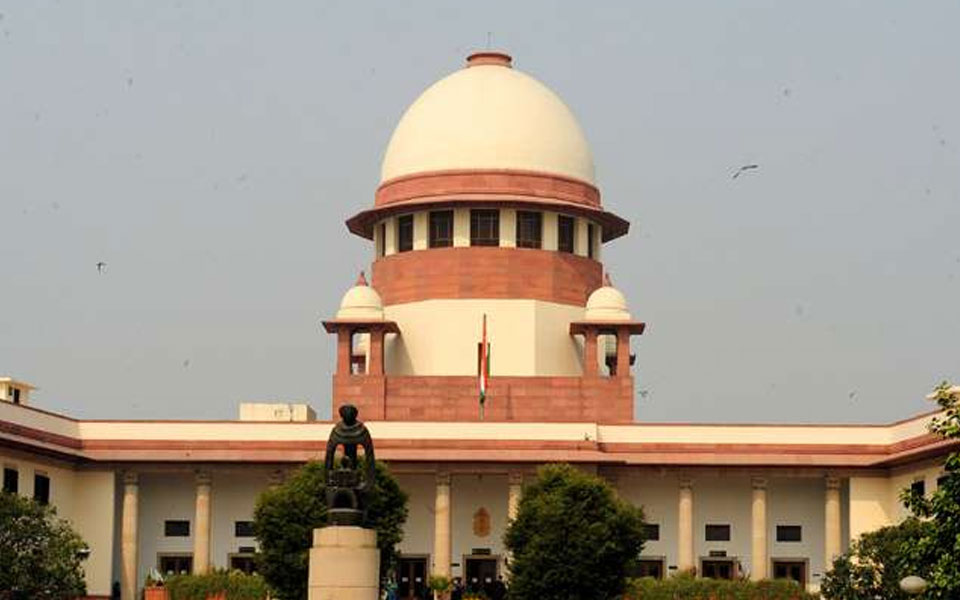
New Delhi, Oct 9 : The Supreme Court Tuesday declined an urgent hearing on a plea seeking review of its verdict allowing women of all age groups entry into the Sabarimala Temple.
A bench comprising Chief Justice Ranjan Gogoi, Justices S K Kaul and K M Joseph had considered the submission of Shylaja Vijayan, president, National Ayyappa Devotees Association through lawyer Mathews J Nedumpara, which contended that the five-judge Constitution bench verdict lifting the ban was "absolutely untenable and irrational".
"It will be listed in due court," the bench said, adding that in any case, the review petition will be heard in chamber and not in open court.
The lawyer, appearing for the Devotees Association, also sought a stay on the verdict and said the temple would be opening on October 16 for pilgrimage.
The bench, however, said the review petition can only be taken up after the Dussehra vacation.
Besides the Association, another petition seeking review of the September 28 verdict of the apex court has also been filed by the Nair Service Society (NSS).
A five-judge constitution bench headed by then Chief Justice Dipak Misra, had in its 4:1 verdict, said banning the entry of women into the shrine is gender discrimination and that the practice violates rights of Hindu women.
The review petition filed by Vijayan submitted that, "Faith cannot be judged by scientific or rationale reasons or logic".
"The notion that the judgment under review is revolutionary, one which removes the stigma or the concept of dirt or pollution associated with menstruation, is unfounded. It is a judgment welcomed by hypocrites who were aspiring for media headlines. On the merits of the case, as well, the said judgment is absolutely untenable and irrational, if not perverse," the petition submitted.
The second petition filed by NSS, an organisation for the uplift and welfare of the Nair community, said as the deity is a 'Naistika Brahmachari, females before the age of 10 and after the age of 50 years are eligible to worship him and there is no practice of excluding worship by females.
"Hence, the delay or wait for 40 years to worship cannot be considered as exclusionary and it is an error of law on the face of the judgement," the plea said.
The NSS said many essential religious practices will be rendered void and the religion itself may be rendered out of existence if the general ground of equality under Article 14 is resorted to and the essential religious practices are tested on the principle of rationality.
"Review judgment and order...on the ground that it is unconstitutional and void inasmuch as it is vitiated by errors apparent on the face of the record; that it is without jurisdiction or in excess of jurisdiction, that it is in violation of principles of natural justice and that it is in violation of express constitutional provisions," the plea filed by Devotees Association said.
Let the Truth be known. If you read VB and like VB, please be a VB Supporter and Help us deliver the Truth to one and all.
Sujit Nair raises concerns over speculation of DMK-AIADMK understanding to block TVK
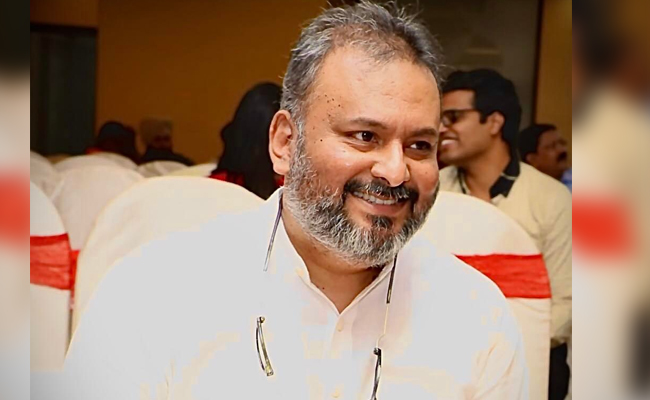
Chennai: Journalist and political commentator Sujit Nair has expressed concern over speculation that the Dravida Munnetra Kazhagam and the All India Anna Dravida Munnetra Kazhagam could explore a post-poll understanding to prevent Vijay-led Tamilaga Vettri Kazhagam from forming the government in Tamil Nadu.
In a social media post, Sujit Nair said the election verdict in Tamil Nadu reflected a clear public demand for political change and argued that the mandate should be respected irrespective of political preferences.
Referring to reports and political discussions surrounding a possible understanding between the DMK and AIADMK, he said he hoped such developments remained only speculative conversations and did not turn into reality.
Nair stated that if such an alliance were to take shape, it would raise serious questions about ideological politics in the country. He said TVK had emerged through a democratic electoral process and that the legitimacy to govern in a parliamentary democracy comes from the people’s verdict.
According to him, attempts to prevent an electoral winner from forming the government through unexpected political arrangements may be constitutionally valid, but many people could view them as politically opportunistic.
He further said that such a move could particularly affect the political image of the DMK, which has historically projected itself around ideology, social justice and opposition politics. Nair said that in ideological terms, the DMK appeared closer to TVK than to the AIADMK, and joining hands with its long-time political rival only to remain in power could weaken its broader political narrative.
He added that the same questions would apply to the AIADMK as well, as the party had spent decades positioning itself against the DMK and such an arrangement could create discomfort among its cadre and supporters.
Drawing a comparison with Maharashtra politics in 2019, Nair said he had expressed similar views when the Shiv Sena formed an alliance with the Indian National Congress and the Nationalist Congress Party after the Assembly elections.
He said post-poll alliances between long-standing political rivals often create a public perception that ideology and electoral mandates become secondary when political power equations come into play.
Nair also said such developments increase public cynicism towards politics and reinforce the belief among voters that ideology is often sidelined after elections.
He maintained that the Tamil Nadu verdict was emphatic and said respecting both the spirit and substance of the mandate was important for the credibility of democratic politics.