Supreme Court delivers major setback to HD Kumaraswamy in land de-notification case
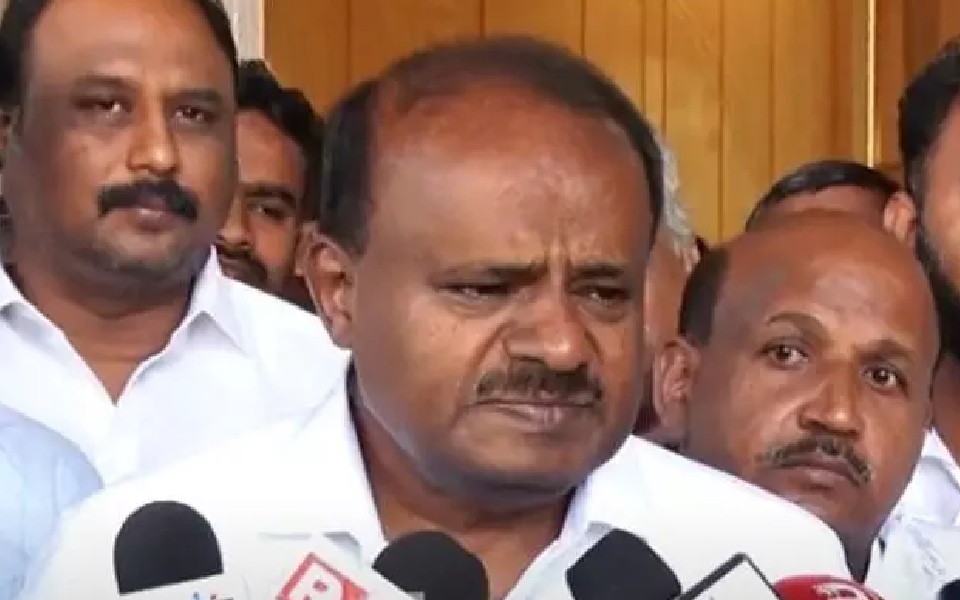
New Delhi: In a significant legal blow to Union Minister for Heavy Industries and Steel, HD Kumaraswamy, the Supreme Court on Tuesday refused to interfere in the ongoing trial against him in a controversial land de-notification case.
A bench comprising Justice Dipankar Dutta and Justice Rajesh Bindal dismissed Kumaraswamy’s plea, rejecting his arguments for immunity under the amended Prevention of Corruption Act, 1988. The ruling has paved the way for the trial to proceed, intensifying legal troubles for the former Karnataka Chief Minister.
The case in question revolves around the de-notification of two parcels of land in Hallage Vaderahalli village in Banashankari 5th Stage, Bengaluru. The land, measuring a total of 2 acres and 24 guntas, was initially acquired by the Bangalore Development Authority (BDA) through a final notification issued on September 12, 1997. An award was subsequently passed in 1998, and possession of the land was officially handed over to the BDA on September 29, 1999. Despite this, the original landowner, Smt. Padma, illegally sold the land to third parties in contravention of the Karnataka Land (Restriction on Transfer) Act, 1991.
Following these transactions, Padma submitted a representation to the then Chief Minister, HD Kumaraswamy, requesting the de-notification of the land. Despite strong opposition from the BDA, which asserted that the property lawfully belonged to the authority, Kumaraswamy intervened directly. Bypassing the de-notification committee, he personally ordered the withdrawal of the acquisition proceedings, leading to the issuance of a de-notification order on October 1, 2007. Subsequently, in March 2010, the de-notified land was sold for a staggering sum of Rs. 4.14 crore.
A private complaint was later filed against Kumaraswamy, alleging corruption and misuse of office. The Special Judge for MPs and MLAs, in an order dated July 4, 2012, directed the Lokayukta Police to investigate the matter. This led to the registration of a case under multiple sections of the Indian Penal Code, including 420 (cheating), 463 (forgery), 468 (forgery for the purpose of cheating), and 471 (using forged documents as genuine), along with sections of the Prevention of Corruption Act and the Karnataka Land Restriction of Transfer Act.
Kumaraswamy initially challenged the FIR in the Karnataka High Court, but his petition was dismissed on July 27, 2015. He subsequently approached the Supreme Court, which also rejected his plea on October 3, 2016. When he returned to power as the Chief Minister of Karnataka in 2018, a closure report was filed in the case, widely seen as an attempt to suppress the investigation. However, on September 4, 2019, the Special Judge rejected the closure report and issued summons to Kumaraswamy.
In response, Kumaraswamy once again moved the High Court, arguing against the summoning order. However, the court noted the seriousness of the allegations against him and refused to interfere with the trial. Persisting in his legal battle, Kumaraswamy took the matter to the Supreme Court, asserting that as a public servant, he could not be tried without prior sanction. His defense, presented by senior advocate Mukul Rohatgi, argued that the 2018 amendments to the Prevention of Corruption Act provided him with retrospective immunity, shielding him from prosecution.
However, the Supreme Court firmly rejected these arguments, emphasizing that the allegations were of grave concern and involved the misuse of the Chief Minister's office for personal gains. The court upheld the state government’s position, which was represented by senior advocate Harin Rawal and Additional Advocate General Aman Panwar. The state contended that Kumaraswamy was no longer a public servant and, therefore, not entitled to any protection under the law. It was further argued that the 2018 amendment to the Prevention of Corruption Act could not be applied retrospectively to shield crimes committed before its enactment.
With this ruling, the Supreme Court has effectively cleared the path for the trial against Kumaraswamy to proceed. The decision is being seen as a major setback for the Union Minister, who now faces serious legal consequences if proven guilty.
Let the Truth be known. If you read VB and like VB, please be a VB Supporter and Help us deliver the Truth to one and all.
Kerala court sentences 20-year-old man in minor girl rape case
Kollam (Kerala) (PTI): A Kerala court has sentenced a 20-year-old man to 21 years of imprisonment for raping a minor girl after befriending her on a social media app.
Karunagappally Fast Track Special Court judge Rajeevan Vachal sentenced the convict to 21 years under the relevant provisions of the Protection of Children from Sexual Offences (POCSO) Act, special public prosecutor (SPP) N C Premchandran said.
The court also imposed a fine of Rs 1.1 lakh on the convict, the prosecutor said.
The incident occurred in 2024 when the accused befriended her on a social media app and then offered to take her to the Azheekal beach here.
However, instead of taking her to the beach, he took her to an isolated place behind the CHC hospital at Mynagappally here and raped her, the SPP said.
Following the incident, the girl attempted suicide, but was saved and then told the doctors what had happened, the prosecutor said.
The hospital authorities informed the police, who registered a case and launched an investigation.
The prosecutor said that seven witnesses were examined and 20 documents were submitted before the court to substantiate the guilt of the accused.