Supreme Court extends stay on court-monitored survey of Shahi Idgah mosque complex in Mathura
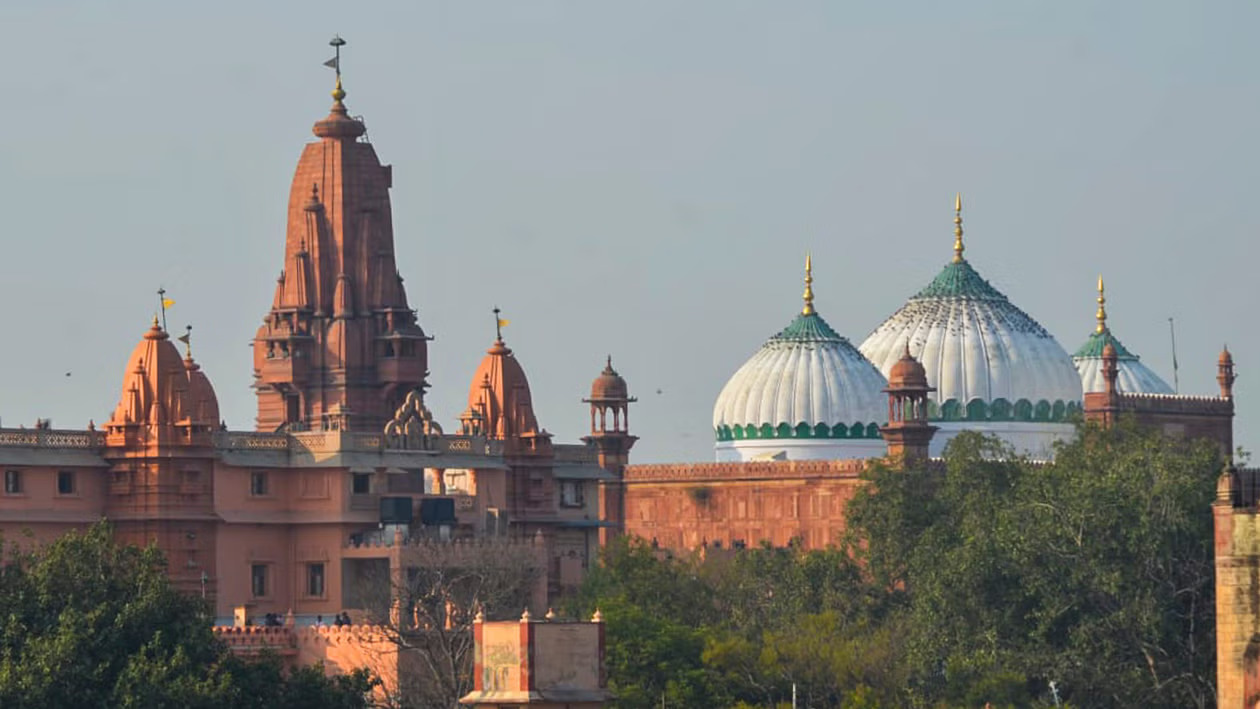
New Delhi (PTI): The Supreme Court on Wednesday extended its stay on the Allahabad High Court's order that permitted a court-monitored survey of the Shahi Idgah mosque complex in Mathura.
The complex is located adjacent to the Krishna Janmabhoomi temple, a site of significant religious importance for Hindus.
A bench comprising Chief Justice Sanjiv Khanna and justices Sanjay Kumar and KV Viswanathan said it will defer the hearing on the plea of the ‘Committee of Management of Trust Shahi Masjid Idgah’ against the court-monitored survey of the mosque complex in the week commencing April 1.
The CJI said there were three issues pending now with the apex court and they are “the issue of an intra-court appeal (against consolidation of lawsuits filed by the Hindu litigants), the other one is the Act (challenge to the Places of Worship (Special Provisions) Act, 1991) itself. List in the week commencing April 1.”
The bench said in the meanwhile the interim order of the Allahabad High Court staying the court-monitored survey of the Shahi Idgah mosque complex will continue to operate.
The top court, on January 16 last year, had first stayed the operation of the December 14, 2023 order of the high court.
The high court had allowed a court-monitored survey of the Shahi Idgah mosque complex and agreed to the appointment of a court commissioner to oversee it.
The Hindu side claims the premises hold signs suggesting that a temple once existed at the site.
Advocate Vishnu Shankar Jain, appearing for the Hindu parties, had said the appeal of the mosque committee was filed against the December 14, 2023 order of the high court and connected orders in the matter had become infructuous.
"All these petitions have become infructuous as the high court has pronounced its order later," he said.
Jain referred to the subsequent order of the high court by which it rejected a plea of the Muslim parties challenging the maintainability of 18 cases related to the Krishna Janmabhoomi-Shahi Idgah dispute in Mathura, and ruled that the religious character of the mosque needs to be determined.
The high court had dismissed the Muslim side's contention that the suits filed by the Hindu litigants relating to the dispute over the Krishna Janmabhoomi temple and the adjacent mosque violated the Places of Worship (Special Provisions) Act of 1991 and therefore were not maintainable.
The 1991 Act prohibits changing the religious character of any shrine from what existed on the day of the country's Independence. It exempted only the Ram Janmabhoomi-Babri Masjid dispute from its purview.
In Mathura, a suit was filed in the court of Civil Judge Senior Division (III) for shifting the Shahi Idgah mosque, claiming that it was constructed on a part of the 13.37 acre land of the Shri Krishna Janmabhoomi Trust.
The Hindu side had requested the high court to conduct the original trial like it had done in the Babri Masjid-Ram Janmabhoomi title dispute.
While allowing the plea for a court-monitored survey, the high court had said that no harm should be caused to the structure during the exercise which it indicated could be overseen by a three-member commission of advocates.
Let the Truth be known. If you read VB and like VB, please be a VB Supporter and Help us deliver the Truth to one and all.
CJI's advice to aspirant: Join the bar, become a lawyer, don't hanker for judicial services post
New Delhi (PTI): She came to the Supreme Court seeking a re-evaluation of her paper in the examination for joining judicial services as a magistrate. What she got instead was a rejection — and a candid confession by the Chief Justice that he too had wanted to join the judicial services in his youth but was advised by a senior judge to become a lawyer instead.
A bench comprising Chief Justice Surya Kant and Justice Joymalya Bagchi on Friday dismissed a plea filed by Prerna Gupta, the judicial services aspirant.
As Gupta pressed her case, the CJI intervened and said, "Let me share my personal story and I hope you will go happily as we cannot allow your petition."
He recounted his time as a final-year law student in 1984 when he wanted to become a judicial officer. As per requirement, he cleared the written test and was set to appear for an interview.
Judicial services is one of the two routes to become a judge after initially joining as a magistrate in lower court and thereafter rising through the ranks to become judge in a high court and possibly the Supreme Court.
The other route is to join the Bar, which means becoming a lawyer, and after building a reputation be picked from the Bar to become a judge at a senior level.
By the time the CJI's exam results came out, he had started practising at the Punjab and Haryana High Court when he was called for the interview.
The senior-most judge on the interview panel happened to be a judge before whom he had recently argued two significant matters.
"One of the matters was Sunita Rani vs Baldev Raj, where he had allowed my appeal in a matrimonial case and set aside the decree of divorce granted by the District Judge on the ground of schizophrenia," he noted.
Before the interview could take place, the judge called the young Surya Kant to his chamber and asked, 'Do you want to become a judicial officer?'
"I said 'yes.' He immediately said, 'Get out from (my) the chamber.'"
The courtroom fell silent as the CJI Justice described his initial heartbreak.
“I came out trembling. All my dreams were shattered. I thought he had snubbed me and that my career was over,” the CJI said.
However, the story took another turn the following day and the judge summoned him again, this time offering a piece of advice that would change the trajectory of his life.
“He said, ‘If you want to become (a judge), you are welcome. But my advice is, don’t become a judicial officer. The Bar is waiting for you,’” Justice Surya Kant recalled.
The CJI said he decided to skip his interview and didn't even tell his parents at first, fearing their disappointment, and instead chose to dedicate himself to his practice as an advocate.
“Now tell me did I make a bad right or bad decision,” the CJI asked and the litigant lawyer left the court with a smile on her face despite her case being dismissed.
Encouraging the petitioner to look toward the future rather than dwelling on the re-evaluation of a single paper, Justice Surya Kant said, "The Bar has much to offer."