Supreme Court moves closer to live streaming of proceedings

New Delhi, Aug 24 : The Supreme Court on Friday moved closer to live streaming of its proceedings as it said that it was an expansion of the concept of open court hearing of matters without crowding the court rooms.
Reserving the order on a batch of petitions by senior counsel Indira Jaising, the bench of Chief Justice Dipak Misra, Justice A.M. Khanwilkar and Justice D.Y. Chandrachud said: "Let us first start with it. We are just on a pilot project. We are not ruling out anything and will improve with time."
Justice Chandrachud expressed his apprehension about its likely misuse but others wanted to further expand its scope by including transcription of the recorded proceedings.
Attorney General K.K. Venugopal on Friday submitted the Comprehensive Guidelines for Live Streaming of Court proceedings.
It says live streaming of the top court proceedings would as a pilot project in the court number one presided over by the Chief Justice of India and would be confined to the proceedings of the constitution bench matters.
It is only upon the success of the pilot project, that live streaming would be extended to other benches of the courts as well.
The guidelines say that apart from live streaming of the proceedings, the court may in future also provide for transcribing facilities and archive the audio-visual record of the proceedings to make webcsast accessible to the litigants and other interested people.
Let the Truth be known. If you read VB and like VB, please be a VB Supporter and Help us deliver the Truth to one and all.
3 Indians injured after fire breaks out in UAE's Fujairah due to drone attack
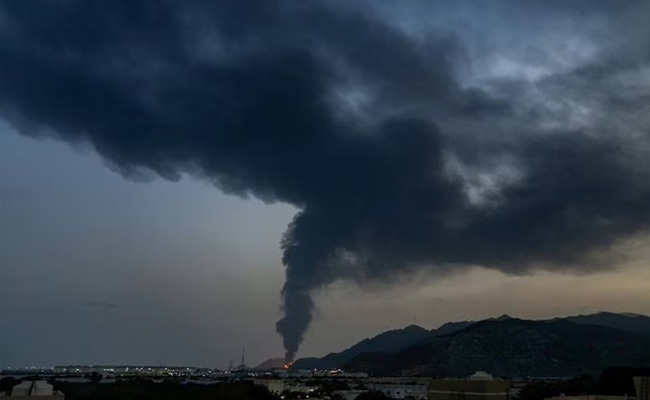
Dubai (PTI): Three Indian nationals were injured on Monday after a fire broke out on the Fujairah Petroleum Industries Zone (FOIZ) in the UAE following a drone strike originating from Iran, according to local media reports.
The relevant authorities in the eastern emirate of Fujairah confirmed that a fire has broken out in the FOIZ, resulting from a drone attack coming from Iran, the state-run WAM news agency reported.
Fujairah Civil Defence teams immediately responded to the incident and are continuing efforts to bring the fire under control, it added.
Three Indian nationals sustained moderate injuries after the fire broke out on the FOIZ, the Khaleej Times reported, quoting authorities in Fujairah.
The injured were taken to the hospital for treatment, it added.
In a post on X, the UAE's Ministry of Defence said that Iran launched four missiles toward various areas across the country. "Three were successfully engaged over the country's territorial waters, while one fell into the sea," it said.
The ministry urged the public to comply with all public safety procedures when warning messages are issued to the public.
Authorities have urged the public not to circulate rumours and to rely only on official sources for information, Gulf News reported.