Supreme Court refuses to reconsider order on SC/ST quota for promotions
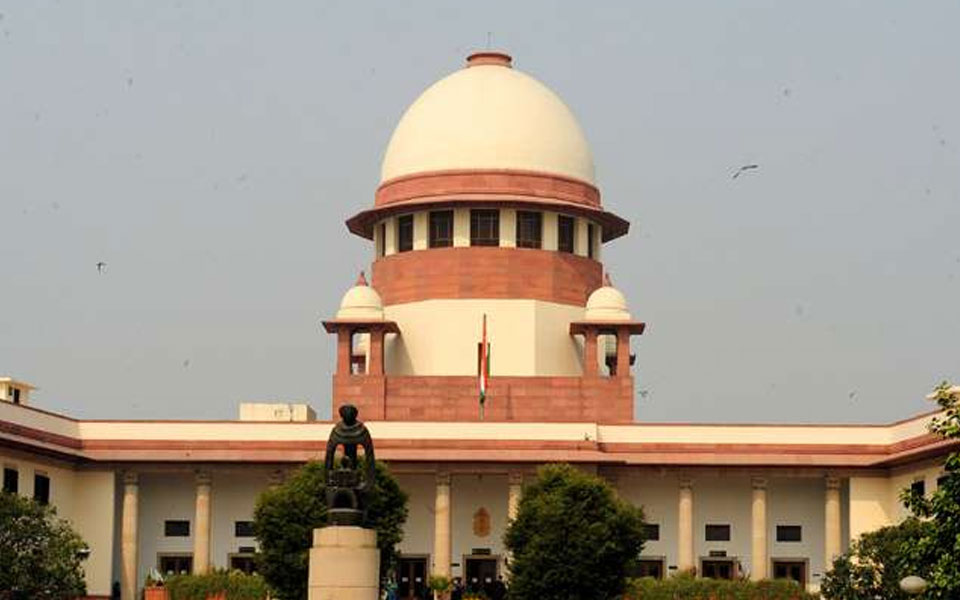
New Delhi, Sep 26 : The Supreme Court Wednesday said its 2006 verdict putting benefits of quotas in job promotions for SC/ST employees need not be referred to a seven-judge bench.
The apex court also turned down the Centre's plea that overall population of SC/ST be considered for granting quota for them.
The unanimous judgement was pronounced by a five-judge Constitution bench headed by Chief Justice Dipak Misra.
The bench, also comprising Justices Kurian Joseph, R F Nariman, S K Kaul and Indu Malhotra, said states need not collect quantifiable data on backwardness of SC/ST for giving quota in job promotion to SC/ST employees.
The bench did not comment on two other conditions given in the 2006 verdict which dealt with adequacy of representation of SC/ST in promotion and not to disturb administrative efficiency.
The court's verdict came on petitions seeking that a seven-judge bench reconsiders the court's 2006 judgement which had put conditions for granting quota benefits in job promotions for SC/ST employees.
The bench had reserved its verdict on August 30 after hearing various stakeholders, including the Centre, on the matter.
A five-judge constitution bench, in its 2006 verdict in the M Nagraj case, had said the states are bound to provide quantifiable data on the backwardness of Scheduled Castes (SC) and Scheduled Tribes (ST), the facts about their inadequate representation in government jobs and the overall administrative efficiency, before providing quota in promotions to members of these communities.
The Centre and various state governments have also sought reconsideration of this verdict on various grounds, including that the members of the SC and ST communities are presumed to be backward and considering their stigma of caste, they should be given reservation even in job promotions.
The Centre has alleged that the verdict in the M Nagraj case had put unnecessary conditions in granting quota benefits to the SC and ST employees and sought its reconsideration by a larger bench.
Attorney General K K Venugopal, appearing for the Centre, had strongly argued in favour of granting quota to SC and ST employees, saying there was a presumption of backwardness in their favour.
He had said the SC and ST communities have been facing caste-based discrimination for long and the stigma of caste is attached to them despite the fact that some of them have come up.
During one of the hearings, senior advocate Rakesh Dwivedi, who represents those opposing quota in promotions, had told the bench that earlier there was presumption of backwardness with regard to scheduled caste and scheduled tribe communities.
There should not be quota in promotions for higher services as the presumption of backwardness of SC and ST employees "vanishes" once they join government service, he had claimed.
Dwivedi had also said quota in promotions for SC/ST may be continued for class-IV and class-III services, but should not be allowed for higher services.
Earlier, the top court had questioned the logic behind granting quota in promotions in government jobs to the kith and kin of affluent persons among the SC and ST communities who have been holding high official positions.
It had asked why the 'creamy layer' principle, used to exclude the affluent among other backward classes (OBCs) from enjoying the fruits of reservation, cannot be made applicable to deny quota benefits in promotion to those affluent among the SC and ST communities.
Let the Truth be known. If you read VB and like VB, please be a VB Supporter and Help us deliver the Truth to one and all.
2 Indian nationals part of crew of luxury cruise ship that reported hantavirus outbreak

London (PTI): At least two Indian nationals are part of the crew of the Dutch vessel MV Hondius which reported a hantavirus outbreak with five confirmed cases and three deaths so far, according to the BBC.
The luxury cruise ship, operated by Oceanwide Expeditions, began its journey on April 1 from Argentina’s Ushuaia and is expected to arrive in Spain’s Canary Islands on May 10.
About 150 passengers and crew from 28 countries were initially aboard the luxury cruise, but dozens disembarked on the island of St Helena on April 24, according to the report.
Of the 28 nationalities onboard, 38 are from the Philippines, 31 from the UK, 23 from the US, 16 from the Netherlands, 14 from Spain, nine from Germany, six from Canada, and two crew members from India, among others, the BBC reported.
ALSO READ: West Bengal board declares class 10 exam results, 86.83 pc students pass
The World Health Organization said on Thursday that five of the eight suspected hantavirus cases had been confirmed.
A 69-year-old Dutch woman, confirmed to have the virus, has died; her Dutch husband and a German woman were also among the fatalities. Their cases are being investigated.
The UN health agency has said the outbreak is not the start of a pandemic.
Maria van Kerkhove, an infectious disease epidemiologist at WHO, told a news briefing that the situation is not the same as six years ago with Covid-19 because hantavirus spreads through “close, intimate contact”.
Van Kerkhove said “this is not Covid, this is not influenza, it spreads very, very differently”. She said authorities had asked “everyone to wear a mask” on board the MV Hondius.
Those in contact with or caring for suspected cases, she added, should “wear a higher level of personal protective equipment”.
Hantavirus typically spreads from rodents - but in the latest outbreak the transmission between people was documented for the first time, the WHO said.
Meanwhile, health authorities are racing to trace dozens of people who have recently disembarked from the Dutch vessel MV Hondius.
Oceanwide Expedition said 29 passengers, of at least 12 different nationalities, had left the MV Hondius in St Helena, the British Overseas Territory.
It also said the body of one deceased person—now known to be a Dutch man - was taken off the vessel.
Seven of those who left the cruise liner were British nationals.