Supreme Court refuses to stay 10 pc quota for poor in jobs, admissions
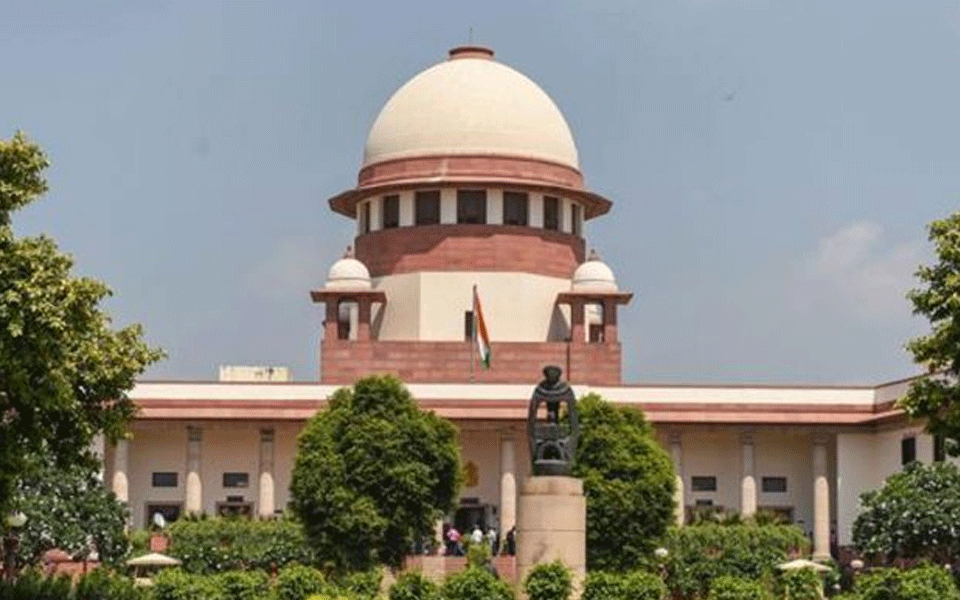
New Delhi, Feb 8 : The Supreme Court Friday refused to stay the Centre's decision to grant 10 per cent quota in jobs and admissions to poor candidates in the general category.
The apex court, however, agreed to examine the validity of the law and issued the notice to the Centre on the plea filed by businessman and Congress supporter Tehseen Poonawala.
"At this stage, we are not inclined to pass any order," said a bench headed by Chief Justice Ranjan Gogoi.
Senior advocate Rajeev Dhavan, appearing for Poonawala, told the bench that his only grievance at this stage was that this quota should not breach the ceiling of 50 per cent as mandated by the apex court.
The bench, also comprising Justices Deepak Gupta and Sanjiv Khanna, had earlier issued notice to the Centre on similar petitions and on Friday ordered tagging of the fresh plea of Poonawalla with pending ones.
Petitions have been filed by parties, including 'Janhit Abhiyan' and NGO 'Youth For Equality', challenging the Centre's decision.
The petition, filed by Youth For Equality through its president Kaushal Kant Mishra, has sought the quashing of the Constitution (103 Amendment) Act, 2019, saying that the economic criterion cannot be the sole basis for reservation.
It said the bill violates basic feature of the Constitution as reservation on economic grounds cannot be limited to the general category and the overall 50 per cent ceiling limit cannot be breached.
In the present form, the upper limit of quota goes up to 60 per cent which violated the decisions of the apex court.
Referring to the nine-judge bench decision of the apex court in the landmark 1992 Indira Sawhney case, the petition said the latest amendment completely violated the Constitutional norm that economic criterion cannot be the only basis of reservation.
It also said that the amendments fail to consider that Articles 14 and 16 form the basic feature of equality, and that they have been violated with the doing away of the restraints that were imposed on the reservation policy, i.e. the 50 per cent ceiling limit and the exclusion of economic status as a sole criterion.
The fresh filed by businessman Poonawalla has sought quashing of the bill, saying that backwardness for the purpose of reservation cannot be defined by "economic status alone".
The top court had earlier refused to stay the Modi government's decision to grant the reservation but agreed to examine the validity of the constitutional amendment which paved the way for this quota.
In poll year, the Modi government has come out with the constitutional amendment bill giving quota benefits to the poor among general category candidates.
The quota will be over and above the existing 50 per cent reservation to SCs, STs and Other Backward Classes (OBCs).
The Lok Sabha and the Rajya Sabha cleared the bill on January 8 and 9 respectively, and has been signed by President Ram Nath Kovind.
Let the Truth be known. If you read VB and like VB, please be a VB Supporter and Help us deliver the Truth to one and all.
Karnataka launches state-led Centre of Excellence for Space Technology in Bengaluru
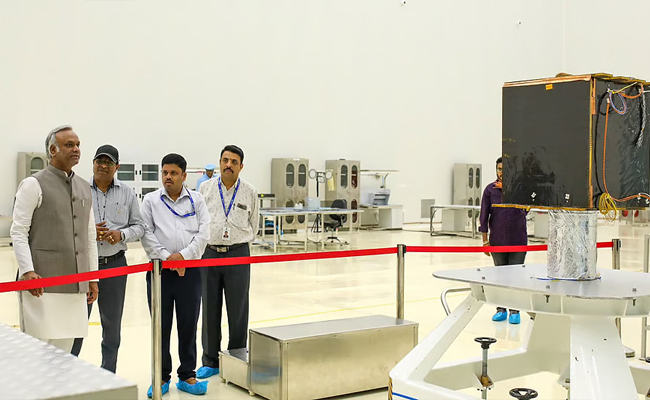
Bengaluru (PTI): In a significant boost to India’s rapidly expanding space economy, the Karnataka government on Friday launched the country’s first state-led Centre of Excellence for Space Technology here, officials said.
The initiative is aimed at strengthening India’s capabilities to translate space innovation into scalable commercial outcomes, they said.
The Centre, established by the Government of Karnataka through the Karnataka Innovation and Technology Society in collaboration with SIA (Satcom Industry Association India) -India, was inaugurated by Minister for Electronics, IT/BT, and Rural Development and Panchayat Raj, Priyank Kharge, in the presence of senior officials and industry leaders, officials said.
Speaking at the launch, Minister Kharge said that Karnataka has consistently been at the forefront of India's technology and innovation journey. With the launch of this Centre of Excellence for Space Technology, we are extending that leadership into one of the most strategic sectors of the future.
"Our focus is not just on advancing research, but on creating an ecosystem where innovation can translate into real-world applications, economic growth, and high-quality jobs. This Centre will play a critical role in positioning Karnataka as a key driver of India's space economy," he said.
According to an official statement, the CoE SpaceTech Foundation has been established under a Memorandum of Agreement between KITS and SIA-India to drive research and innovation in space technologies, industry-aligned training, startup incubation and cross-sector applications, it said.
The Centre has also formalised strategic MoUs with multiple industry and academic partners to support research in space biotech and microgravity, enable collaboration, build talent pipelines, and provide startups with training and market access, it added.