Supreme Court rejects plea of mother of two to terminate over 26-week pregnancy
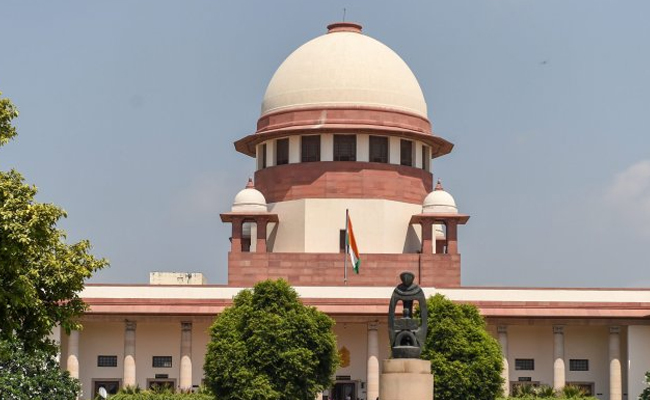
New Delhi (PTI): The Supreme Court on Monday declined to permit a married woman, a mother of two, to terminate her over 26-week pregnancy as the foetus was healthy and the AIIMS medical board found no abnormality with it.
A bench headed by Chief Justice DY Chandrachud said the length of pregnancy has crossed 24 weeks, the upper limit for allowing Medical Termination of Pregnancy (MTP), and therefore it cannot be permitted.
The top court said the foetus is 26 weeks and 5 days old and there is no immediate threat to the mother. There was also no foetal abnormality, it said.
"The length of the pregnancy has crossed 24 weeks and it is approximately 26 weeks and 5 days old. The medical termination of the pregnancy cannot be permitted," the bench, also comprising Justices JB Pardiwala and Manoj Misa said.
The top court had said earlier in the day that the challenge to pregnancy termination law will be dealt with in separate proceedings, and the present case would be limited to the issue between the petitioner and the State.
The apex court had earlier sought a report from the AIIMS medical board on whether the foetus was suffering from any abnormality.
The bench was hearing arguments on the Centre's application seeking recall of the apex court's October 9 order permitting the 27-year-old woman, a mother of two, to undergo termination of pregnancy at AIIMS as she was suffering from post-partum psychosis after the birth of her second child.
Under the MTP Act, the upper limit for the termination of pregnancy is 24 weeks for married women, special categories including survivors of rape, and other vulnerable women such as the differently-abled and minors.
The apex was faced with a conundrum over whether to allow the woman to terminate her 26-week pregnancy. The moral dilemma stemmed from what the court said the rights of the unborn child and the woman's right to her bodily autonomy.
The issue arose after one of the doctors of the AIIMS medical board, which examined the woman and filed a report dated October 6 in the apex court, sent an e-mail on October 10 saying the foetus had a strong possibility of survival.
The matter came up before the CJI-led bench after a two-judge bench on Wednesday gave a split verdict on the Centre's plea for recall of its October 9 order granting permission to the woman to terminate her pregnancy.
Let the Truth be known. If you read VB and like VB, please be a VB Supporter and Help us deliver the Truth to one and all.
AIITA welcomes Karnataka’s ban on obscene songs in school events
Bhatkal: The Karnataka unit of the All India Ideal Teachers Association (AIITA) has welcomed the Karnataka government’s decision to strictly ban school children from dancing to obscene songs during educational and cultural programmes in government, aided, and private schools across the state.
AIITA Karnataka State President M. R. Manvi congratulated the government for taking what he termed an important step to preserve the sanctity of education.
“Such decisions to safeguard the dignity of school children and uphold the values of education are the need of the hour. This rule should not be limited to government schools alone but must be strictly implemented in all private educational institutions as well,” he said.
He further urged the government to address other concerns within school programmes.
“The government should not only prohibit obscene dances in the name of school anniversaries, but also ensure that plays and dialogues that incite religious hatred are avoided. Schools should be centres of harmony, not platforms for spreading hatred,” he added.
According to a recent circular issued by the Department of School Education and Literacy, obscene dances are adversely affecting the mental health and moral values of students.
In this regard, schools have been advised to use songs that promote nationalism, positive thinking, the greatness of Kannada culture, and value-based traditions instead of inappropriate content during programmes.
The circular also emphasises that students should be dressed in decent attire.
AIITA also backed the department’s warning that disciplinary action would be taken against head teachers if such guidelines are violated. The association has further demanded that district Deputy Directors of Public Instruction strictly monitor the implementation of these rules.