Supreme Court says need to regulate electronic media; Centre bats for journalistic freedom
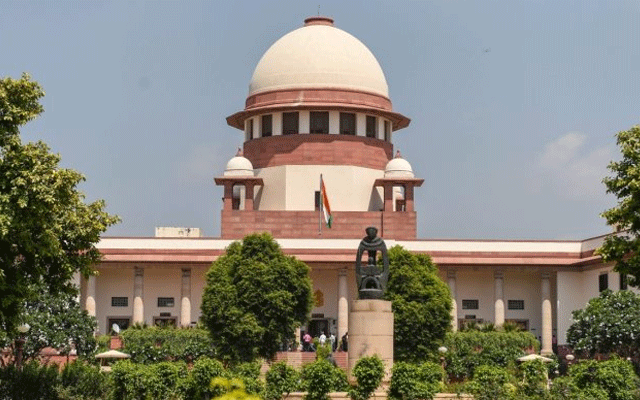
New Delhi: There is a need to regulate the electronic media as most of the channels are running for TRPs, leading to more sensationalism, the Supreme Court said on Tuesday even as the Centre batted for journalistic freedom saying it would be disastrous for any democracy to control the press.
The apex court, making clear it is not suggesting censorship on media, said there should be some kind of self-regulation in the media.
Regulating internet is very difficult but we need to regulate the electronic media now, a bench headed by Justice D Y Chandrachud said.
The top court said this while hearing a plea which has raised grievance over Sudarshan TV's Bindas Bol' programme whose promo had claimed that the channel would show the 'big expose on conspiracy to infiltrate Muslims in government service'.
While the apex court said that some kind of self-regulation in media was needed, Solicitor General Tushar Mehta argued that freedom of journalist is supreme.
It would be disastrous for any democracy to control press, Mehta told the bench, also comprising Justices Indu Malhotra and K M Joseph.
The bench restrained Sudarshan TV from telecasting two episodes of 'Bindas Bol' programme, scheduled for Tuesday and Wednesday, saying it prima facie appears to vilify the Muslim community.
During the hearing conducted through video-conferencing, the apex court said that most of the channels are running for TRPs.
Mehta said sometimes certain channels are being used for providing the medium to accused to point his or her views. Mehta also said that it needs to be seen if a potential accused could be given a platform to air his or her defense. The problem with electronic media is all about TRPs, thus leading to more and more sensationalism. So many things masquerade as a form of right, the bench observed.
We are not saying states will impose any such guidelines as it would be an anathema to Article 19 of freedom of speech and expression, the bench said.
The apex court said the electronic media has become more powerful than print media and we have not been supportive of pre-broadcast ban.
I am not necessarily saying that electronic media should be regulated by the state but there must be some kind of self-regulation, Justice Chandrachud said, adding, We are talking about the electronic media and not about the social media at the moment.
Mehta said that there should be some kind of self-regulation but the freedom of journalist has to be maintained. No freedom is absolute let me make myself clear on this, Justice Joseph told the solicitor general.
Mehta told the bench that few years ago, some channels were saying Hindu terror, Hindu terror.
We are talking about the electronic media as today people may not read newspapers but may watch electric media, the bench said.
Reading newspapers may not have entertainment value but the electronic media has got some entertainment value, it added. The bench then referred to the criminal investigation being carried out by some media houses.
When journalists operate, they need to work around right to fair comment. See criminal investigation, media often focuses only one part of the investigation, it said.
What are you doing?, the bench asked the counsel appearing for the News Broadcasters Association. We need to ask you if you exist apart from the letter head. What do you do when a parallel criminal investigation goes on in media and reputation is tarnished?
The bench observed that the law does not have to regulate everything to regulate something.
Let the Truth be known. If you read VB and like VB, please be a VB Supporter and Help us deliver the Truth to one and all.
AIITA welcomes Karnataka’s ban on obscene songs in school events

Bhatkal: The Karnataka unit of the All India Ideal Teachers Association (AIITA) has welcomed the Karnataka government’s decision to strictly ban school children from dancing to obscene songs during educational and cultural programmes in government, aided, and private schools across the state.
AIITA Karnataka State President M. R. Manvi congratulated the government for taking what he termed an important step to preserve the sanctity of education.
“Such decisions to safeguard the dignity of school children and uphold the values of education are the need of the hour. This rule should not be limited to government schools alone but must be strictly implemented in all private educational institutions as well,” he said.
He further urged the government to address other concerns within school programmes.
“The government should not only prohibit obscene dances in the name of school anniversaries, but also ensure that plays and dialogues that incite religious hatred are avoided. Schools should be centres of harmony, not platforms for spreading hatred,” he added.
According to a recent circular issued by the Department of School Education and Literacy, obscene dances are adversely affecting the mental health and moral values of students.
In this regard, schools have been advised to use songs that promote nationalism, positive thinking, the greatness of Kannada culture, and value-based traditions instead of inappropriate content during programmes.
The circular also emphasises that students should be dressed in decent attire.
AIITA also backed the department’s warning that disciplinary action would be taken against head teachers if such guidelines are violated. The association has further demanded that district Deputy Directors of Public Instruction strictly monitor the implementation of these rules.