Supreme Court stays HC order granting bail to ex-UP minister in gang rape case
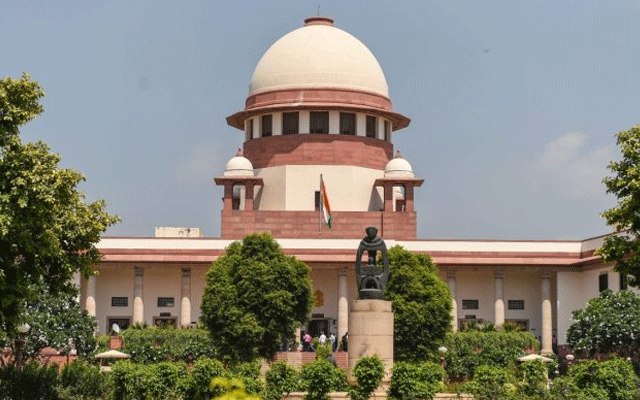
New Delhi: The Supreme Court Monday stayed former Uttar Pradesh minister Gayatri Prasad Prajapati's interim bail, granted for two months on medical grounds by the Allahabad High Court, in a gang rape case.
The Lucknow bench of the Allahabad High Court on September 3 had granted the interim bail to Prajapati who was a minister in the erstwhile Samajwadi Party government.
Despite the high court bail, Prajapati remained in judicial custody as a fresh case of fraud, forgery and criminal intimidation was registered against him.
A bench comprising Justices Ashok Bhushan, R Subhash Reddy and M R Shah took note of the plea of the Uttar Pradesh government and stayed the high court's bail order and sought response of the accused leader on the petition.
The state government, in its appeal, said that the "High Court has erroneously granted a short-term bail of two months to the Respondent accused in a POCSO case solely on medical grounds ignoring that the accused has throughout been treated in premier national medical Institutes KGMC / SG-PGI, also specially when the regular bail application of the Respondent has already been fixed for hearing in the week commencing September 28".
It said the accused was a "very prominent Minister in the erstwhile government and wielded considerable influence in the environs of powers".
The political position of the accused was so dominating that the FIR against him was registered only after the victim approached the Supreme Court, the UP government said.
The high court, while granting the bail, had said the threat to the ex-minister from COVID-19 was real and imminent and he has been asked by doctors to get treated at a super-specialty hospital as he was suffering from various diseases.
Prajapati is in jail since March 15, 2017 and is currently undergoing treatment for various ailments at KGMU. He, along with others, is accused of raping a woman and attempting to molest her minor daughter
The gang rape case was lodged with Gautampalli police station in 2017 and later, Prajapati was arrested and sent to jail on March 15, 2017.
He was earlier granted bail by a sessions court in the case but it was cancelled by the high court before his release from jail.
Let the Truth be known. If you read VB and like VB, please be a VB Supporter and Help us deliver the Truth to one and all.
AIITA welcomes Karnataka’s ban on obscene songs in school events
Bhatkal: The Karnataka unit of the All India Ideal Teachers Association (AIITA) has welcomed the Karnataka government’s decision to strictly ban school children from dancing to obscene songs during educational and cultural programmes in government, aided, and private schools across the state.
AIITA Karnataka State President M. R. Manvi congratulated the government for taking what he termed an important step to preserve the sanctity of education.
“Such decisions to safeguard the dignity of school children and uphold the values of education are the need of the hour. This rule should not be limited to government schools alone but must be strictly implemented in all private educational institutions as well,” he said.
He further urged the government to address other concerns within school programmes.
“The government should not only prohibit obscene dances in the name of school anniversaries, but also ensure that plays and dialogues that incite religious hatred are avoided. Schools should be centres of harmony, not platforms for spreading hatred,” he added.
According to a recent circular issued by the Department of School Education and Literacy, obscene dances are adversely affecting the mental health and moral values of students.
In this regard, schools have been advised to use songs that promote nationalism, positive thinking, the greatness of Kannada culture, and value-based traditions instead of inappropriate content during programmes.
The circular also emphasises that students should be dressed in decent attire.
AIITA also backed the department’s warning that disciplinary action would be taken against head teachers if such guidelines are violated. The association has further demanded that district Deputy Directors of Public Instruction strictly monitor the implementation of these rules.