
Supreme Court to consider plea for early hearing of PIL challenging Article 370
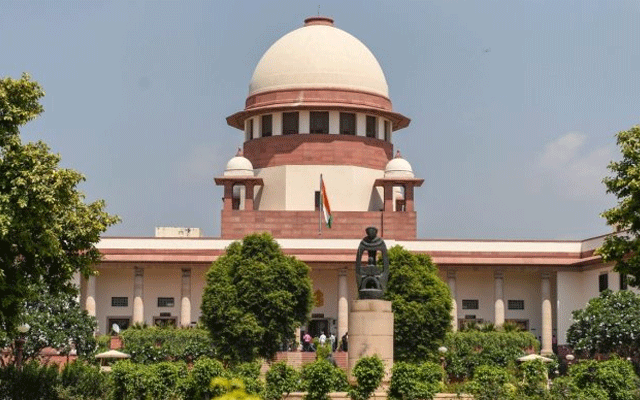
New Delhi: The Supreme Court Wednesday said it would consider the plea seeking urgent hearing of a PIL challenging the constitutional validity of Article 370 which grants special status to Jammu and Kashmir and limits Parliament's power to make laws for the state.
A bench comprising Chief Justice Ranjan Gogoi and Justices Deepak Gupta and Aniruddha Bose took note of the submission of BJP leader and lawyer Ashwini Upadhyay that his PIL be listed for an urgent hearing.
"File a memo. We will see," the bench said.
On February 18 this year as well, he had mentioned the PIL for urgent listing for the hearing.
Upadhyay, in his plea which was filed in September last year, has contended that the special provision was "temporary" in nature at the time of framing of the Constitution and Article 370(3) lapsed with the dissolution of the Jammu and Kashmir Constituent Assembly on January 26, 1957.
The plea also seeks a declaration from the apex court that the separate Constitution of Jammu and Kashmir was "arbitrary" and "unconstitutional" on various grounds, including that it was against the "supremacy of the Constitution of India and contrary to dictum of 'One Nation, One Constitution, One National Anthem and One National Flag'".
"The Constitution of Jammu and Kashmir is invalid mainly for the reason that the same has not yet got the assent of the President, which is mandatory as per provisions of the Constitution of India," the plea, which may come up for hearing next week, said.
The petition, filed through advocate R D Upadhyay, claims that the maximum life span of Article 370 was only till the existence of the Constituent Assembly, that was January 26, 1950 when the national document was adopted.
Article 370 is a "temporary provision" with respect to Jammu and Kashmir and restricts the applicability of various provisions of the Constitution by "curtailing" the power of Parliament to make laws on subjects which fall under the Union and Concurrent lists, it said.
Consequently, it allows the state to accord special rights and privileges to the natives, the plea said.
It claimed that the Article empowered the state legislature to frame any law without attracting a challenge on the grounds of violation of the right to equality of people from other states or any other right under the Constitution.
Let the Truth be known. If you read VB and like VB, please be a VB Supporter and Help us deliver the Truth to one and all.
Kharge expresses regret over 'illiterate' remark, says he has highest of respect for Gujaratis
_vb_85.jpeg)
New Delhi (PTI): Congress president Mallikarjun Kharge on Wednesday expressed regret over his controversial statement calling the people of Gujarat "illiterate", and said he has always had and will continue to have the highest of respect for the people of the state.
In a post on X, the Congress president said, "Some remarks of mine in a recent election speech in Kerala are being deliberately misinterpreted. Even so, I express my sincere regret.
"It was never my intention to hurt the sentiments of the people of Gujarat for whom I have always had and will continue to have the highest of respect."
Kharge on Sunday had sparked a row during his Assembly poll campaign in Kerala, calling the people of Gujarat "illiterate" and claiming they were being "fooled" by Prime Minister Narendra Modi.
At the same time, Kharge said neither Modi nor Kerala Chief Minister Pinarayi Vijayan could fool the people of Kerala, describing them as "very clever and educated".
"Don’t misguide the people of Kerala. They are very clever and educated. Modiji, Vijayan, you both can fool people who are illiterate in Gujarat or other places, but you cannot fool the people of Kerala," the Congress chief had said.
He made the remark while alleging that both Modi and Vijayan were following the same path, with no difference between them except the parties they lead.
The BJP on Tuesday had demanded an apology from Kharge for his remarks, saying that the comment was "shameless, demeaning and utterly despicable."
Addressing a press conference here, senior BJP leader and former Union minister Ravi Shankar Prasad asked Congress leaders Rahul Gandhi, Sonia Gandhi and Priyanka Gandhi Vadra to clarify whether they agreed with Kharge's statement.
_vb_92.jpeg)
_vb_51.jpeg)
_vb_41.jpeg)