Surging mkts: CJI Chandrachud advises SEBI, SAT to be cautious, pitches for more tribunal benches
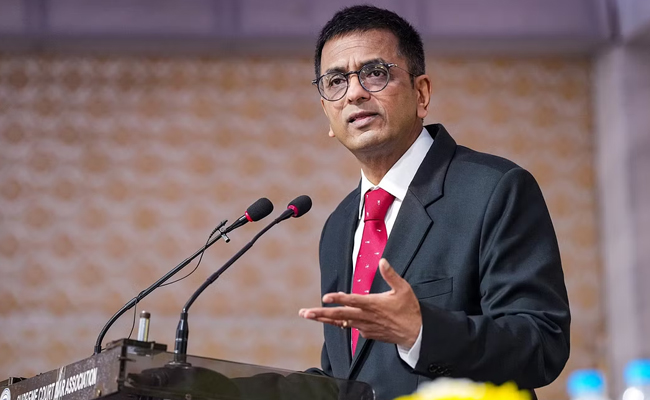
Mumbai (PTI): Chief Justice of India D Y Chandrachud on Thursday advised market regulator SEBI and the Securities Appellate Tribunal (SAT) to exercise caution amid a significant surge in equity markets and pitched for more tribunal benches to ensure that the "backbone is stable".
Inaugurating the new SAT premises here, CJI Chandrachud pitched for authorities to consider opening up new benches of the SAT given the higher workloads because of higher quantum of transactions and newer regulations.
Referring to newspaper articles calling the crossing of the 80,000 points milestone by the BSE as an ecstatic moment, where India is entering a "stratospheric domain", the CJI pointed out that such events emphasize the need for regulatory authorities to ensure that everyone holds their "balance and nerves" amid the wins.
"The more you see the surge in the stock market, the greater the role, I believe, for SEBI and SAT, as institutions which will exercise caution, celebrate the successes but at the same time, ensure that the backbone is stable," the CJI said.
He added that SEBI and appellate fora like SAT assume "immense national importance" in fostering a stable and predictable investment environment, and explained how this can benefit in economic growth for the country.
"When investors feel assured that their investments are protected by law and that there are effective mechanisms for dispute resolution, they are more likely to invest in the country's markets. This influx of investment can lead to better economic outcomes such as increased capital formation, job creation and overall economic growth," the CJI said.
The role of SAT in the "dog eat dog" world of finance is that of a referee in ensuring that everybody plays by the rules, he said, stressing on the need to be updated by keeping pace with new developments.
With the rapid growth in the number of market participants and transaction volumes, there is a likelihood of an increase in disputes and may be even instances of regulatory non-compliance, he said.
In addition, issues like market conduct and corporate governance have increased appeals filed with SAT "manifold", the CJI said, pitching for an early filling up of the vacancies at SAT to ensure that the tribunal functions effectively and at full capacity.
CJI Chandrachud, who called the event as a "homecoming" because he had appeared in the tribunal first as a lawyer, also pitched for more SAT benches pointing out that the statutes allows for it.
He later told reporters that creating additional benches is a "policy issue" and he has flagged the issue as the Chief Justice of India given the growth in the work. "It is an aspect which should be considered by those who have responsibility for taking these decisions," he said.
SAT's presiding officer Justice P S Dinesh Kumar said there are 1,028 pending appeals in the SAT and it has disposed of over 6,700 appeals since its inception in 1997.
The CJI said timely actions and correction of aberrations is very important in the financial sphere, and cited a 5-bench judgement on a critical matter recently which came within a month of the original order as a case in point.
The CJI also shared the thinking during the selection of the SAT head recently to point out that there is a perception in the "highest level of government" that it is a key tribunal in terms of economic regulation.
"Therefore it is necessary to have a person who may not necessarily be someone who has practiced securities law or presided over securities cases but who has the basic and robust approach to regulation," he said.
He also launched a new website of the SAT on Thursday which has been created by the National Informatics Centre, and stressed on the need to devote adequate attention to the issue of technology.
With the advancements in the digital arena, there is a need to reimagine the concept of access to justice, he said.
Let the Truth be known. If you read VB and like VB, please be a VB Supporter and Help us deliver the Truth to one and all.
Representative of Iran's Supreme Leader in India calls current situation 'no war, no peace'
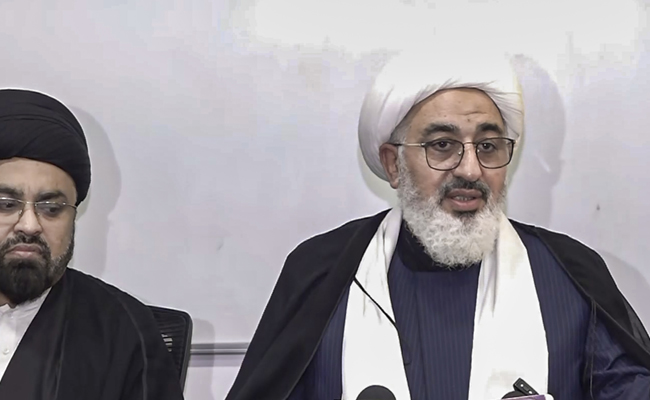
Bengaluru (PTI): Representative of Iran's Supreme Leader in India, Abdul Majeed Hakeem Ilahi on Saturday characterised the ongoing tensions between his country and the Israel-US alliance as a state of “no war, no peace”.
Calling for an immediate halt to the conflict, he said the global stability hinges on those who initiated the war.
He questioned why countries affected by the war and suffering from the energy crisis are not pressuring the US and Israel to stop the aggression.
Addressing a press conference here, Ilahi said Iran did not want the conflict, but was compelled to respond amid continued attacks, even as negotiations were expected to continue.
"Iran didn't want this war, but Iran was forced by the war and several times Iran tried to avoid this war... I don't know what is the condition of these people and these countries (US-Israel)... they want to impose on other countries what they want, and who gave them this authority?" he questioned.
Recalling the negotiations Iran held in Oman, he said talks later moved to Geneva and made progress before being disrupted by sudden attacks.
Ilahi claimed that airstrikes and missile attacks led to the deaths of Iran’s supreme leader Ayatollah Ali Khamenei, ministers, commanders and civilians.
"They killed a lot of civilians… They attacked a primary school, and they killed 175 innocent girls," he said, claiming over 4,000 deaths, more than 40,000 injuries, and widespread damage to houses, hospitals, universities and public infrastructure.
Despite these losses, he said Iran resisted calls for “unconditional surrender” and stood firm and defended itself.
"They wanted unconditional surrender. Which no one—no one can accept it. Iran said, 'Okay, we are ready to be sacrificed,' but we are not ready to submit ourselves," he added.
He argued that they (US-Israel) proposed the current ceasefire only after realising that they could not achieve any of their objectives after 40 days of conflict.
The envoy further claimed that the ceasefire is not an actual ceasefire, but a “no war, no peace” situation.
Explaining the current situation in Iran, he said conditions remain stable and people are going about their daily lives.
"They are working ....(leading) their ordinary life. They are working—they're going farming and they do everything....and they aren't scared of anything. And they are ready to defend themselves," he added.
Addressing the crisis in the Strait of Hormuz, he said the situation was stable before February 28 and all countries benefited from it.
"(For) 10,000 years, the Strait of Hormuz was open...and Iran daily yearly spent a lot for providing security in the Strait of Hormuz... so no one even complained anything about the Strait of Hormuz. Everyone was free...and even our enemies their warship was passing through the Strait of Hormuz," he said.
However, he linked the current maritime instability to the actions of the US and Israel.
"So Iran cannot do anything. Those people who initiated, created and started this war, they have to stop it. And everything will go back to normal," he said.
Criticising the mentality of the "great powerful country", Ilahi said, "they think they have the right to do whatever they want. It should change."
He sought to know why the countries affected by the conflict are not exerting pressure on the US and the "Zionist" regime to halt the war.
"Why are they not asking them? This crisis and problem by which a lot of countries are affected was created by them. A lot of factories are closed and even working days in some countries reduced... A lot of restaurants are closed," he said.
Seeking fairness and justice, Ilahi said instead of asking Iran, all those nations should ask those who initiated this war to stop it, by telling them, "we are suffering."
To a query on international mediation, Ilahi, referring to the US, asked, "Is it acceptable and reasonable that one country orders all countries -- you should not deal with this country, You should not purchase from this country. You should not have business with this country. You should not buy from this country."
Ilahi also highlighted Iran's long-standing ties with India and said, "It is a great country and we respect India and Indians."
"We have 5,000 years relationship and friendship. We are connected to India by education, by philosophy, by culture, by civilisation and by the economy," he said.
According to him, the bilateral cooperation remains strong, citing diplomatic engagement.
"At the moment also, our relationship, collaboration, cooperation with India is very good," he said, adding Iran allowing Indian ships to pass through Strait of Hormuz reflects the ties.
"Iran allowed Indian ships to pass through the Strait of Hormuz. Why? A lot of countries couldn't get this permission?... The relationship between Iran and India is very good," he added.
He expressed confidence that in future too, the ties between Iran and India will be strong.