Suspension of preferential trade status for India under GSP is "done deal": US

Washington: The Trump administration has said it is not going back on its decision to terminate India's designation as a beneficiary developing nation under the key GSP trade programme, terming the suspension a "done deal".
The Generalized System of Preference (GSP) is the largest and oldest US trade preference programme and is designed to promote economic development by allowing duty-free entry for thousands of products from designated beneficiary countries.
On March 4, President Donald Trump announced that the US intended to terminate India's designation as a beneficiary developing country under the GSP programme.
The 60-day notice period ended on May 3. A formal notification is now expected anytime.
The Trump administration has prioritised working with the Government of India to ensure that US companies have a level playing field, a senior State Department official told reporters on Thursday, hours after Narendra Modi was sworn in as Prime Minister for a second time following his spectacular electoral victory in the general elections.
"The persistent market access issues, which we were engaged with our Indian counterparts over the last year, led us to announce in March that we would be suspending or withdrawing India's benefits under the generalised system of Preferences Program," said the official who spoke on the condition of anonymity.
"That suspension is a done deal. Now the task is how do we look ahead; how do we work under the second Modi Administration, to identify a path forward?" the official said, reflecting the Trump administration's decision that the GSP termination is final.
Under the GSP programme, nearly 2,000 products including auto components and textile materials can enter the US duty-free if the beneficiary developing countries meet the eligibility criteria established by Congress.
India was the largest beneficiary of the program in 2017 with USD 5.7 billion in imports to the US given duty-free status and Turkey the fifth largest with USD 1.7 billion in covered imports, according to a Congressional Research Service report issued in January.
"We believe there's enormous potential to grow our trade relationship and to help stimulate the jobs that Prime Minister Modi is committed to bringing to an overwhelmingly young Indian population.
"We believe that if India is prepared to address policies including data localisation and ecommerce measures, that served to stifle international investment from top tier companies, that we can continue to make significant progress moving forward," the official said.
Noting that President Trump has already made the announcement regarding his decision to terminate the designation of India as a beneficiary nation under GSP, the official said there was a 60-day notification to Congress.
The official said that does not rule out in the future, being able to achieve the reforms and the market access that the US needs under this programme to restore benefits.
"But I think we need to be looking forward at how do we relaunch an ambitious set of discussions between our trade teams in order to address these outstanding irritants," the official said, asserting that there is every reason to believe that the GSP suspension will move forward.
Responding to questions, the official reiterated that India needed to address some of its major concerns in particular those related to market access and data localisation.
"Data localisation is a phenomenon that's been taking place globally where we've seen increasing digital protectionism. While we recognise that there are legitimate security and privacy and law enforcement issues related to data protection, we're looking at nearly eight per cent of India's GDP, about USD 160 billion is associated with IT firms who depend upon the free flow of data," the official said.
So, the US does not want to see market access barriers to American firms in India when the Indian companies currently enjoy largely unfettered access to the US markets, the official said.
These issues as well as that surrounding ecommerce will certainly be a topic of conversation with the Indians, the official said.
The senior State Department official said there has been significant growth in the bilateral trade relationship as well as a narrowing of the trade deficit.
The bilateral trade is now at about USD 142 billion. US exports last year increased 28 per cent. The trade deficits for goods and services stands at about USD 24 billion, which is about 11.9 per cent reduction.
"We have also seen strategic Indian investments in aviation, defense, oil and gas. In the the last year, India has imported more than USD 3.3 billion worth of US crude and is contracted to import USD 2 billion worth of liquefied natural gas annually which obviously brings tangible benefits to both our economies and our people," the official said.
At the same time, the official asserted that the tension remained between the two countries.
"India remains one of the least open major economies in the world. The Trump administration is committed to ensuring free and fair and reciprocal trade. And we've prioritised working with the government of India to ensure that US companies have a level playing field," the official said.
Let the Truth be known. If you read VB and like VB, please be a VB Supporter and Help us deliver the Truth to one and all.
Trump says EU has until July 4 to approve last year's trade deal or it will face higher tariffs
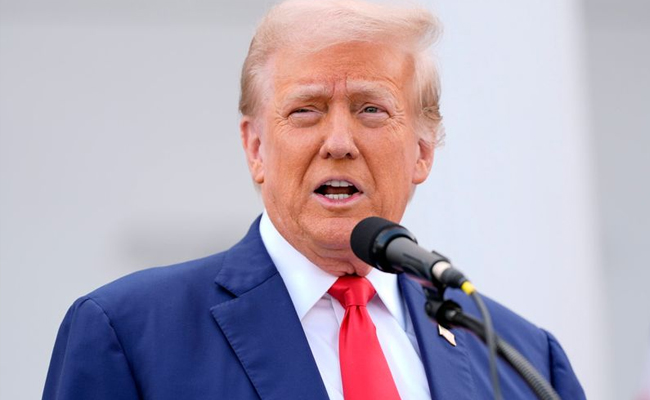
Washington (AP): President Donald Trump has said in a social media post that goods from the European Union would face higher tariff rates if the 27-member bloc fails to approve last year's trade framework by July 4.
The announcement on Thursday appeared to be a deadline extension after the president said last Friday that EU autos would face a higher 25 per cent tariff starting this week. Trump made the updated announcement after what he described as a "great call" with European Commission President Ursula von der Leyen.
Still, the US president was displeased that the European Parliament had yet to finalize the trade arrangement reached last year, which was further complicated in February by the US Supreme Court ruling that Trump lacked the legal authority to declare an economic emergency to impose the initial tariffs used to pressure the EU into talks.
"A promise was made that the EU would deliver their side of the Deal and, as per Agreement, cut their Tariffs to ZERO!" Trump posted. "I agreed to give her until our Country's 250th Birthday or, unfortunately, their Tariffs would immediately jump to much higher levels."
It was unclear from the post whether Trump was implying that the tariff rates would jump on all EU goods or the increase would only apply to autos.
His latest statement indicates he might be backing away from his earlier threat on EU autos by giving the European Parliament several more weeks to approve the agreement.
Under the original terms of the framework, the US would charge a 15 per cent tax on most goods imported from the EU.
But since the Supreme Court ruling, the administration has levied a 10 per cent tariff while investigating trade imbalances and national security issues, aiming to put in new tariffs to make up for lost revenues.