Tamil Nadu to delay Waqf Board reconstitution pending Supreme Court verdict: Minister
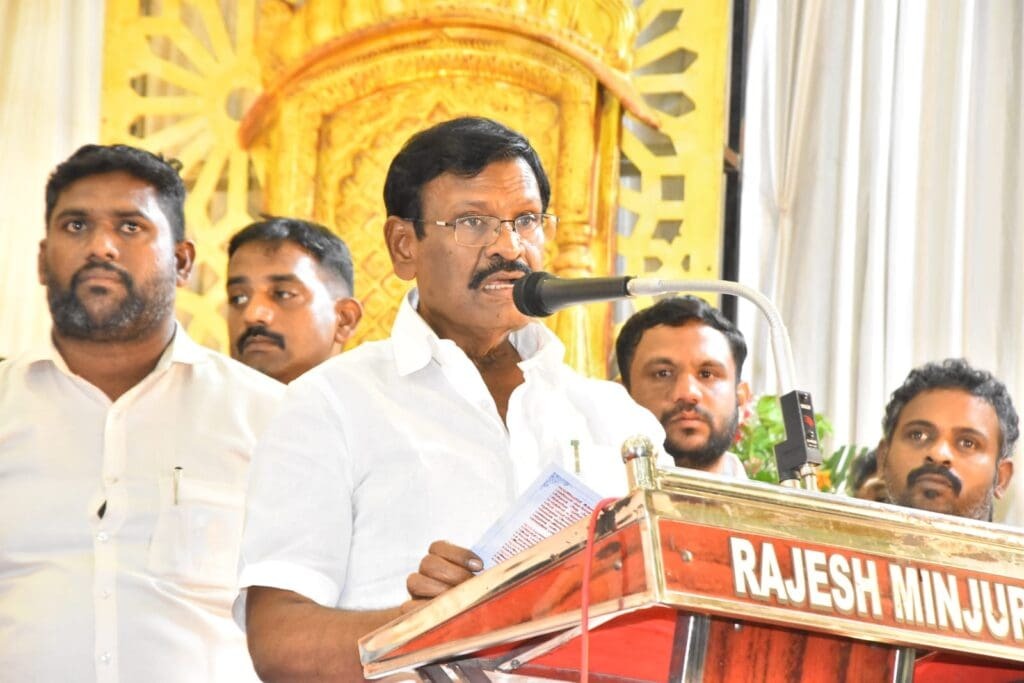
Chennai: Tamil Nadu Minorities Welfare and Non-Resident Tamils Welfare Minister S. M. Nasar on Saturday announced that the state government will not reconstitute the Tamil Nadu Waqf Board under the amended Waqf Act until the Supreme Court delivers its final verdict.
Nasar said the Union government had brought in the Waqf (Amendment) Act, 1995—renamed as the Unified Waqf Management, Empowerment, Efficiency and Development Act, 1995—which came into effect on April 8, 2025. The ruling DMK, he added, has opposed the legislation from the outset and has challenged it before the apex court.
“Several other stakeholders have also filed petitions against the new law. Considering these, the Supreme Court passed an interim order on September 15, staying certain provisions of the amended Act,” Nasar said, accusing the Union government of rushing the Bill through without proper consultation.
Reaffirming the DMK government’s stand, he said the administration is committed to safeguarding the rights and interests of the Muslim community, which has voiced concerns over the amendments.
Meanwhile, MMK president M. H. Jawahirulla urged the state government to ensure smooth functioning of the Waqf Board by immediately appointing a special officer and filling the post of assistant secretary, which has been vacant for nearly two years.
Earlier, Chief Minister M. K. Stalin declared that the DMK would continue to oppose the law in court, stressing, “This amendment is not just to be opposed but should be fully taken back.” Stalin also accused the BJP-led Union government of pursuing “ulterior motives” aimed at targeting a particular section of society.
The All India Muslim Personal Law Board (AIMPLB), which is leading opposition to the Waqf (Amendment) Act, welcomed the Tamil Nadu government’s decision not to form a new Waqf Board under the amended law. Calling the move “timely, appropriate, and courageous,” AIMPLB spokesperson Dr. SQR Ilyas praised Stalin’s administration for taking what he described as a “constitutionally sound” position.
The Tamil Nadu Assembly had in March adopted a resolution urging the Union government to withdraw the Bill, while the Kerala Legislative Assembly had passed a similar resolution in October 2024.
The Waqf (Amendment) Act, 2025, which received presidential assent on April 5, has faced widespread protests and multiple legal challenges. Critics argue that the law undermines Muslim religious autonomy and property rights by expanding government control over waqf properties.
Recently, a Supreme Court Bench led by Chief Justice B. R. Gavai and Justice A. G. Masih partially stayed provisions of the Act. These included the five-year continuous practice requirement to create a waqf and the clause empowering government officials to adjudicate waqf property disputes, which the Court directed must be heard by Waqf Tribunals instead.
Let the Truth be known. If you read VB and like VB, please be a VB Supporter and Help us deliver the Truth to one and all.
Advocate found dead in car on Nainital court premises

Nainital (PTI): A 55-year-old advocate allegedly died by suicide after shooting himself inside his car at the Nainital district court parking lot here on Monday, police said.
According to the police, Puran Singh Bhakuni, a resident of Mallital, was found in the rear seat of his vehicle with a gunshot wound to his temple.
Police recovered a licensed pistol from his hand and a suicide note from the car’s dashboard. The note stated that Bhakuni was unwell and suffering from depression.
"We received information through lawyers around noon. The deceased was lying in the back seat with a pistol in his hand and blood near his ear," Circle Officer Anjana Negi said.
Forensic teams and ballistic experts reached the spot to collect evidence, as no witness reported hearing the gunshot.
Government counsel Sushil Sharma stated that Bhakuni left home at 9 am and was found dead at 9.30 am.
Sharma raised concerns over the circumstances, noting that the body was in the rear seat, and demanded a thorough probe to rule out foul play. Bhakuni, who worked as a notary, had married six months ago, he said.
Police took the body into custody and sent it for a postmortem to confirm the cause of death.
The forensic laboratory will examine the suicide note and the ballistics of the weapon, the police said, adding that the investigation is ongoing.