Telangana cabinet likely to recommend assembly dissolution on Thursday
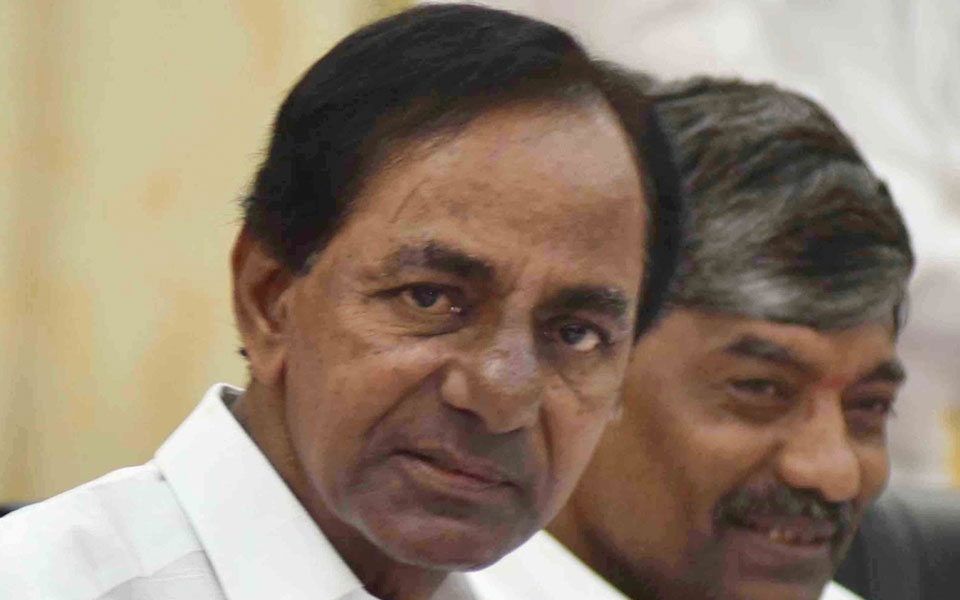
Hyderabad, Sep 5 : A crucial meeting of the Telangana cabinet is likely to be held on Thursday to recommend dissolution of the state assembly to pave way for early polls.
Chief Minister K. Chandrasekhar Rao has asked his cabinet colleagues to be available at 6 a.m. on September 6 for the cabinet meeting, according to sources in the ruling Telangana Rashtra Samithi (TRS).
The TRS chief considers '6' as his lucky number and that's the reason cited for not taking the decision during the cabinet meeting on September 2, which was held hours before the massive public meeting by the ruling party to sound the poll bugle.
The cabinet is expected to pass a resolution recommending to Governor E. S.L. Narasimhan to dissolve the assembly. The term of the assembly is till May, 2019 and the elections in normal course have to be conducted along with the polls for Lok Sabha.
On the eve of the cabinet meeting, the state capital on Wednesday witnessed hectic activity in the political circle. Chief Secretary S.K. Joshi, Chief Advisor to government Rajiv Sharma, Principal Secretary to the Chief Minister, S. Narsing Rao and Legislative Assembly Secretary Narasimhacharyulu called on Narasimhan on Wednesday.
KCR also had a series of meetings with top party leaders.
A day after recommending dissolution of assembly, KCR will be launching the election campaign with a public meeting at Husnabad in Siddipet district on September 7.
Christened 'Prajala Aasirwada Sabha', this will be the first of 100 public meetings planned by TRS over next 50 days.
Political observers say TRS is keen for early assembly elections as it believes that simultaneous elections to assembly and Lok Sabha may not help it in properly highlighting the welfare and development works undertaken during last four years.
The political circle has been abuzz with the talks of early polls for the last few weeks with KCR himself giving strong hints with his two meetings with Prime Minister Narendra Modi in August, announcement of sops for various sections of people and transfer of top police and civil officials.
There was strong possibility of a decision in the cabinet meeting before September 2 public meeting, attended by lakhs of people and claimed to be mother of all rallies.
While the cabinet took no decision, KCR kept the suspense by telling the party cadres that the party leaders have empowered him to take a decision and that they would soon hear it (decision on early polls).
At the public meeting, the TRS chief highlighted the achievements of his government since it took reins in the newly created state in 2014.
He sought fresh mandate to continue the good work and achieve the goal of 'Bangaru Telangana' or golden Telangana. He urged people to protect their 'self-respect' by rejecting the parties from Delhi who want to make them slaves.
Let the Truth be known. If you read VB and like VB, please be a VB Supporter and Help us deliver the Truth to one and all.
18 injured in amusement ride mishap at Jatra Mahotsava in Gadag
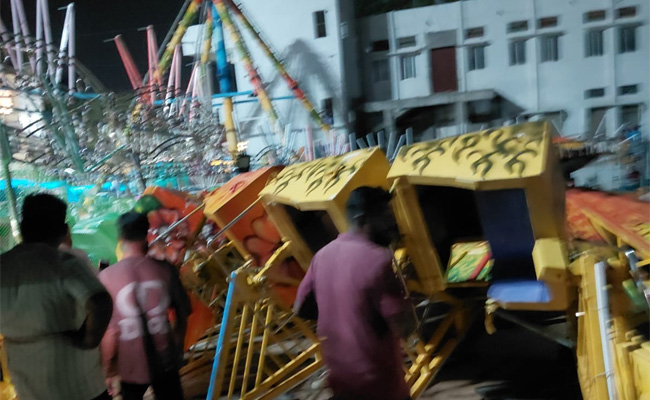
Gadag: At least 18 people were injured, four of them critically, after an amusement ride malfunctioned during the Jatra Mahotsava held at the premises of Tontadarya Mutt on Sunday night.
According to Deccan Herald, the incident occurred around 9 pm when the ‘Dancing Play’ ride (also known as Break Dance or Crazy Dance) reportedly developed a mechanical fault, causing three chairs to tilt dangerously while in motion.
The people inside these chairs were injured and rushed to Gadag Institute of Medical Sciences and Karnataka Medical College and Research Institute (KMC-RI) Hubballi.
Police said that among the injured, two are from Koppal district, one from Tumakuru, and the remaining are from Gadag district. The identities of some victims are yet to be confirmed.
The four victims, who are in critical condition, are severely injured in the head and have been shifted to KMC-RI, officials said.
Meanwhile, members of the Hindu Veerashaiva Lingayat Yuva Vedike staged a protest, demanding strict action against the contractor responsible for organizing the amusement rides, as well as the Jatra Mahotsava committee.