Telangana Govt sacks 48,000 employees over their indefinite strike
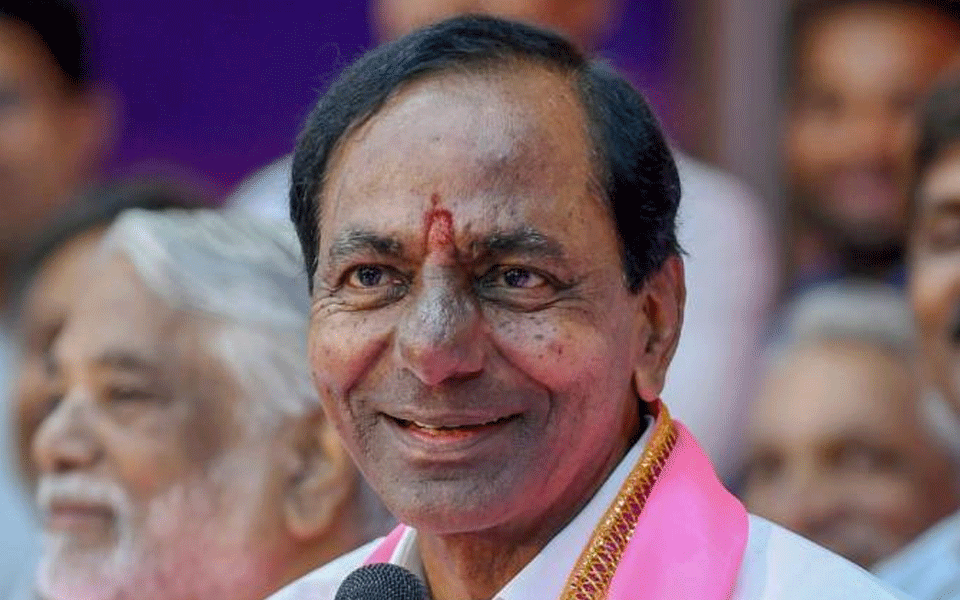
HYDERABAD: The Telangana government sacked over 48,000 employees and workers of Telangana State Road Transport Corporation (TSRTC) on Sunday over an indefinite strike that Chief Minister K Chandrasekhar Rao called an "unpardonable crime".
The striking workers had refused to end their two-day protest by the government's deadline of 6 pm on Saturday.
Mr Rao a.k.a KCR, ruled out any negotiation with the sacked employees. "It is an unpardonable crime that they went on a strike during the festive season and at a time when the TSRTC was incurring a huge loss of Rs. 1,200 crore and its debt burden had gone up to Rs. 5,000 crore," he said.
Nearly 50,000 employees and workers of the road transport corporation had been on strike since Friday midnight, with a list of 26 demands including the merger of the corporation with the government so that they become government employees and are entitled to benefits that accrue to them. Many state buses stayed off the roads, affecting thousands in the festival season.
The state government has hired 2,500 buses for the festival rush. Some 4,114 buses will be given state carriage permission and brought under the RTC. The situation is likely to stabilise in 15 days, it said.
The Vacation Bench of the Telangana High Court has set October 10 as the deadline for the government to explain its alternative arrangements that have been made to ensure that passengers do not face problems due to the strike.
Over one crore people use 10,400 buses of the RTC.
The chief minister has ruled out the merger of the RTC with the government as was done in Andhra Pradesh. "The government will not succumb to any indiscipline and blackmailing tactics of the employees' unions," he said.
"Now, the RTC is left with 1,200 employees. We shall soon start the recruitment process for making fresh appointments. But the new recruits will have to give an undertaking that they would not join any unions," he said.
courtesy: ndtv.com
Let the Truth be known. If you read VB and like VB, please be a VB Supporter and Help us deliver the Truth to one and all.
Man arrested with Rs 2.54-crore heroin in Mumbai

Mumbai (PTI): Police have arrested a man and seized over 500 grams of heroin worth Rs 2.54 crore in the illicit market from him in Mumbai, officials said on Friday.
The police's Anti-Narcotics Cell (ANC) made the drug seizure in Santacruz in the western suburbs. The operation was conducted by the Kandivali unit of the ANC on Thursday as part of a special crackdown against drug trafficking in the area, they said.
Acting on specific inputs, an ANC team conducted a raid in Santacruz (East) and intercepted a man. During a search, the team recovered 508 grams of high-grade heroin from his possession, an official said.
The seized contraband, a highly addictive, opioid drug derived from morphine, is estimated to be worth Rs 2.54 crore in the international market, he informed.
Following the seizure, a case was registered against the man under relevant sections of the Narcotic Drugs and Psychotropic Substances (NDPS) Act, 1985, and he was formally placed under arrest in the early hours of Friday.
The police are currently investigating the source of the drug and trying to identify the intended recipients of the consignment, he said.