Telangana may head for early polls, key cabinet meet on Sunday
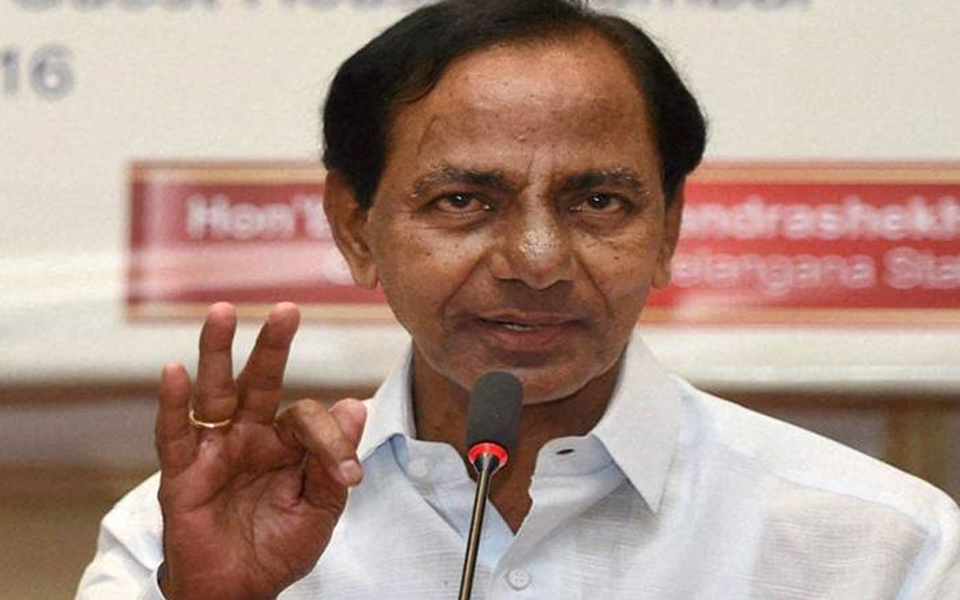
Hyderabad, Sep 1 : Telangana may be heading for an early polls as all eyes are on a crucial state cabinet meeting followed by a massive public meeting by the ruling TRS here on Sunday.
Amid strong indications of polls being advanced, Telangana Rashtra Samithi (TRS) is all set to hold a massive show of strength.
The rally will be preceded by a meeting of the state cabinet, which is likely to decide for dissolution of Assembly, seven months ahead of its term.
TRS leaders said Chief Minister K. Chandrasekhar Rao will take "key decisions" at the cabinet meeting and announce them at the public meeting.
The cabinet may pass a resolution to dissolve the Assembly and recommend this to Governor E.S.L. Narasimhan. If the Election Commission agrees, the polls may be held in December along with the elections in three other states --Rajasthan, Madhya Pradesh and Chhattisgarh.
The state cabinet will meet at 1 p.m. while the public meeting is scheduled to begin an hour later.
For the last few weeks, Rao had been dropping hints of assembly elections being advanced. He has already declared that the party will announce the candidates in September.
KCR, as Rao is popularly known, is keen to advance the assembly polls to avoid simultaneous elections to the Assembly and the Parliament.
His two meetings with Prime Minister Narendra Modi in August further added to the speculation. Over the last few days, he announced sops for various sections of people and also transferred IAS and IPS officers.
On Saturday, the Chief Minister announced 35 per cent pay hike for the employees of electricity department.
KCR's son and cabinet minister K.T. Rama Rao said the Chief Minister would take a final decision on early polls. Rama Rao, who is number two in the party and the government, is confident of TRS retaining power whenever the elections are held.
Titled "Pragati Nivedana" (Progress report), the meeting to be held at Kongara Kalan at Ibrahimpatnam on the city outskirts is expected to attract 25 lakh people. Rama Rao claims that this will be the biggest political rally in the country.
According to him, TRS has 47 lakh members and if half of them turn up, the meet would be a huge success. TRS leaders are mobilising people for the meet from across the state.
TRS, which formed the first government in Telangana after the state came into being on June 2, 2014 with the bifurcation of Andhra Pradesh, will highlight its achievements during the last four years while KCR is expected to sound the poll bugle.
TRS workers from various parts of state started pouring in for the meeting.
The massive mobilisation of people is expected to hit the traffic on Outer Ring Road (ORR) as thousands of vehicles will be heading towards the venue from different entry points along ORR. Rama Rao has suggested to people not attending the meeting to stay indoors.
Let the Truth be known. If you read VB and like VB, please be a VB Supporter and Help us deliver the Truth to one and all.
26 killed, 61 injured in blast at fireworks factory in China
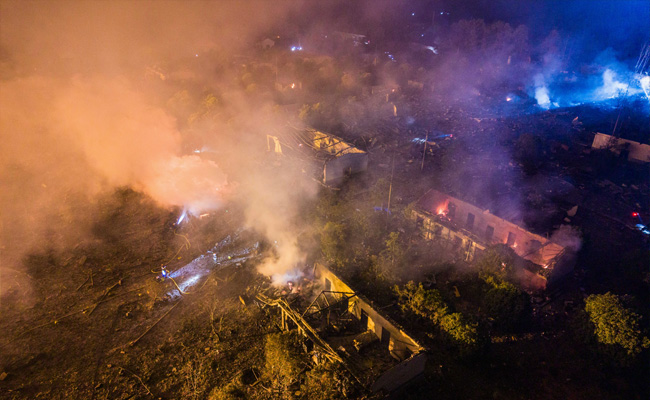
Beijing (PTI): At least 26 people were killed and 61 others injured in a massive explosion at a fireworks factory in China's Hunan province, officials said on Tuesday.
The explosion occurred on Monday afternoon at the plant operated by the Huasheng fireworks manufacturing and display company in Liuyang, a county-level city under Changsha, the provincial capital.
Videos circulating on Chinese social media showed massive destruction of property spanning several kilometres.
ALSO READ: Will of people supreme, says Mahua Moitra after BJP's landslide victory in Bengal
More than 480 rescuers, organised into five teams, have been deployed for relief operations, with three rescue robots pressed into service.
Officials said 26 people were killed and 61 others were injured. The injured have been rushed to hospitals for treatment, while a second round of search operations is underway.
China is a leading manufacturer and exporter of fireworks.
As the explosion site is located near two black powder warehouses, the rescuers have evacuated nearby residents and set up a buffer zone to prevent a secondary accident, the state-run Xinhua news agency reported.
The Ministry of Emergency Management has dispatched experts to the scene to guide rescue efforts.
The person in charge of the company has been detained by police and the cause of the accident is being investigated, the report said.