Temple desecration sparks communal tensions in Maharashtra’s Jalna despite arrest of Hindu accused
Jalna: A village in Maharashtra’s Jalna district has become a flashpoint of communal tension following the desecration of a 12th-century Mahadev temple on September 19. Police investigations, however, revealed that the accused was not from the Muslim community but a Hindu man, a fact that has done little to calm the unrest.
According to police, CCTV footage confirmed the involvement of 38-year-old Nandkishor Suresh Wadgaonkar, a resident of Anwa village in Bhokardan tehsil. Wadgaonkar, who lived near the temple, allegedly threw meat pieces inside the premises after being denied permission to build a house close to the shrine. Officers suspect personal grievances fueled his actions.
Despite his arrest, right-wing groups rejected the police findings and launched protests, alleging a cover-up. Agitations quickly escalated, with inflammatory speeches targeting Muslims and abusive slogans raised during a bandh. Fear spread through the community, forcing many Muslim families to flee. Students from minority-run BHMS and ITI colleges also vacated their hostels and returned home.
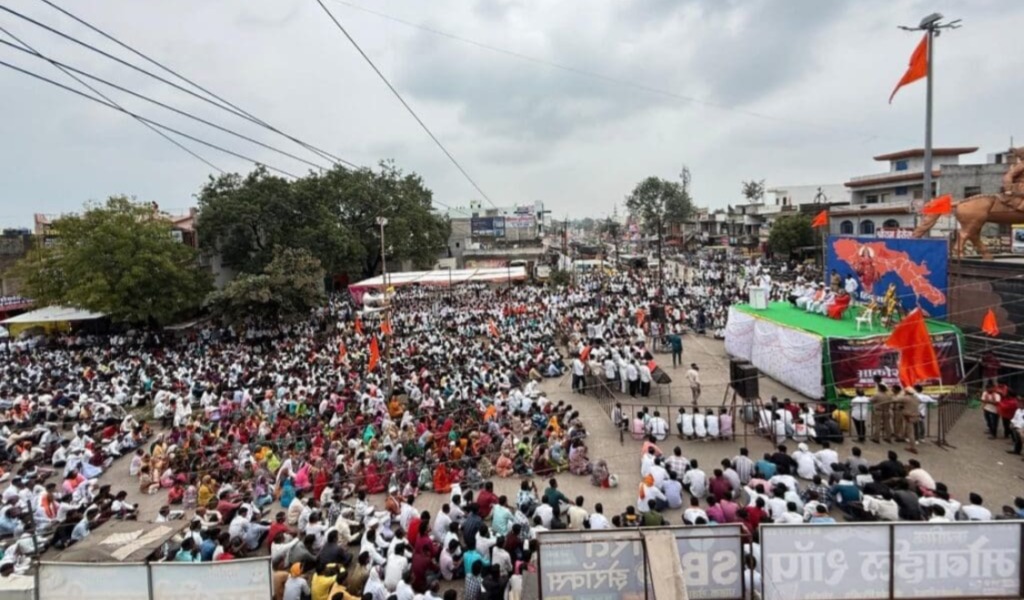
On Friday, thousands gathered at Chhatrapati Shivaji Chowk in Bhokardan under the banner of a “Hindu Jan Akrosh Morcha,” demanding a Special Investigation Team (SIT). Leaders such as Ratnagiri Maharaj, activist Sangram Bhandare, Ahilyanagar MLA Sangram Jagtap (NCP–Ajit Pawar faction), and Ambadas Ambhore addressed the rally, delivering speeches laced with communal rhetoric.
The incident has revived memories of past violence in the region. On March 23, 2023, Imam Zakir Sayyad Khaja of Anwa village was attacked in a mosque by unidentified assailants who forced him to chant “Jai Shri Ram.” When he refused, they slashed his beard with a blade.
In the wake of the current unrest, Muslim residents petitioned Additional Superintendent of Police Ayush Nopany, demanding legal action against right-wing activists who, they alleged, “abused Muslims and vitiated the atmosphere.” Former MP Imtiyaz Jaleel also condemned the hate-filled speeches, urging police not to bow to political pressure and to act firmly against those inciting communal discord.
Let the Truth be known. If you read VB and like VB, please be a VB Supporter and Help us deliver the Truth to one and all.
It's govt's responsibility to support youth who dare to dream: Omar Abdullah
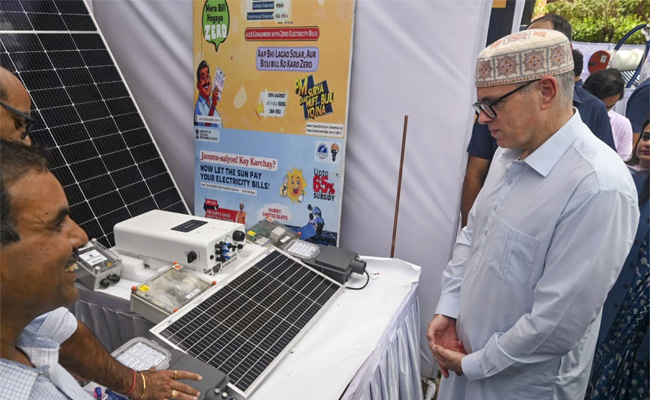
Jammu (PTI): Jammu and Kashmir Chief Minister Omar Abdullah on Monday said the government may not be able to provide jobs to everyone, but it can create an ecosystem for youngsters to become entrepreneurs and innovators.
It is the responsibility of the government to support youth who dare to dream, he said.
After inaugurating the 11th National Conference and Exhibition on Emerging and Innovative Trends in Engineering Technology (NCEEITET) at the Government College of Engineering and Technology (GCET) in Jammu, Abdullah said, “We may not be able to provide jobs to everyone, but we can certainly create an environment where our youngsters become entrepreneurs and innovators.”
The two-day conference is being organised by the GCET in collaboration with the Indian Institute of Technology-Kharagpur and the World University Consortium (WUC).
Addressing the gathering, Abdullah assured that all necessary steps would be taken to strengthen infrastructure and support systems at the GCET, ensuring that it continues to evolve as a premier institution.
The chief minister also inaugurated a new building for the School of Architecture in the college, built at Rs 19.71 crore.
Stressing the need to balance modernity with the region’s cultural and historical identity, Abdullah said, “Not every building needs to be made of glass and steel. Our structures must reflect our heritage and preserve our cultural ethos.”
Highlighting the role of emerging technologies such as artificial intelligence and machine learning, Abdullah said they could significantly improve tourism management, visitor experience and service delivery in Jammu and Kashmir.
However, he cautioned that technological advancement should complement human effort rather than replace jobs, especially in a region where unemployment remains a concern.
The chief minister said that attracting tourists to Jammu and Kashmir was not difficult, but ensuring repeat visits required consistently enriching experiences and better infrastructure across tourism segments, including pilgrimage, border and leisure tourism.
To address the infrastructure gaps in the college, Abdullah announced that funds would be provided this year for the construction of an auditorium.
He also assured support for setting up an incubation centre in GCET.
During the event, Abdullah also released the e-proceedings of the conference, comprising 28 shortlisted research papers.