Terrorists don't play by rules, so country's response to them can't have rules: Jaishankar
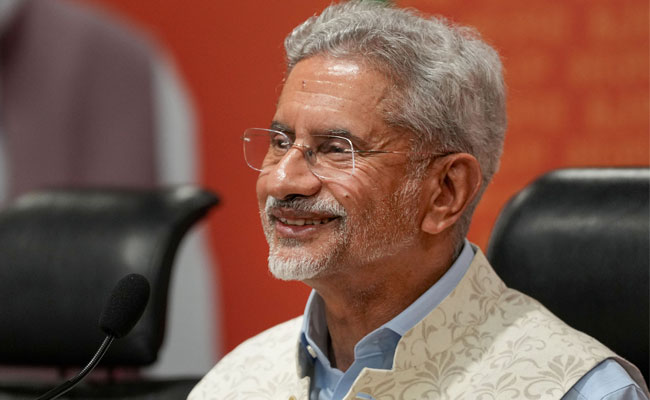
Pune (PTI): External Affairs Minister S Jaishankar has said that India was committed to respond to any act of terrorism perpetrated from across the borders, and asserted that since terrorists do not play by rules, there cannot be any rules in the country's answer to them.
Attacking the United Progressive Alliance (UPA) dispensation over its response to the 26/11 Mumbai terror attacks in 2008, he said that after a lot of deliberation at the government level, nothing fruitful came out at that time as it was felt that the cost of attacking Pakistan was more than not attacking it.
Interacting with youth on Friday at an event titled 'Why Bharat Matters: Opportunity for youth and participation in global scenario' here, he asked that if a similar attack happens now and one does not react to it, how can the next such attacks be prevented.
Jaishankar also said that the country's foreign policy has undergone a change since 2014 and it is the way terrorism is dealt with.
When asked about countries with which India finds it challenging to maintain relationships, Jaishankar said India should question whether it should maintain any relationship with certain countries.
"Well, one is just next to us. Let us be honest, the one country that is very, very difficult is Pakistan, and for that, we should only introspect why. One reason for this is us," he said.
He added that had India been clear from the start that Pakistan was indulging in terrorism, which India should not tolerate under any circumstances, the country would have had a vastly different policy.
"In 2014, Modi ji came. But this problem (terrorism) did not start in 2014. It did not begin with the Mumbai attack. It happened in 1947. In 1947, the first people (invaders) came to Kashmir, they attacked Kashmir. It was an act of terrorism. They were burning down villages and towns. They were killing people. These people were tribals from Pakistan's North-West Frontier Province. The Pakistan army backed them. We sent the army, and the integration of Kashmir took place," Jaishankar said.
"While the Indian army was taking action, we stopped in the middle and went to the UN, mentioning that the attack was by tribal invaders instead of terrorism, as if it was a legitimate force," he said.
He added that in the 1965 Indo-Pak war, Pakistan first sent infiltrators to sabotage.
"We have to be very clear in our minds about terrorism; under no circumstances is terrorism acceptable from any neighbour or from anyone who uses terrorism to force you to sit at the negotiating table. This should never be accepted," he said.
He mentioned that sometimes he is asked about the continuity in India's foreign policy and he responds clearly that there is 50 per cent continuity and 50 per cent change.
"One change is regarding terrorism. After the 26/11 Mumbai attack, there was not a single person in the country who felt that we should not have responded to the attack. Everybody in the country felt it. There is an account of that time. The NSA had written that this minister looked at it, that minister looked at it. Everybody deliberated, a lot of analysis took place, and then it was decided that the cost of attacking Pakistan is more than not attacking Pakistan. So after a lot of deliberation, nothing fruitful came out," he said.
He emphasized that if something like Mumbai happens and you do not react to it, how can you prevent the next one from happening? "They (terrorists) should not feel that since they are across the border, no one can touch them. Terrorists do not play by any rules. The response to terrorists cannot have any rules," he said.
Let the Truth be known. If you read VB and like VB, please be a VB Supporter and Help us deliver the Truth to one and all.
AI, IndiGo, SpiceJet seek ATF price relief; say airline industry on verge of 'stopping operations'
Mumbai (PTI): Air India, IndiGo and SpiceJet have told the government that the country's airline industry is under extreme stress and on the verge of "stopping operations", as they sought revision in ATF pricing and financial support.
The West Asia turmoil has pushed up oil prices, and airspace restrictions have increased airlines' operating costs, especially on long-haul routes. Aviation Turbine Fuel (ATF) accounts for around 40 per cent of a carrier's operational expenses.
Against this backdrop, the Federation of Indian Airlines (FIA) has written to the civil aviation ministry, seeking steps to extend the same fuel pricing mechanism uniformly across both domestic and international operations as was done in the past with the establishment of the crack band.
ALSO READ: Tharoor junks Rijiju's claim that he agreed Cong is 'anti-women'; hails his party
With an unprecedented rise in jet fuel prices and exorbitant crack/differential between crude and ATF, the federation said the operation of airlines is being challenged in totality.
"... any ad hoc pricing (domestic vs international) and/or irrational increase in the price of ATF will result in unsurmountable losses for airlines and will lead to grounding of aircraft, resulting in cancellation of flights," the federation, which represents Air India, IndiGo and SpiceJet, said.
"In order to survive, sustain and continue operation, we request your urgent intervention for immediate and meaningful financial support to tide over the current situation," it said in a letter on April 26.
Also, the airlines have sought temporary deferment of excise duty on ATF, which is at 11 per cent.
"With the abnormal increase in ATF prices from the pre-crisis period, adding rupee depreciation to the increased prices, the 11 per cent excise duty also increases manifold for the airlines and adds to the ATF price as a big impact on airlines," they said.
Last month, the government limited the hike in ATF price to Rs 15 per litre for domestic operations, but for international operations, the price rose by Rs 73 per litre.
The airlines said the situation has practically made international operations, along with domestic operations, completely unviable and resulted in significant losses for the aviation sector in April.
Seeking urgent intervention on the current ATF ad hoc pricing, FIA said the current situation is creating a severe imbalance in domestic and international operations and rendering airline networks unviable and unsustainable.
"The airline industry in India is under extreme stress and is on the verge of closing down or of stopping its operations."
The federation has pitched for a transparent pricing framework under the crack band mechanism (USD 12–22/BBL) that was implemented in October 2022, saying there was a fair and reasonable margin for Oil Marketing Companies (OMCs).
According to FIA, the country's largest aviation hub Delhi has the second-highest value-added tax (VAT) of 25 per cent on jet fuel, while the highest rate is 29 per cent levied in Tamil Nadu.
"The other major aviation cities, viz. Mumbai, Bangalore, Hyderabad, and Kolkata range between 16 per cent and 20 per cent. These 6 cities cover more than 50 per cent of airlines' operations within India," the federation said.