Tharoor urges Kerala govt to swiftly resolve Waqf land dispute in Munambam
_vb_65.jpeg)
Kochi (PTI): Congress MP Shashi Tharoor urged the Kerala government on Thursday to act swiftly in resolving the Waqf land dispute in Munambam.
He also appealed to the government not to turn it into a communal issue.
Residents in Cherai and Munambam in Ernakulam district allege that the "Waqf Board has been unlawfully claiming" their land and property, despite them holding registered deeds and land tax receipts.
Protesters from Munambam village have urged Kerala Chief Minister Pinarayi Vijayan to find a lasting solution to their ongoing land dispute with the Waqf Board.
Interacting with reporters after visiting the locals who have been on a hunger strike for the past 96 days, Tharoor said, "It's not a Muslim-Christian issue, it's a technical-legal issue and should be resolved in that way."
"So let's not make it a communal conflict. It's an administrative, legal confusion which should be clarified in the earliest possible moment," he said while urging the state government to act immediately to resolve the issue.
The MP from Thiruvananthapuram said, "My appeal is no one should wait much more and the state government should not delay in establishing the facts on file what is happened."
"Whatever judicial process has already begun should be expeditiously concluded so that these people should get their lands," he added.
Responding to RSS chief Mohan Bhagwat's remark that India got "true independence" after the Ram temple consecration, Tharoor said, "Independence was won with a lot of sacrifices and hard work of a lot of people in our minds, starting with Mahatma Gandhi, the father of our nation."
Bhagawat may have several other ways of being happy in his political career or political interests but it's not the right category in which it was discussed, he added.
How can any responsible Indian denigrate the achievements of freedom fighters who have given their lives in several cases as well as their freedom in British jails to fight for the freedom that we take for granted today, he posed.
Welcoming the Israel-Hamas ceasefire deal, the former union minister said, durable and permanent peace should be established.
Let the Truth be known. If you read VB and like VB, please be a VB Supporter and Help us deliver the Truth to one and all.
Massive turnout in assembly polls across states, women voters outnumber men: EC data
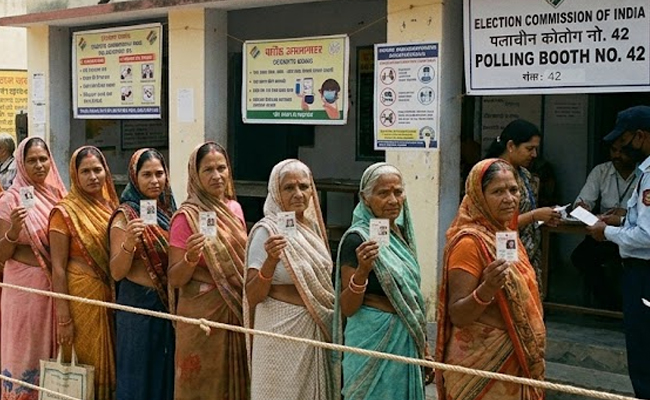
New Delhi (PTI): The recently-concluded assembly elections witnessed exceptionally high voter participation across states, with women voters outnumbering men in turnout percentages, according to Election Commission data.
West Bengal recorded the highest voter turnout among states, with 93.71 per cent polling in 293 constituencies where counting has been completed. The state saw over 6.38 crore votes cast, including postal ballots, against a total of more than 6.81 crore electors.
Women voters recorded a turnout of 93.8 per cent in the West Bengal Assembly polls, slightly higher than the 92.06 per cent participation among men.
The data for West Bengal does not include the figures for the Falta assembly constituency, which is scheduled for repolling.
Tamil Nadu registered an 85.01 per cent turnout, with nearly 4.8 crore votes polled from an electorate of 5.74 crore. Women voters recorded a turnout of 86.2 per cent, higher than the 83.77 per cent among men.
Assam also witnessed robust participation, with the final turnout touching 85.74 per cent. More than 2.15 crore votes were cast in the state, while female turnout at 86.53 per cent marginally exceeded the 84.95 per cent recorded among male voters.
Kerala registered a turnout of 78.11 per cent, with over 2.12 crore votes polled. Female voter participation stood at 81.17 per cent against 74.9 per cent among men.
Puducherry recorded a turnout of 89.82 per cent, with women voters again leading participation at 91.39 per cent. More than 8.5 lakh votes were polled in the Union territory.
Yet, women's representation among elected candidates remained modest.
Tamil Nadu elected 23 women MLAs (9.83 per cent) out of 234 members, West Bengal elected 37 women legislators (12.62 per cent) out of 293, while Kerala returned only 11 women MLAs (7.85 per cent) in the 140-member House.
Only two third-gender candidates contested the elections - one each from Tamil Nadu and Kerala, and both lost, forfeiting their deposits.
The elections also reflected extensive electoral mobilisation infrastructure. West Bengal had the highest number of polling stations at 85,092, followed by Tamil Nadu with 75,064 and Assam with 31,490.
In terms of candidates, Tamil Nadu saw the largest contest with 4,023 candidates in the fray across 234 constituencies, averaging 17 candidates per seat and peaking at 79 contestants in one constituency.
West Bengal pitted 2,920 candidates for 293 constituencies, while Kerala had the fewest contestants among the major states, with 883 candidates for 140 seats.
The data also showed relatively low NOTA votes across states. Tamil Nadu recorded the lowest NOTA share at 0.4 per cent of total votes polled, while Assam recorded the highest at 1.23 per cent. In West Bengal, 0.78 per cent of the total votes polled were NOTA, while it 0.77 per cent and 0.57 per cent of the electorate opted for None of the Above (NOTA) in Puducherry and Kerala, respectively.