There can't be universal policy on right to protest: SC in anti-CAA blockade case
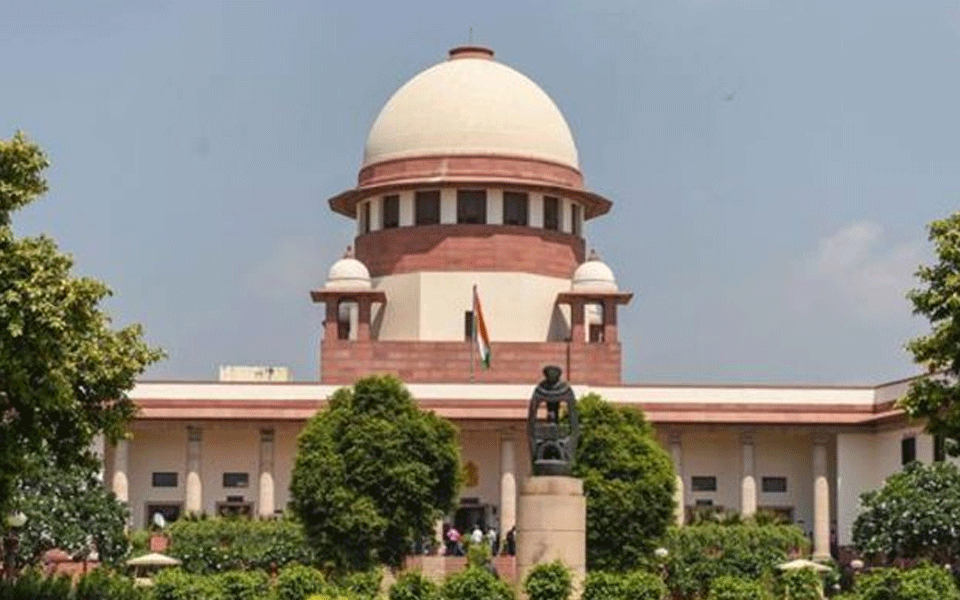
New Delhi: There cannot be a "universal policy" on right to protest and possible curbs as also balancing it with acts like blocking of roads are needed because the situation may "vary" from case-to-case, the Supreme Court said on Monday.
The top court's observation came while reserving the verdict on a batch of pleas against the anti-CAA protests which had led to blocking of a road in Shaheen Bagh in the national capital last December.
The situation normalized later due to COVID-19 pandemic fear and subsequent observance of protocol.
"There were some supervening circumstances which came into play and it was no one's hand. God almighty itself intervened," said a bench comprising Justices S K Kaul, Aniruddha Bose and Krishna Murari.
Taking note of the submissions of lawyers including Shashank Deo Sudhi, the bench said: "We have to balance right to protest and the blocking of roads. We have to deal with the issue. Their cannot be universal policy as the situation may vary on case to case basis.
"In parliamentary democracy protest can happen in Parliament and on roads but on road it has to be peaceful".
Amit Sahni, one of the lawyers who had filed the plea in the case, said that this kind of protests should not have been allowed in the larger public interest.
"This was allowed to have continued for more than 100 days and people faced difficulty. This kind of incident should not have happened. Yesterday in Haryana there was 'Chakka Jam' in Haryana. They have also called Bharat Bandh on September 24-25," he said.
Advocate Mehmood Pracha, appearing for an intervenor, said that there was a right to peaceful protest and "some people from a political party went and their created riots".
"We have the right to protest. State machinery is not sacrosanct. Members of a political party went there with the police and created the situation," he said.
Reserving the verdict, the bench said that it had appointed "interlocutors" as an experiment and they had suggested some measures which can be looked into.
It said that the experiment of sending interlocutors may or may not have succeeded and the have been COVID-19 situation may also have an effect on the situation.
Solicitor General Tushar Mehta, appearing for the Centre, said that the Right to protest cannot be absolute and their are some judgements to this affect.
The top court had earlier heard the pleas, filed by Sahni, former BJP MLA Nand Kishore Garg and Ashutosh Dubey, against the anti-CAA protests at Shaheen Bagh after the February 8 Delhi assembly elections.
Sahni had approached the high court seeking directions to Delhi Police to ensure smooth traffic flow on the Kalindi Kunj-Shaheen Bagh stretch, which was blocked by anti-CAA protesters on December 15
The high court had urged local authorities to deal with the situation keeping in mind law and order. Sahni has filed a special leave petition in the apex court against the high court's order.
The plea has sought directions to the police to ensure smooth traffic flow on Kalindi Kunj-Shaheen Bagh stretch.
It has sought supervision of the situation in Shaheen Bagh, where several women are sitting on protest, by a retired Supreme Court judge or a sitting judge of the Delhi High Court in order to circumvent any violence.
Separately, Garg, through his counsel Shashank Deo Sudhi, had filed a petition in the Supreme Court seeking directions to authorities to remove the protestors from Shaheen Bagh.
Restrictions had been imposed on the Kaindi Kunj-Shaheen Bagh stretch and the Okhla underpass, which were closed on December 15 last year due to the protests against the CAA and the National Register of Citizens (NRC).
The plea of Gaeg has said that various other arterial roads of Delhi have been facing traffic congestion due the protest at Shaheen Bagh.
Saying that the law enforcement machinery has been "held hostage to the whims and fancies of the protesters," the plea has sought laying down of guidelines for protests leading to obstruction of public place.
"It is disappointing that the state machinery is muted and a silent spectator to hooliganism and vandalism of the protesters who are threatening the existential efficacy of the democracy and the rule of law and had already taken the law and order situation in their own hand," the plea said.
It said the Shaheen Bagh protest is "undoubtedly within the constitutional parameter" but it has lost its legality as constitutional protection were being "blatantly and brazenly flouted and violated".
The state has a duty to protect the fundamental rights of its citizens, who have been facing trouble due to the road blockade, it said.
"Hence, it is urgently required that the public places must not be allowed to be abused and misused for ulterior and mala fide purposes such as staging protest against the constitution amendment in the heart of the capital city and thereby causing incalculable hardships and difficulties to the common people," it said.
Let the Truth be known. If you read VB and like VB, please be a VB Supporter and Help us deliver the Truth to one and all.
AIITA welcomes Karnataka’s ban on obscene songs in school events

Bhatkal: The Karnataka unit of the All India Ideal Teachers Association (AIITA) has welcomed the Karnataka government’s decision to strictly ban school children from dancing to obscene songs during educational and cultural programmes in government, aided, and private schools across the state.
AIITA Karnataka State President M. R. Manvi congratulated the government for taking what he termed an important step to preserve the sanctity of education.
“Such decisions to safeguard the dignity of school children and uphold the values of education are the need of the hour. This rule should not be limited to government schools alone but must be strictly implemented in all private educational institutions as well,” he said.
He further urged the government to address other concerns within school programmes.
“The government should not only prohibit obscene dances in the name of school anniversaries, but also ensure that plays and dialogues that incite religious hatred are avoided. Schools should be centres of harmony, not platforms for spreading hatred,” he added.
According to a recent circular issued by the Department of School Education and Literacy, obscene dances are adversely affecting the mental health and moral values of students.
In this regard, schools have been advised to use songs that promote nationalism, positive thinking, the greatness of Kannada culture, and value-based traditions instead of inappropriate content during programmes.
The circular also emphasises that students should be dressed in decent attire.
AIITA also backed the department’s warning that disciplinary action would be taken against head teachers if such guidelines are violated. The association has further demanded that district Deputy Directors of Public Instruction strictly monitor the implementation of these rules.