Third journalist of Noida-based TV channel held for "defamatory content" against Adityanath
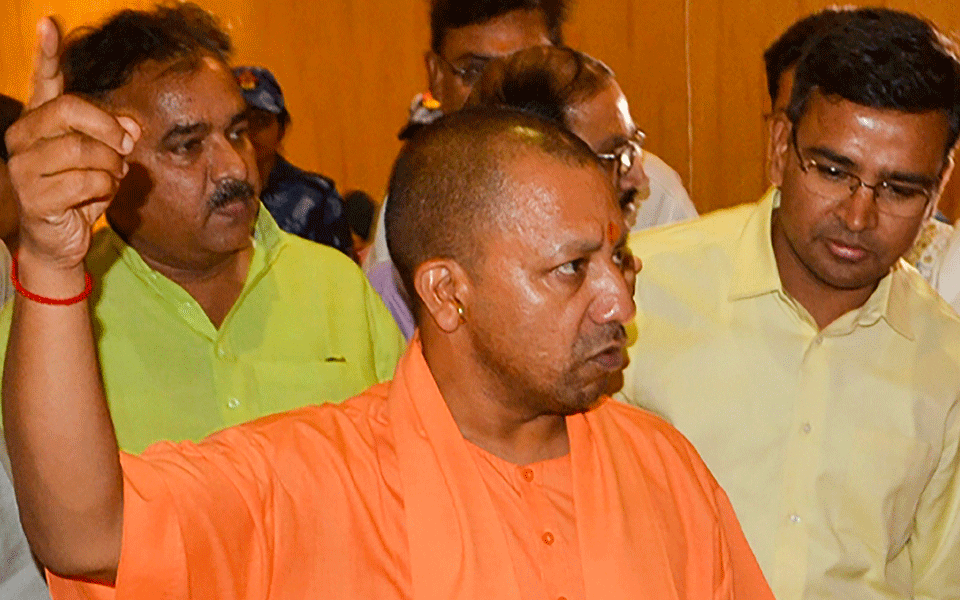
Noida (UP): Another journalist at a Noida-based TV channel has been arrested allegedly over defamatory content against Uttar Pradesh Chief Minister Adityanath, said officials.
Nation Live editor Anshul Kaushik was arrested Monday night and remanded in 14-day judicial custody Tuesday on the same charges as the channel head Ishika Singh and editor Anuj Shukla.
During a debate on the channel on June 6, a woman had allegedly made defamatory statements against Adityanath.
"Editor Anshul Kaushik of Nation Live was arrested last night and produced in the district and sessions court in Surajpur, Gautam Buddh Nagar. The court has remanded him in 14-day judicial custody," a police officer privy to the probe told PTI requesting anonymity.
"One more editor of the channel is absconding and police are on the lookout for him as well," the officer said.
This is the third arrest in the case in which the district administration and the police themselves had taken cognizance to lodge two FIRs and also reported the matter to the Union Ministry of Information and Broadcasting after it emerged during the probe that the Noida-based news channel did not have the requisite licence to operate.
Ishika Singh and Anshul Shukla were arrested on June 8 and remanded in a 14-day judicial custody, two days after the channel allegedly aired the controversial content defaming Adityanath without verifying its authenticity , the officials said.
Two persons were arrested Monday in Uttar Pradesh's Gorakhpur district for allegedly posting objectionable comments on social media against the chief minister.
On Tuesday, observing that the right to liberty is "sacrosanct and non-negotiable", the Supreme Court had ordered that journalist Prashant Kanojia, arrested for allegedly sharing objectionable posts on Adityanath, be immediately released on bail.
Anshul Kaushik was arrested under Sections 153 (promoting enmity between different groups), 501 (printing or engraving matter known to be defamatory), 505 (1) (whoever makes, publishes or circulates any statement, rumour or report) and 505 [2] (statements conducing to public mischief), the officials said.
An additional complaint over the illegal operation of the channel was made by the district additional director, information, at the Phase 3 police station following which an FIR under Sections 420 (fraud), 467 (forgery of documents) and related offences was registered, police said.
Police had on Sunday sealed the premises of the channel in Block B of Sector 65 amid protests by social activists and the Editors Guild of India, which described the episode an attempt to "intimidate" the press and "stifle the freedom of expression".
Responding to the criticism over the arrest of the journalists, District Magistrate Brajesh Narain Singh had told reporters on Monday that there were no directions from the state government for action and the administration had taken a note of it on its own.
"There is a report in a section of media that it is a case of defamation, but it is not only about defamation. It is about nuisance which has a larger impact on the public order, peace and tranquillity, the DM said.
I request the media for a deeper and not superficial analysis of the episode and see that if the district administration is trying to prevent such incidents, it is based on merit and is correct," Singh said.
"It was a fake and unauthorised channel, so there is sufficient ground for action," the DM said.
SSP Vaibhav Krishna during the same press conference had said, "The incident could have created a law and order situation, a riot-like situation, hence, filing FIRs and arresting the duo were needed and during the probe it also emerged that they did not have the requisite licence for operating a TV news channel."
"We are not trying to regulate anything. Let it be very clear," the district police chief had said.
Let the Truth be known. If you read VB and like VB, please be a VB Supporter and Help us deliver the Truth to one and all.
Massive turnout in assembly polls across states, women voters outnumber men: EC data
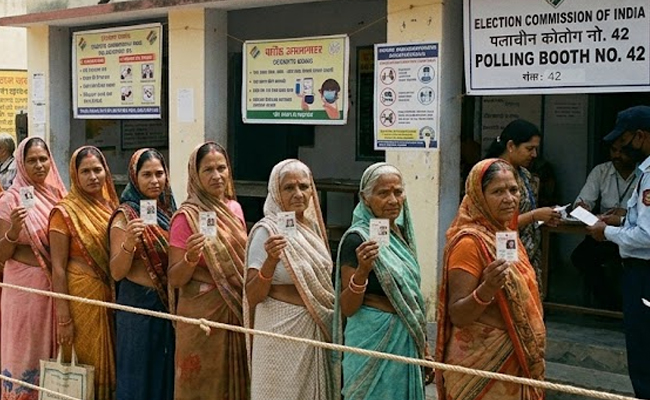
New Delhi (PTI): The recently-concluded assembly elections witnessed exceptionally high voter participation across states, with women voters outnumbering men in turnout percentages, according to Election Commission data.
West Bengal recorded the highest voter turnout among states, with 93.71 per cent polling in 293 constituencies where counting has been completed. The state saw over 6.38 crore votes cast, including postal ballots, against a total of more than 6.81 crore electors.
Women voters recorded a turnout of 93.8 per cent in the West Bengal Assembly polls, slightly higher than the 92.06 per cent participation among men.
The data for West Bengal does not include the figures for the Falta assembly constituency, which is scheduled for repolling.
Tamil Nadu registered an 85.01 per cent turnout, with nearly 4.8 crore votes polled from an electorate of 5.74 crore. Women voters recorded a turnout of 86.2 per cent, higher than the 83.77 per cent among men.
Assam also witnessed robust participation, with the final turnout touching 85.74 per cent. More than 2.15 crore votes were cast in the state, while female turnout at 86.53 per cent marginally exceeded the 84.95 per cent recorded among male voters.
Kerala registered a turnout of 78.11 per cent, with over 2.12 crore votes polled. Female voter participation stood at 81.17 per cent against 74.9 per cent among men.
Puducherry recorded a turnout of 89.82 per cent, with women voters again leading participation at 91.39 per cent. More than 8.5 lakh votes were polled in the Union territory.
Yet, women's representation among elected candidates remained modest.
Tamil Nadu elected 23 women MLAs (9.83 per cent) out of 234 members, West Bengal elected 37 women legislators (12.62 per cent) out of 293, while Kerala returned only 11 women MLAs (7.85 per cent) in the 140-member House.
Only two third-gender candidates contested the elections - one each from Tamil Nadu and Kerala, and both lost, forfeiting their deposits.
The elections also reflected extensive electoral mobilisation infrastructure. West Bengal had the highest number of polling stations at 85,092, followed by Tamil Nadu with 75,064 and Assam with 31,490.
In terms of candidates, Tamil Nadu saw the largest contest with 4,023 candidates in the fray across 234 constituencies, averaging 17 candidates per seat and peaking at 79 contestants in one constituency.
West Bengal pitted 2,920 candidates for 293 constituencies, while Kerala had the fewest contestants among the major states, with 883 candidates for 140 seats.
The data also showed relatively low NOTA votes across states. Tamil Nadu recorded the lowest NOTA share at 0.4 per cent of total votes polled, while Assam recorded the highest at 1.23 per cent. In West Bengal, 0.78 per cent of the total votes polled were NOTA, while it 0.77 per cent and 0.57 per cent of the electorate opted for None of the Above (NOTA) in Puducherry and Kerala, respectively.