Jammu (PTI): Jammu and Kashmir Deputy Chief Minister Surinder Choudhary on Wednesday said those who set up industries in Jammu and Kashmir will have to provide employment to local youth in the region.
Crediting previous National Conference governments for industrial development in Jammu and Kashmir, he said Chief Minister Omar Abdullah is committed to industrial development in Jammu and Kashmir but that will not be at the cost of the people.
"Those (investors) who will set up industries in Jammu and Kashmir will have to provide employment to local youth in the region," Choudhary said while replying to supplementary questions during the Question Hour in the Assembly here.
He said the Omar Abdullah government is committed to ensuring no injustice to the people of Jammu and Kashmir.
"It is the commitment of the Omar Abdullah government. The industrial estates, whether in Kashmir, Jammu, Gangyal, or any other place, were set up during National Conference rule. The Chief Minister is committed to industrial development in Jammu and Kashmir but that will not be at the cost of the people," he said.
Replying to a question from BJP MLA Rajiv Jasrotia, the Deputy Chief Minister further said, "It is the endeavour of this government that we will not allow the lands of the people of J&K to be given to outsiders. Whatever is right will be done."
He said the local youth have a right to jobs in industries.
The deputy chief minister said soon after the formation of the government, Chief Minister Omar Abdullah held meetings with various stakeholders in the industrial sector. "It is a fact that the local industry faced losses during the past 10 years. Nothing was done for the employment of local youth. We are committed to changing that," he added.
Choudhary said the key highlights of the Jammu and Kashmir Industrial Policy 2021-30 aim to bolster industrial growth across various sectors, focusing on manufacturing, IT, agriculture, food processing, healthcare, pharmaceuticals, infrastructure, real estate, herbal and medicinal plants, among other sectors notified by the Jammu and Kashmir government.
He said the incentives under the policy include a 100 per cent subsidy for the purchase and installation of DG sets (up to Rs 45 lakh), exemption of stamp duty and court fees on land transactions in government industrial estates.
He further said other incentives include a 25 per cent subsidy on automation, a 30 per cent subsidy on procuring and obtaining machinery, a quality certification subsidy, a 60 per cent subsidy for the purchase and installation of pollution control devices, and a 50 per cent subsidy on the total cost incurred on environment-friendly production technology expenditures.
"Besides this, there is a 100 per cent net SGST reimbursement for eligible existing units registered under GST in Jammu and Kashmir as of March 31, 2021, for 10 years. The turnover incentives under the policy include 3 per cent for micro units and 2 per cent for small, medium, and large units for 5 years," he said.
Choudhary said a dedicated entrepreneur and skill development fund will be established to nurture local youth with entrepreneurial skills, facilitating sustained industrial growth in the Union Territory.
"This initiative will include training and skill development programmes conducted by the J&K Entrepreneurship Development Institute (JKEDI) and other premier institutes nationwide," he added.
On the ease of doing business, the Deputy Chief Minister said Jammu & Kashmir has undertaken significant initiatives to enhance the ease of doing business through the single-window setup under the Industrial Investments and Business Facilitation Act 2018.
"These reforms aim to streamline the regulatory framework, accelerate the grant of licences, permissions, approvals, and simplify procedural requirements," he said.
Regarding investment promotion and grievance redressal, he said the Jammu & Kashmir Trade Promotion Organization (JKTPO) will serve as the investment promotion agency, while industrial grievance forums will ensure effective grievance redressal under the supervision of the director.
On the central sector scheme and other initiatives, he said the Government of India has introduced the new central sector scheme 2021 with a financial outlay of Rs 28,400 crore for industrial development in Jammu and Kashmir, effective from April 1, 2021, to March 31, 2037.
Special provisions have been made to support women entrepreneurs, including reserved marks in land allotment criteria and benefits under the Prime Minister's Employment Generation Programme (PMEGP), Choudhary said.
The Deputy Chief Minister added that the department has granted several mining leases and permits for essential construction materials to support major infrastructure projects across the Union Territory.
Let the Truth be known. If you read VB and like VB, please be a VB Supporter and Help us deliver the Truth to one and all.
Sujit Nair raises concerns over speculation of DMK-AIADMK understanding to block TVK
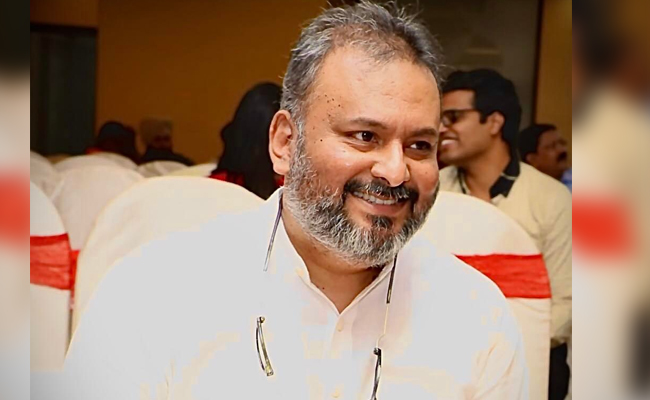
Chennai: Journalist and political commentator Sujit Nair has expressed concern over speculation that the Dravida Munnetra Kazhagam and the All India Anna Dravida Munnetra Kazhagam could explore a post-poll understanding to prevent Vijay-led Tamilaga Vettri Kazhagam from forming the government in Tamil Nadu.
In a social media post, Sujit Nair said the election verdict in Tamil Nadu reflected a clear public demand for political change and argued that the mandate should be respected irrespective of political preferences.
Referring to reports and political discussions surrounding a possible understanding between the DMK and AIADMK, he said he hoped such developments remained only speculative conversations and did not turn into reality.
Nair stated that if such an alliance were to take shape, it would raise serious questions about ideological politics in the country. He said TVK had emerged through a democratic electoral process and that the legitimacy to govern in a parliamentary democracy comes from the people’s verdict.
According to him, attempts to prevent an electoral winner from forming the government through unexpected political arrangements may be constitutionally valid, but many people could view them as politically opportunistic.
He further said that such a move could particularly affect the political image of the DMK, which has historically projected itself around ideology, social justice and opposition politics. Nair said that in ideological terms, the DMK appeared closer to TVK than to the AIADMK, and joining hands with its long-time political rival only to remain in power could weaken its broader political narrative.
He added that the same questions would apply to the AIADMK as well, as the party had spent decades positioning itself against the DMK and such an arrangement could create discomfort among its cadre and supporters.
Drawing a comparison with Maharashtra politics in 2019, Nair said he had expressed similar views when the Shiv Sena formed an alliance with the Indian National Congress and the Nationalist Congress Party after the Assembly elections.
He said post-poll alliances between long-standing political rivals often create a public perception that ideology and electoral mandates become secondary when political power equations come into play.
Nair also said such developments increase public cynicism towards politics and reinforce the belief among voters that ideology is often sidelined after elections.
He maintained that the Tamil Nadu verdict was emphatic and said respecting both the spirit and substance of the mandate was important for the credibility of democratic politics.