Those who don’t chant Bharat Mata should be killed in encounter: BJP MP's controversial statement

Hyderabad: The BJP national general secretary Bandi Sanjay made a controversial remark on Tuesday during the BJP’s rally held in Adilabad. The Karimnagar MP said that people who attacked Hindus in Bhainsa would be beaten and chased down the streets if BJP in Telangana comes to power, reports The News Minute.
Addressing the gathering at the Jana Garjana Sabha, the MP said, “Modi’s rule must come in Telangana, so that those who attacked Hindu society and created destruction in Bhainsa, and the people from AIMIM who raped minors, are stripped and chased down the streets.”
He added, “Those who are hoisting Pakistan flags instead of chanting Bharat Mata ki Jai should be killed in encounters and buried in Pakistan.”
The controversial remarks by the MP goes against the Model Code of Conduct, which states that “there shall be no appeal to caste or communal feelings for securing votes…”
He further referred to Adilabad as ‘Hindutva adda’ calling it the land of Komaram Bheem who fought against Nizam oppression. He compared Chief Minister K Chandrashekhar Rao with Nizam VIII and Amit Shah to Sardar Patel who will oust KCR just like Sardar Patel ousted Nizam.
Let the Truth be known. If you read VB and like VB, please be a VB Supporter and Help us deliver the Truth to one and all.
Efforts of party cadres will be rewarded on May 4: DMK chief Stalin
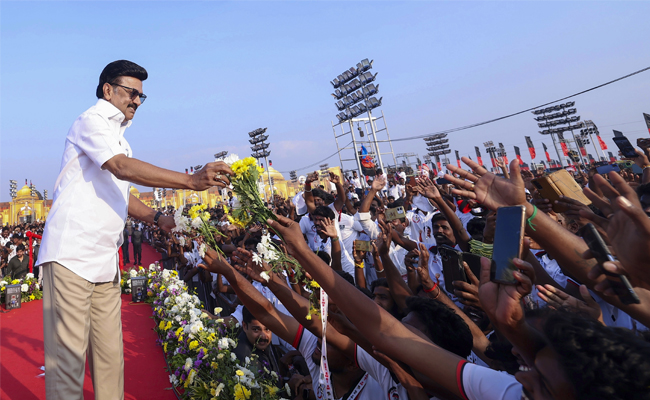
Chennai (PTI): Tamil Nadu Chief Minister M K Stalin on Friday said that the efforts made by his party cadres during the Assembly elections would be rewarded on May 4.
The counting of votes for the Assembly elections held on April 23 will be taken up on May 4.
"We are set to reap the rewards of the hard work put in by our party cadres on the coming fourth (May 4 counting day). There is absolutely no change in this and not even the slightest deviation," Stalin said at a May Day event here.
"There is no need for anyone to assume that I am speaking merely on the basis of exit polls," he added.
Stalin, who is also DMK chief, said that "good news" would come for those eagerly waiting for the election results.
Stating that the DMK governance is based on philosophy and principles, Stalin said, "This will continue."
He recalled the pivotal role of the then Chief Minister C N Annadurai, who first declared May Day as a government holiday, and subsequently, late CM M Karunanidhi, who was instrumental in extending it as a paid holiday across the nation.
"Responding to the request of Kalaingnar (Karunanidhi), the then Prime Minister V P Singh accepted the plea and declared it (May 1) a paid government holiday not merely for Tamil Nadu, but for the entire nation," Stalin said.