Thousands sleep outside in Nepal after earthquake kills at least 157 people and destroys most houses
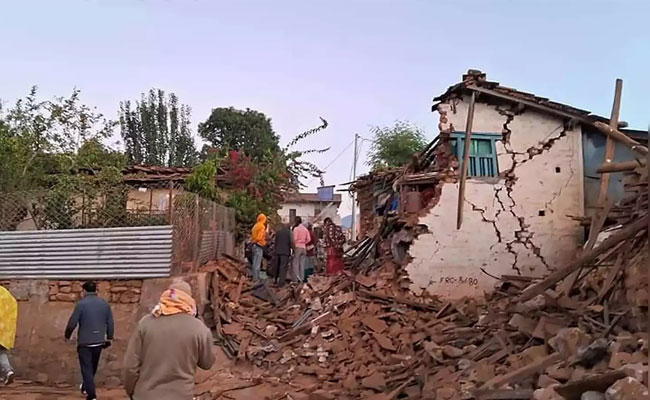
Kathmandu (AP): Thousands of villagers in the mountains of northwestern Nepal slept outdoors Saturday night in the bitter cold after an earthquake killed at least 157 people and damaged or destroyed most homes.
Most of the houses in villages in Jajarkot district either collapsed or were severely damaged by the sudden earthquake Friday night, while the few concrete houses in towns were also damaged.
"We are waiting to cremate the bodies of our villagers and have been trying to take care of the people who were injured in the earthquake," said Lal Bahadur Bika, a resident of Chiuri village, pointing to 13 bodies wrapped in white cloth awaiting cremation on Sunday morning.
Most houses in Chiuri village collapsed.
People used whatever they could find to set up shelter for the night, using plastic sheets and old clothes to keep them warm. Most people have been unable to retrieve their belongings from under the rubble.
Most of those killed were crushed by debris when their houses usually made by stacking rocks and logs crumbled under the force of the earthquake, local media reported.
While rescuers were scrambling to rush aid, operations were hampered by the fact that many of the mountainous villages could only be reached by foot. Roads were also blocked by landslides triggered by the earthquake. Soldiers could be seen trying to clear the blocked roads.
The government is trying to get aid to the affected areas, Deputy Prime Minister Narayan Kaji Shrestha said on Saturday. Tents, food and medicine were flown in as thousands became homeless overnight.
"I was fast asleep when all of a sudden it started shaking violently. I tried to run but the whole house collapsed. I tried escaping but half my body got buried in the debris," said Bimal Kumar Karki, one of the first people to be brought to the regional hospital.
"I screamed, but every one of my neighbors was in the same situation and screaming for help. It took nearly a half-hour to an hour before rescuers found me," he said.
Another injured man recovering in the hospital also described getting buried while he was asleep.
"I was asleep and around 10 or 11 at night it started shaking and the house caved. So many houses have collapsed and so many people have been buried," said Tika Ram Rana, who had his head wrapped in a white bandage.
Besides aid, rescuers were focused on finding survivors.
Local television aired footage of troops recovering bodies while others helped dig out and carry the injured.
Let the Truth be known. If you read VB and like VB, please be a VB Supporter and Help us deliver the Truth to one and all.
Rickelton's ton in vain as SRH beat MI by 6 wickets

Mumbai (PTI): Ryan Rickelton's whirlwind unbeaten ton was overshadowed by Heinrich Klaasen's unbeaten 65 as Sunrisers Hyderabad defeated Mumbai Indians by six wickets in an IPL match here on Wednesday.
Chasing an imposing 244-run target, Travis Head (76 off 30) and Abhishek Sharma (45 off 24) shared 129 runs for the opening wicket to set the platform for SRH.
Klaasen (65 not out off 30 balls) then displayed his all-round hitting abilities to guide SRH home with the help of Nitish Kumar Reddy (21) and Salil Arora (30 not out off 10) in 18.4 overs.
Earlier, Rickelton's knock powered MI to 243 for five.
MI rode on a 93-run stand between Rickelton (123 not out off 55 balls) and Will Jacks (46 off 22) in 7.1 overs for the opening stand to power the side.
MI skipper Hardik Pandya scored a valuable 31 off 15 balls before being dismissed.
Praful Hinge (2/54), Eshan Malinga (1/29), Sakib Hasan (1/39) and Nitish Kumar Reddy (1/31) were the wicket-takers for SRH.
Brief Scores:
Mumbai Indian: 243 for 5 in 20 overs (Ryan Rickelton 123 not out; Praful Hinge 2/54).
Sunrisers Hyderabad: 249 for 4 in 18.4 overs (Travis Head 76, Heinrich Klaasen 65 not out; AM Ghazanfar 2/51).