Three Singapore apex court judges share ceremonial benches at Bombay High Court
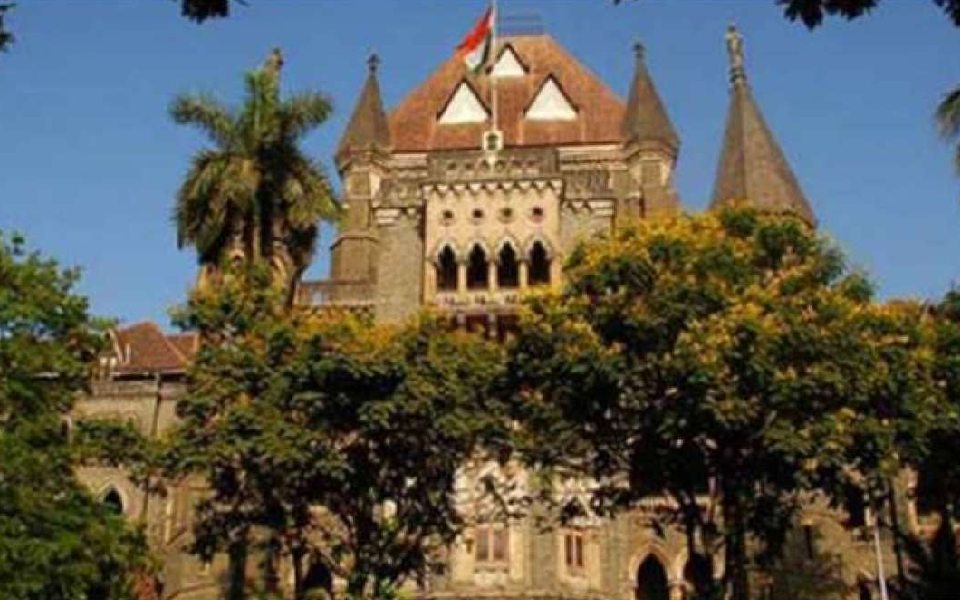
Mumbai, Sep 6: In a first, three judges from Singapore's Supreme Court, including its Chief Justice Sundaresh Menon, were part of Bombay High Court benches on Friday.
Chief Justice Menon of Singapore's Supreme Court shared a Ceremonial Bench with Bombay HC's Chief Justice Devendra Kumar Upadhyaya as well as Justices GS Kulkarni and Firdosh Pooniwalla in the historic central courtroom.
The bench briefly heard petitions challenging reservation granted to the Maratha community in Maharashtra.
Justice Ramesh Kannan of Singapore's apex court shared the bench with Justices Nitin Jamdar and MM Sathaye, while Justice Andre Francis Maniam from that nation shared the Ceremonial Bench with HC Justices KR Shriram and Jitendra Jain.
Welcoming Singapore's Chief Justice Menon before the court began proceedings, CJ Upadhyaya said, "I am very glad and happy to announce that amongst us today is the CJ of Singapore Supreme Court. He was here in Bombay in 2015. I welcome him once again."
Advocate General Birendra Saraf, appearing for the Maharashtra government, informed that the bench was assembled in a courtroom where the trial against freedom fighter Bal Gangadhar Tilak was held and where he was convicted.
"Chief Justice Menon shares ideas similar to our own Chief Justice of India (D Y Chandrachud) regarding collaboration of ideas between Singapore and India," Saraf said.
Senior counsel Pradeep Sancheti, appearing for the petitioners in the Maratha reservation issue, said the reservation decision was arbitrary and illegal.
The bench heard the matter briefly. Before leaving, CJ Menon bowed and thanked everyone present in court.
Let the Truth be known. If you read VB and like VB, please be a VB Supporter and Help us deliver the Truth to one and all.
Bengaluru airport introduces AI-based system to enhance safety at vehicle-aircraft intersections
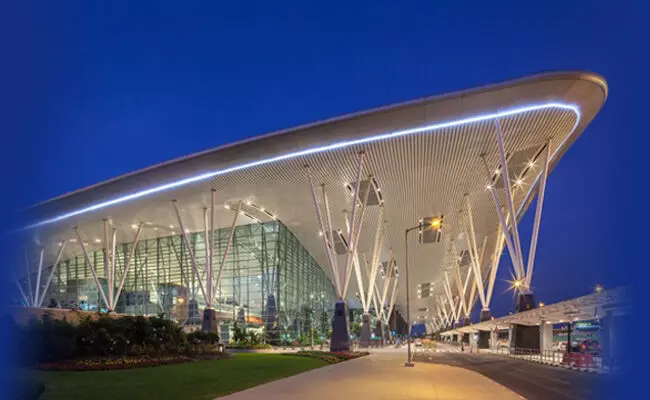
Bengaluru: Bangalore International Airport Limited (BIAL) has introduced an integrated smart airside safety system at Kempegowda International Airport to improve operational safety at key intersection zones.
According to The Hindu, the system has been designed to enhance safety at Cross Service Roads (CSRs), where aircraft and ground vehicle movements intersect.
According to BIAL, the system integrates AI-based computer vision, automation, and centralised monitoring to manage right-of-way movements and reduce the risk of human error.
“CRSs are among the most sensitive areas within airport operations, requiring precise and seamless coordination between aircraft and ground vehicles. Traditionally, right of way protection at these intersections relied on manual or semi-manual inset light activation, creating dependencies on human intervention, increasing the risk of delays and limiting operational visibility,” TH quoted BIAL as saying.
The new system uses real-time detection of vehicle movement, risk assessment, and automated signalling. AI-enabled cameras identify potential conflicts and trigger automated inset light signals to ensure aircraft priority. Normal operations resume once the area is confirmed clear.
“Based on these detections, the system triggers automated inset light activation to protect aircraft right‑of‑way and restores normal signalling once the intersection is confirmed clear. A centralised monitoring and analytics platform digitally logs all events, strengthening governance, compliance, and operational control,” BIAL said.
By embedding technology into operations, the system creates a data-driven separation layer between aircraft and ground vehicles, significantly reducing human error, especially during night and low-visibility conditions.
“Precision-led signal activation improves traffic flow, minimises unnecessary stoppage and enhances turnaround efficiency. It also establishes a scalable foundation for predictive safety analytics, enabling trend analysis, peak-hour optimisation, compliance mapping and risk forecasting to support continuous improvement and stronger airside governance,” BIAL said.