Three TNM journalists win Ramnath Goenka awards
Udupi’s Prajwal Bhat among winners

The prestigious Ramnath Goenka Excellence in Journalism Awards for the year 2022 saw The News Minute's reporters Azeefa Fathima, Balakrishnan Ganesan, and Prajwal Bhat clinching top honors in two distinguished categories. Their exceptional journalistic endeavors were recognized at the awards ceremony held in New Delhi on Tuesday, March 19.
Azeefa, Balakrishnan, and Prajwal were lauded in the Civic Journalism category for their comprehensive five-part series shedding light on the pervasive issue of manual scavenging prevalent in India. Their in-depth investigation delved into the deplorable conditions faced by manual scavengers across five southern states, namely Telangana, Tamil Nadu, Andhra Pradesh, Kerala, and Karnataka.
The series critically examined the role of district administrations in tackling this grave social problem, scrutinizing measures implemented to eradicate the practice. Supported by data obtained through the Right to Information Act, the reports assessed the effectiveness of governmental interventions, including expenditure on machinery and equipment to minimize human intervention in sanitation work, identification and rehabilitation of former manual scavengers, and provision of compensation to the families of victims.
In addition to their commendable work in civic journalism, Prajwal Bhat, who hails from Udupi, received individual recognition in the Political Reporting category for his remarkable series on the 2022 hijab agitations in Karnataka. Prajwal's reporting provided comprehensive coverage of the controversy that erupted in a government college in Udupi district. He documented the sequence of events, including detailed interviews with students at the heart of the protests and investigations into the involvement of various groups. Prajwal's series not only reported on the immediate protests but also analyzed the broader implications of the controversy on education and communal harmony in the region.
Prajwal's dedication to investigative journalism was underscored by his four-month stint in Udupi for sustained reportage on the hijab controversy, where he uncovered the orchestrated nature of the protests and their impact on Muslim women's education. His series delved into the challenges faced by Muslim families and the threat posed to the educational progress of Muslim women in the region, highlighting the repercussions of the hijab controversy on enrollment patterns in pre-university colleges.
The award ceremony, attended by eminent personalities from the media fraternity, featured Nitin Gadkari, Minister for Road Transport & Highways, as the chief guest.
Let the Truth be known. If you read VB and like VB, please be a VB Supporter and Help us deliver the Truth to one and all.
Court can reject anticipatory bail but cannot direct accused to surrender: SC
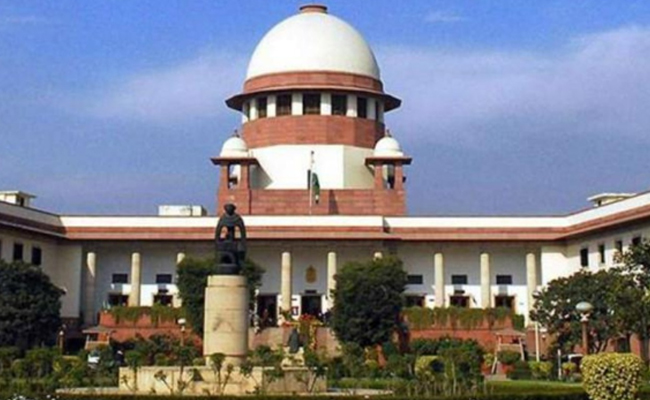
New Delhi (PTI): A court can reject anticipatory bail of an accused but it has no jurisdiction to direct him to surrender before the trial court, the Supreme Court has said.
A bench of Justices J B Pardiwala and Ujjal Bhuyan made the observation while hearing a plea filed by a man accused of cheating and forgery.
"If the court wants to reject the anticipatory bail, it may do so, but the court has no jurisdiction to say that the petitioner should now surrender," the bench said.
The Jharkhand High Court had rejected anticipatory bail plea of the accused and asked him to surrender and seek regular bail.
In this case, a complaint had been filed before a magistrate alleging offences under Sections 323 (voluntarily causing hurt), 420 (cheating), 467 (forgery of valuable security), 468 (forgery for purpose of cheating), 471 (using forged document) and 120B read with 34 of the IPC, in connection with a land dispute.
The high court had dismissed the second anticipatory bail application of the accused on the ground that no new circumstances were shown.
It had relied on its earlier order rejecting his first anticipatory bail plea, in which the court directed the petitioner to surrender before the trial court and seek regular bail in terms of the decision in Satender Kumar Antil v. CBI.
The top court said such a direction was wholly without jurisdiction and said that if a court chooses to reject anticipatory bail, it may do so, but it cannot compel the accused to surrender.