Three women killed in blast in illegal cracker unit in Bengal
Kolkata (PTI): Three women of the same family, including a minor, were killed and several persons were injured in a blast at an illegal firecracker manufacturing unit at Budge Budge, about 26 km from the city, police said.
The blast took place on Sunday evening at around 8.30 pm and the three killed are 65-year-old Jamuna Das, her daughter Pampa Ghati and her 10-year-old granddaughter Jayashree, the police said on Monday.
The area falls under South 24 Parganas district.
The incident was the second of its kind in West Bengal in a week.
The state government ordered a CID probe into the incident on Monday, a senior official confirmed.
The police official said that according to the preliminary investigation, the blast may have occurred from the fire of incense sticks lit in the 'puja room' on the terrace of the house, where it took place.
"It seems that the blast occurred after the explosives illegally stored in the house caught fire, which probably spread from incense sticks lit in the evening in the puja room located on the terrace of the house," he said.
At least 30 people, allegedly running illegal firecracker manufacturing units in the locality, were arrested and a large quantity of explosives stored in different houses were seized during police raids throughout the intervening night of Sunday and Monday, the police official said.
The number of injured in the blast was, however, not specified.
The three women were on the terrace of the single storied house where the incident took place.
"Three women, including a minor, were declared brought dead when they were taken to a nearby ESI hospital. All of them had suffered third degree burn injuries from a blaze which was reported from the terrace of their house, where an illegal firecracker factory was operated," a senior police officer of Diamond Harbour police district told PTI.
"We have conducted raids in the area and seized at least 20,000 kg of explosive materials used to manufacture firecrackers and arrested more than 30 people for their involvement in running such illegal businesses. Raids are on and police are investigating the cause of the fire," the officer said.
Contradicting the police, locals in the area claimed that the seized explosive materials were "purchased legally" and they are "license holders" for manufacturing firecrackers. "This is torturous. We are license holders for firecracker manufactures. We had purchased all the explosive materials seized by the police ... The police have wrongfully seized them. We are poor people and this will definitely ruin our livelihood," the owner of a firecracker manufacturing unit in the locality, Sajal Das said.
I Budge Budge area has a thriving fireworks industry and the now banned 'chocolate bomb' manufactured at Nungi near it was a popular firecracker during Diwali.
BJP leader Suvendu Adhikari mocked the state government after the blast and as in the case of the Egra blast, demanded an NIA probe into the incident. He also alleged that the state police had tampered with evidence in the night while conducting the raid.
On May 16 an explosion had taken place at an illegal firecracker manufacturing unit at Egra in Purba Medinipur district in which 12 people lost their lives.
The main accused in the Egra blast died at a hospital at Cuttack in Odisha on May 19.
Let the Truth be known. If you read VB and like VB, please be a VB Supporter and Help us deliver the Truth to one and all.
India, New Zealand ink free trade agreement
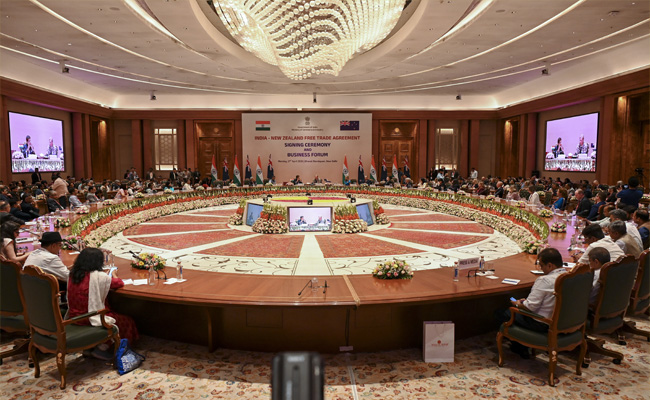
New Delhi (PTI): India and New Zealand on Monday inked a free trade agreement, aimed at boosting two-way commerce and investments.
The pact was signed by Commerce and Industry Minister Piyush Goyal and visiting New Zealand's Trade and Investment Minister Todd McClay.
The FTA provides duty-free access for 100 per cent of India's exports to New Zealand, covering all tariff lines or produce categories, and is expected to significantly boost MSMEs and employment by enhancing competitiveness in labour-intensive sectors such as textiles, apparel, leather, footwear, gems and jewellery, engineering goods, and processed foods.
Earlier, New Zealand maintained peak tariffs of up to 10 per cent on key Indian exports, including ceramics, carpets, automobiles, and auto components.
With zero-duty market access from entry into force as New Zealand's other trade partners, Indian products will be fully competitive in that country, enjoying a level playing field.
ALSO READ: Cal HC urges EC to dispose of TMC complaint over police observer's meeting with BJP nominee
Significantly, India also secured duty-free inputs for its manufacturing sector, including wooden logs, coking coal, and waste and scraps of metals, lowering production costs and enhancing the global competitiveness of the Indian industry.
On the other hand, India has offered tariff liberalisation on 70.03 per cent of tariff lines covering 95 per cent of bilateral trade value, while keeping 29.97 per cent of tariff lines excluded to protect India's sensitive sectors.
The products that are kept in exclusion are mainly -- dairy (milk, cream, whey, yoghurt, cheese etc.), animal products (other than sheep meat), agricultural products (onions, chana, peas, corn, almonds), sugar, artificial honey, animal, vegetable or microbial fats and oils, arms and ammunition, gems and jewellery, copper and articles thereof (cathodes, cartridges, rods, bars, coils), aluminium and articles thereof (ingots, billets, wire bars) among others.
On 30 per cent of tariff lines of New Zealand, India will provide duty elimination on goods such as wood, wool, sheep meat, and leather-raw hides.
Similarly, 35.60 per cent of tariff lines are subject to phased elimination over 3, 5, 7, and 10 years, including petroleum oil, malt extract, vegetable oils, selected electrical and mechanical machinery, and peptones.
New Zealand products which enjoy tariff reductions include wine, pharmaceutical drugs, polymers, aluminum, iron and steel articles, and goods that only 0.06 per cent fall under tariff rate quotas, including Manuka honey, apples, kiwi fruit, and albumins, including milk albumin.
The FTA also includes a commitment to facilitate USD 20 billion in investment into India.
A rebalancing clause is incorporated into the Agreement to provide a framework for addressing any shortfall in investment delivery, thereby ensuring robust and tangible economic outcomes.
Total bilateral trade in goods and services reached USD 2.4 billion in 2024.