TikTok goes offline; removed from Google Play Store, Apple App Store

New Delhi: Short video sharing app TikTok went offline in the country on Tuesday following the government order banning it and 58 other apps citing threat to India's sovereignty and security.
The app was also removed from Google Play Store and Apple App Store. The status of other banned apps could not be immediately ascertained.
According to some users, they were able to use the app for a brief period on Tuesday. It had 200 million users in India.
"Dear users, we are in the process of complying with the Government of India's directive to block 59 apps. Ensuring the privacy and security of all our users in India remains our utmost priority," as per a message displayed by the app.
The India website of TikTok, which employs about 2,000 people in the country, has also been pulled down.
Besides ByteDance's TikTok, other banned apps include e-commerce giant Alibaba Group Holding Ltd's UC Browser, Tencent Holdings Ltd's social media platform WeChat, and Baidu Inc's map and translation platforms.
The ban in India would hit Chinese internet companies that were making headway in the world's fastest-growing mobile market.
Blaise Fernandes, Director at policy think tank Gateway House, said there are essentially four types of Chinese apps functioning in India -- economic activity apps, service-oriented apps, vanity apps, and strategic apps.
"The Digital India story is globally tracked. Baidu, Alibaba, and Tencent are part of the digital 'Silk Route' of China. The ban of the 59 Chinese Apps in India, will negatively impact the valuations of these apps and their respective promoters," he said.
Fernandes also noted that a case in point is the upcoming IPO of TikTok, whose 30 per cent user base comes from India. This will impact the TikTok valuations negatively, he added.
In a statement, TikTok India Head Nikhil Gandhi said the company has not shared any information of its users in India with any foreign government, including the Chinese Government, and that it places the highest importance on user privacy and integrity.
Helo - another group company of ByteDance - said it was working with key stakeholders for an opportunity to respond and submit clarifications. It also said that it strictly follows all rules and regulations of the region.
Meanwhile, Roposo, which describes itself as a 'Made in India' short video app with over 65 million downloads, said many TikTok users, including influencers have moved to its platform following the ban.
"Influencers who have switched to Roposo include Prem Vats and Noor Afshan who had fan followings of 9.5 million and 9 million, respectively on TikTok," InMobi Group-led Roposo said.
On Tuesday, traders' body CAIT called for an investigation into investments made by Chinese firms in various Indian startups to ensure that data accrued by these startups is not being transferred to Chinese investors and there is no threat to the country's security.
The CAIT has written to Finance Minister Nirmala Sitharaman, IT Minister Ravi Shankar Prasad and Commerce Minister Piyush Goyal seeking a probe to ascertain that no "foul play" was taking place under the garb of investment.
"We wish to state that Chinese companies have major investments in many startups in India and the few majors are Flipkart, Paytm Mall, Paytm.com, Swiggy, Ola, OYO, Zomato, Policybazaar, BigBasket, Delhivery, MakeMyTrip, Dream 11, Hike, Snapdeal, Udaan, Lenskart.com, Byjus...," CAIT Secretary General Praveen Khandelwal said in the letter to Sitharaman.
Chinese companies like Alibaba, Tencent and others are lead investors in many of these startups and it should be ensured that no foul play is taking place under the garb of investment, he added.
Industry executives believe that the government's move to ban these Chinese apps presents an opportunity for homegrown companies to woo millions of young users and brands onto their platforms.
Regional language social media platform ShareChat said MyGov India joined its platform, giving the citizen engagement platform the opportunity to connect and engage with over 60 million active users in 15 Indian languages.
Chingari, an Indian app touted as TikTok rival, has seen manifold growth in usage in the past few weeks. It has crossed more than 2.5 million downloads from 550,000 downloads in about 10 days.
Sumit Ghosh, Co-Founder and Chief Product Officer of Chinagri app said the step taken by the government was good and welcomed TikTok users to try the app.
Naveen Mishra, senior research director at Gartner, said with the ban of TikTok, 200 million Indian consumers are evaluating alternatives.
"This ban creates immediate opportunities for Indian developers to create a similar robust platform. There are bunch of early stage similar Indian products, which will be aggressively tested by Indian consumers now."
Genius Consultants Ltd CMD RP Yadav said this will open up great opportunities for the IT MSME sector. "They can work on developing application software that is similar or better."
Sunil Nair, the India CEO of Silicon Valley-based Firework, said for any platform that wants to enter India and operate, it is important for it to understand the sensitivities towards the country's culture and the importance of taking responsibilities for the actions of its users. Firework is a short video network and caters to an audience across nine countries.
Let the Truth be known. If you read VB and like VB, please be a VB Supporter and Help us deliver the Truth to one and all.
Putin meets Iran's FM Araghchi, says Russia ready to do its best to help bring peace to West Asia
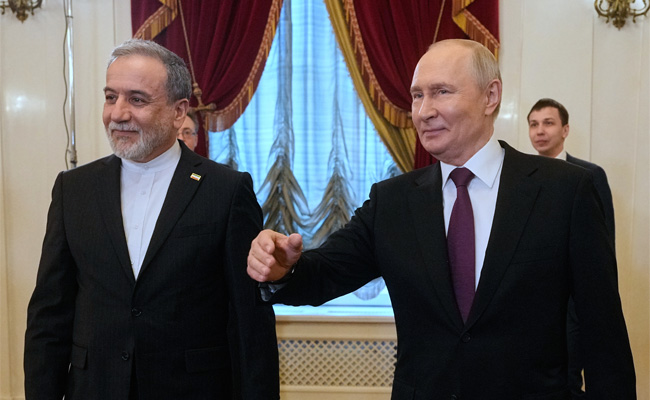
Moscow (PTI): Iran's Foreign Minister Abbas Araghchi on Monday met Russian President Vladimir Putin, who hailed the Iranian people for fighting bravely and heroically for their sovereignty and said Moscow is ready to do its best to help bring peace to West Asia as soon as possible.
Araghchi, who held talks with Omani and Pakistani leadership before arriving in Russia, met Putin in St. Petersburg and thanked him for supporting Iran, state-owned TASS news agency reported.
"Russia is ready to do everything in its power to ensure that peace in the Middle East is achieved as soon as possible," Putin said during his meeting with Araghchi, which was also attended by Russian Foreign Minister Sergey Lavrov.
Revealing that he received a message from Iranian Supreme Leader Mojtaba Khamenei last week, Putin asked Araghchi to convey his "gratitude for this message and best wishes for his health and well-being."
He praised the Iranian people for fighting "bravely and heroically" for their sovereignty, Iran's state-run PRESS TV reported.
"We really hope that, based on the courage and desire for independence, the Iranian people, under the guidance of the new leader, will weather this difficult period of trials and peace will come,” Putin said.
He also stressed that Russia “intends to maintain” its strategic relations with Iran.
Araghchi said that the world witnessed Iran’s strength in countering the US during the recent war, and that the Islamic Republic is a "stable and powerful establishment."
"With their courage, the Iranian people succeeded in resisting the US aggression and will be able to endure it,” he said.
He said that it became clear that Iran has “great friends and allies” like Russia, and conveyed “warmest greetings” from Supreme Leader Mojtaba Khamenei and President Masoud Pezeshkian to the Russian leader.
Araghchi said relations between Moscow and Tehran represent a “strategic partnership at the highest level” and will continue to develop "regardless of circumstances."
"We are grateful to you for the solid and strong positions in support of the Islamic Republic of Iran," he said.
Foreign Minister Lavrov said that the talks between President Putin and the Iranian Foreign Minister were "useful and constructive."
Kremlin Spokesman Dmitry Peskov later said that Russia is "ready to provide any good offices, any mediation services that are acceptable to the parties."
"We will be ready to do everything so that ultimately peace ensues, guaranteed peace, and that there is no return to hostilities," Peskov was quoted as saying by TASS.
He was asked how Moscow can assist in future negotiations on the Iranian settlement.
Araghchi arrived in Russia after his whirlwind trip to Islamabad, which, according to him, was “very productive” and involved “good consultations" with Pakistan's Army Chief Field Marshal Asim Munir, amid uncertainty over the second round of peace talks to resolve the war in West Asia.
"We held good consultations with our friends in Pakistan. The trip was successful. We assessed the outcome of our recent (meetings) and discussed in what direction and under what conditions talks can move on,” Araghchi said in a video posted on his Telegram channel upon his arrival in St Petersburg.
Referring to the second round of talks between the US and Iran to resolve the conflict in West Asia, Araghchi said: "Developments have taken place in the negotiations."
"Despite some progress in earlier rounds, the talks failed to reach their objectives due to the Americans' approach, the excessive demands they made, and the wrong approaches they adopted. Therefore, it was necessary to consult with our friends in Pakistan to review the latest situation,” Iran's official news agency IRNA quoted him as saying.
He said that the trip to Pakistan was a good opportunity to review developments related to the US-Israeli war against Iran, expressing confidence that “these consultations and coordination between the two countries will be highly significant.”
Araghchi arrived at St. Petersburg's Pulkovo Airport early Monday, where he was welcomed by Russian officials and Iran’s ambassador to Russia, Kazem Jalali, the report said.
The first round of peace talks between Iran and the US, held on April 11 and 12, failed to bring the desired result for the parties to the conflict.
The Iranian minister arrived in Islamabad for the second time on Sunday after a short visit to Oman, where he held talks with Sultan Haitham bin Tariq al-Said on security in the Strait of Hormuz and diplomatic efforts to end the Iran-US conflict.
After Araghchi left Pakistan for Oman on Saturday, President Donald Trump announced that US negotiators Steve Witkoff and Jared Kushner would no longer be going to Islamabad for talks with Iran, contending that Washington held all the cards on the matter.
Trump on Sunday reiterated that the US and Iranian officials can talk by phone for a peace solution to the conflict.
On Tuesday, Trump extended the two-week ceasefire with Iran indefinitely to give Tehran more time to prepare a unified proposal to end the war, just hours before the truce was set to expire.
The war began when the US and Israel jointly attacked Iran on February 28, killing Iranian Supreme Leader Ayatollah Ali Khamenei and several top commanders. The retaliation by the Islamic Republic extended the war to the entire Gulf region.