TMC claims 40 SIR-related deaths in West Bengal; EC junks claims
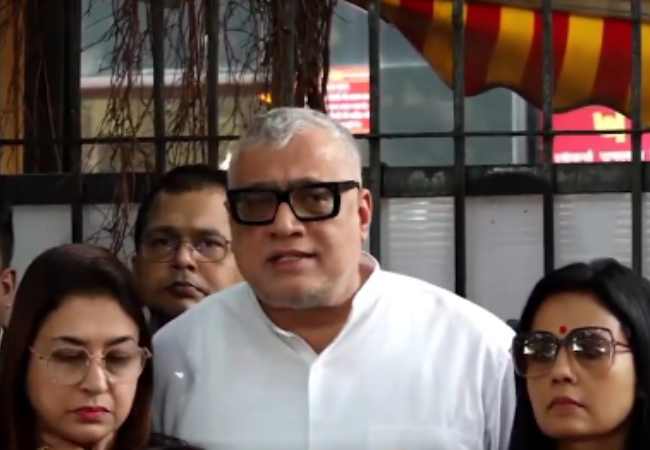
New Delhi (PTI): A Trinamool Congress delegation on Friday alleged before the Election Commission top brass that around 40 SIR-related deaths had occurred in West Bengal so far, a charge junked by the poll authority.
The TMC delegation, which met the EC top brass, also accused Chief Election Commissioner (CEC) Gyanesh Kumar of having "blood on his hands".
The 10-member delegation, led by TMC Rajya Sabha leader Derek O'Brien, met the EC officials amid the ongoing Special Intensive Revision (SIR) of electoral rolls in West Bengal.
EC officials noted that during the meeting, the TMC leaders were told that the independence of booth-level officers should not be interfered with during the enumeration forms distribution process as part of SIR.
"EC also told the delegation of TMC not to influence or threaten the BLOs regarding dead, shifted and duplicate voters," an official later said.
The ECI also told the AITC delegation that while political rhetoric is their prerogative, they should refrain from spreading misinformation relating to election procedures.
Following their meeting, O'Brien addressed reporters, saying that the party had raised five questions, but CEC Kumar did not respond to any of them.
"We started the meeting by stating that the CEC has blood on his hands. We raised five questions. After this, Kalyan Banerjee, Mahua Moitra, and Mamata Thakur spoke and shared whatever they had to in about 40 minutes," O'Brien said.
"Then the CEC spoke uninterrupted for one hour. We were also not interrupted while we spoke, but we did not receive any answer to any of our five questions," he added.
EC officials said the poll authority gave a point-wise rebuttal to all concerns and "baseless allegations" raised by the TMC delegation.
The commission urged them to present their claims and objections after December 9, when the draft list will be shared with them.
"Till then, they should not interfere with the independent functioning of BLOs, electoral registration officers and district election officers who are state government employees on deputation to election-related works," the official said.
Additionally, the Election Commission shot off a letter to DGP West Bengal and Kolkata Police Commissioner to ensure that the BLOs are not pressurised and threatened by political party workers.
Moitra mentioned that the delegation provided the CEC with a list of 40 people whose deaths, they alleged, were linked to the SIR exercise. The commission, however, dismissed it as mere allegations, the Lok Sabha MP claimed.
"We began by presenting a list of individuals whose deaths we believe are linked to the SIR process... The CEC said that these are merely allegations," Moitra said.
The TMC MPs asked the poll body about the claim that the exercise would weed out non-voters, and questioned why the exercise was not being undertaken in the Northeastern states, which also face the risk of infiltration as they share borders with Bangladesh and Myanmar.
They also questioned how the electoral roll, on which the last Lok Sabha election was held, suddenly became "unreliable". The MPs raised the issues of alleged deaths linked to the SIR process, and questioned who would take responsibility for it. Additionally, they expressed worries about the neutrality and effectiveness of the SIR process and noted a recent amendment in the rules by the poll panel that allows for the appointment of external Booth Level Agents (BLAs).
The TMC further informed the CEC that BJP leaders in West Bengal are claiming that one crore voters' names will be deleted. "The ECI has taken no cognisance of these comments, nor have they negated the dear mongering by the BJP," a TMC leader said.
A party source said they have compiled a list of 60 tragedies linked to SIR - 41 common people and 19 BLOs. Of the common individuals, 35 have died, and six are receiving medical attention. Among the 19 BLOs affected, four have died, while 15 are hospitalised or receiving care.
The SIR is currently underway in 12 states and Union territories, including West Bengal.
The delegation consisted of Lok Sabha MPs Mahua Moitra, Satabdi Roy, Kalyan Banerjee, Pratima Mondal, Sajda Ahmed, and Rajya Sabha MPs Dola Sen, Mamata Thakur, Saket Gokhale, and Prakash Chik Barik.
Let the Truth be known. If you read VB and like VB, please be a VB Supporter and Help us deliver the Truth to one and all.
Have no personal involvement in Cong’s action against some minority leaders: Shivakumar
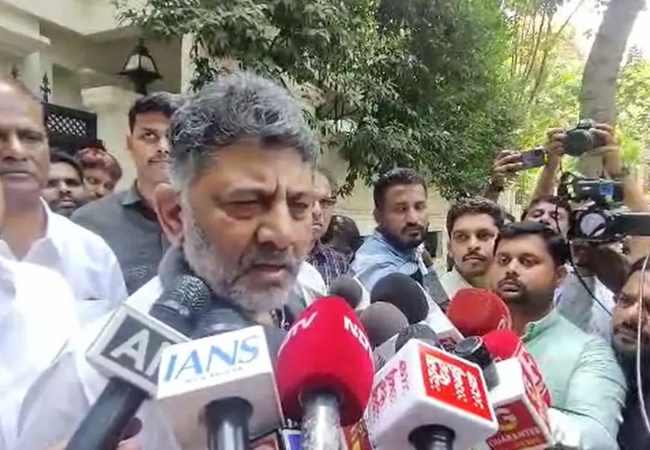
Bengaluru (PTI): Karnataka Deputy Chief Minister D K Shivakumar on Friday said he has no personal involvement in action taken against certain Congress leaders from the minority community following allegations of an internal conspiracy during the recently held Davanagere South bypolls.
He clarified that the decisions were taken by the party high command based on available reports.
Asserting that party discipline is of utmost importance, Shivakumar, who is also the Karnataka Pradesh Congress Committee (KPCC) president, sought to downplay concerns that action against minority leaders may send the message that “Muslims are being targeted.”
“I don’t have any personal involvement in this. Whatever decisions are taken are made by the party leadership. The party has its own reports. Decisions regarding MLAs or MLCs cannot be taken at the state level without instructions from Delhi,” he said.
Speaking to reporters, he added, “People may blame me; I am not concerned. Everyone must function in accordance with party discipline.”
Responding to concerns within sections of the party that recent actions may convey the impression that minority leaders are being targeted, he said the Congress exists for the welfare of Scheduled Castes, Scheduled Tribes, minorities, backward classes, farmers, and all sections of society.
The Congress has suspended MLC K Abdul Jabbar from primary membership and relieved another MLC, Naseer Ahmed, from the post of Chief Minister’s political secretary.
The action followed allegations by a group of Muslim leaders that certain party members conspired to defeat the official candidate in Davanagere South.
Following the action, speculation has emerged that Housing Minister B Z Zameer Ahmed Khan may also face disciplinary measures during the next cabinet reshuffle.
The three leaders had reportedly sought a Muslim candidate for the Davanagere South bypoll ticket, which the party instead allotted to the late MLA Shamanur Shivashankarappa’s grandson, Samarth Mallikarjun.
They were also said to have not actively participated in the campaign.
Shivakumar also rejected claims of factionalism within the ruling party amid speculation that leaders close to Chief Minister Siddaramaiah were being targeted.
Naseer Ahmed and Zameer Ahmed Khan are considered close to the CM.
Rejecting allegations of factionalism within the party, Shivakumar said, “We speak to each other every day. It is the media that creates divisions. Where is my faction? Has anyone put up a board saying they belong to the Siddaramaiah faction? Have I put up any such board?”
“All 139 legislators are my people, and they are all Siddaramaiah’s people as well. Everyone belongs to the Congress,” he added, saying there are no factions within the party and that such claims are media-driven.
Public Works Department (PWD) Minister Satish Jarkiholi met Shivakumar on Friday, a day after expressing concerns that disciplinary action against minority leaders may send the wrong message.
Shivakumar said he discussed with Jarkiholi the need to decongest Bengaluru traffic by diverting vehicles entering the city from state and national highways, along with party-related issues.
“We also discussed political matters in the interest of the party and the need to work together,” he said.
Later, speaking to reporters, Jarkiholi said he discussed with Shivakumar the issue of withdrawing Jabbar’s suspension. He said he will also visit New Delhi next week to meet the high command and discuss state developments.
“Jabbar’s suspension was discussed (with Shivakumar). It should be withdrawn. Let’s issue him a notice and allow him to reply. Then let’s send the report to the high command and seek their approval. High command approval is necessary because the instructions came from there. It may take some time,” he said.
Stating that he met the KPCC chief for “damage control,” the minister said, “We have tried to convince him. Sometimes certain decisions happen that need rectification.”
_vb_33.jpeg)