TMC to raise SIR issue, related deaths in Bengal in Parliament winter session

Kolkata (PTI): The TMC will raise the SIR exercise and deaths allegedly linked to it in West Bengal during the winter session of Parliament next month, a senior leader said here.
The ruling party of the state has been accusing the Election Commission of imposing "SIR-linked inhuman pressure" on ground staff through compressed timelines and "unworkable deadlines."
The party claimed the accelerated voter-roll revision has unleashed fear, fatigue and fatalities among Booth Level Officers (BLOs) and citizens, and will question why West Bengal has been subjected to the most intensive scrutiny while several border states with similar demographic profiles have been exempted from the SIR, the leader said.
The TMC said it would seek an explanation from the Centre and the EC on the selection of states for the SIR.
The senior party MP said, "Why have Tripura, Meghalaya, Mizoram, Arunachal Pradesh, Nagaland and Manipur, all bordering countries like Bangladesh and Myanmar, been exempted entirely? Why is Assam under a lighter Special Revision? Is the real intent to challenge Bengali identity and systematically prune Bengali voters from the rolls?"
The winter session of Parliament will be conducted between December 1 and 19.
Senior TMC leaders said the voter-roll revision, launched in early November across 12 states and Union territories, has been carried out in West Bengal with "extraordinary haste," triggering panic among citizens and placing an "unprecedented burden" on Booth Level Officers (BLOs), several of whom have reportedly died while juggling teaching duties and late-night enumeration work.
The party claimed that 41 people, including four BLOs, have died since the start of the process.
Families of some of the deceased have attributed their deaths to crippling deadlines, inadequate training, and the stress of the massive exercise.
"What should normally take two to three years has been squeezed into two months just to please political masters at the Centre," a TMC MP alleged.
According to official data, the West Bengal SIR is nearing completion, with 7.64 crore forms circulated, 82 per cent digitised, and 99.8 per cent of voters covered in the door-to-door verification drive. The final electoral roll is expected to be published on February 7, 2026.
But TMC leaders said the numbers do not reveal the human toll of the exercise.
"BLOs are collapsing under pressure, common people are gripped by fear psychosis, and the EC is watching silently," another TMC parliamentarian said. "There are reports of suicides, anxiety-induced deaths and teachers fainting in the middle of duty. This cannot be passed off as routine enumeration."
The party also pointed to rising anger among schoolteachers, who form the majority of BLOs and have complained of impossible working hours, lack of training, and the absence of transport or other logistical support.
"How can you expect a teacher to finish schoolwork, visit dozens of households, upload data, and still meet daily targets?" a TMC leader asked. "This is administrative coercion by EC masquerading as electoral correction."
TMC sources said the party will demand compensation for families of deceased BLOs, immediate relaxation of deadlines, and a parliamentary discussion on what it calls a "selective and punitive" enumeration exercise.
"Human lives cannot be collateral damage in the pursuit of a voter-roll cleanup," a party leader said. "If the EC has nothing to hide, let them explain why Bengal alone has been subjected to this aggressive drive."
The TMC plans interventions in both Houses throughout the winter session, pressing for accountability from the Election Commission and the Union government.
Let the Truth be known. If you read VB and like VB, please be a VB Supporter and Help us deliver the Truth to one and all.
Have no personal involvement in Cong’s action against some minority leaders: Shivakumar
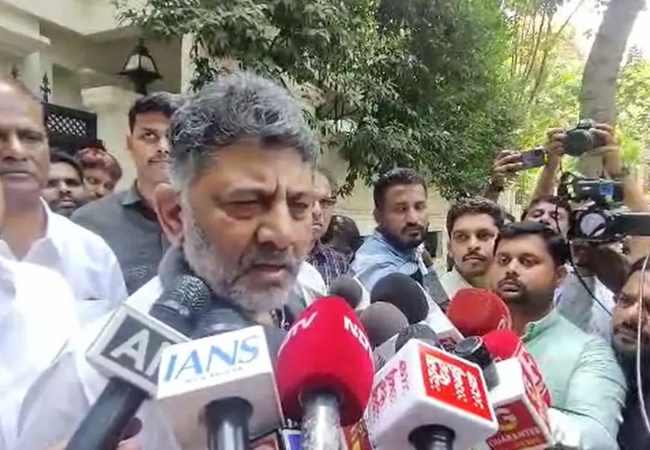
Bengaluru (PTI): Karnataka Deputy Chief Minister D K Shivakumar on Friday said he has no personal involvement in action taken against certain Congress leaders from the minority community following allegations of an internal conspiracy during the recently held Davanagere South bypolls.
He clarified that the decisions were taken by the party high command based on available reports.
Asserting that party discipline is of utmost importance, Shivakumar, who is also the Karnataka Pradesh Congress Committee (KPCC) president, sought to downplay concerns that action against minority leaders may send the message that “Muslims are being targeted.”
“I don’t have any personal involvement in this. Whatever decisions are taken are made by the party leadership. The party has its own reports. Decisions regarding MLAs or MLCs cannot be taken at the state level without instructions from Delhi,” he said.
Speaking to reporters, he added, “People may blame me; I am not concerned. Everyone must function in accordance with party discipline.”
Responding to concerns within sections of the party that recent actions may convey the impression that minority leaders are being targeted, he said the Congress exists for the welfare of Scheduled Castes, Scheduled Tribes, minorities, backward classes, farmers, and all sections of society.
The Congress has suspended MLC K Abdul Jabbar from primary membership and relieved another MLC, Naseer Ahmed, from the post of Chief Minister’s political secretary.
The action followed allegations by a group of Muslim leaders that certain party members conspired to defeat the official candidate in Davanagere South.
Following the action, speculation has emerged that Housing Minister B Z Zameer Ahmed Khan may also face disciplinary measures during the next cabinet reshuffle.
The three leaders had reportedly sought a Muslim candidate for the Davanagere South bypoll ticket, which the party instead allotted to the late MLA Shamanur Shivashankarappa’s grandson, Samarth Mallikarjun.
They were also said to have not actively participated in the campaign.
Shivakumar also rejected claims of factionalism within the ruling party amid speculation that leaders close to Chief Minister Siddaramaiah were being targeted.
Naseer Ahmed and Zameer Ahmed Khan are considered close to the CM.
Rejecting allegations of factionalism within the party, Shivakumar said, “We speak to each other every day. It is the media that creates divisions. Where is my faction? Has anyone put up a board saying they belong to the Siddaramaiah faction? Have I put up any such board?”
“All 139 legislators are my people, and they are all Siddaramaiah’s people as well. Everyone belongs to the Congress,” he added, saying there are no factions within the party and that such claims are media-driven.
Public Works Department (PWD) Minister Satish Jarkiholi met Shivakumar on Friday, a day after expressing concerns that disciplinary action against minority leaders may send the wrong message.
Shivakumar said he discussed with Jarkiholi the need to decongest Bengaluru traffic by diverting vehicles entering the city from state and national highways, along with party-related issues.
“We also discussed political matters in the interest of the party and the need to work together,” he said.
Later, speaking to reporters, Jarkiholi said he discussed with Shivakumar the issue of withdrawing Jabbar’s suspension. He said he will also visit New Delhi next week to meet the high command and discuss state developments.
“Jabbar’s suspension was discussed (with Shivakumar). It should be withdrawn. Let’s issue him a notice and allow him to reply. Then let’s send the report to the high command and seek their approval. High command approval is necessary because the instructions came from there. It may take some time,” he said.
Stating that he met the KPCC chief for “damage control,” the minister said, “We have tried to convince him. Sometimes certain decisions happen that need rectification.”
_vb_33.jpeg)