Trade deal with US compromises India's interests in agriculture sector; farmers to suffer: Kejriwal
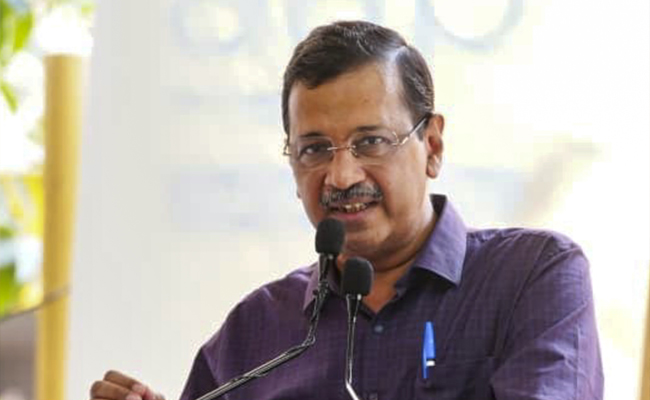
Ahmedabad (PTI): AAP leader Arvind Kejriwal on Saturday accused the Centre of "selling" India and its farmers to the US through the interim trade deal, and claimed that it is for the first time that the country's interests in the agriculture sector have been compromised in such a manner.
He expressed fear that India's exports to the US will eventually stop as our goods will become 18 per cent more expensive in that country, which will ultimately pose a big threat to the farmers.
Kejriwal and Punjab Chief Minister Bhagwant Mann are in Gujarat to prepare groundwork for their Aam Aadmi Party (AAP) ahead of the Gujarat assembly elections expected to be held in December 2027.
Addressing a press conference, Kejriwal said, "For the first time, India has compromised in the agriculture sector in such a manner. In the coming days, we will see the impact of this trade deal. Prime Minister Narendra Modi sold the entire country and the farmers to the United States. The country will never forgive this."
The US had imposed a reciprocal tariff of 25 per cent on India in August last year. Later, an additional 25 per cent was imposed for buying Russian crude oil, taking the total tariffs on India to 50 per cent. Earlier this month, both countries agreed to finalise an interim trade deal, under which Washington will cut down the tariffs to 18 per cent.
The US Supreme Court, however, passed a verdict against President Donald Trump's sweeping duties on several nations, following which India will now face a lower reciprocal tariff of 10 per cent. According to Trump's proclamation, the temporary import surcharge of 10 per cent is for a period of 150 days from February 24.
Dubbing the trade deal as "unfortunate", Kejriwal said Gujarat produces maize, soybean, dairy products, peanut and cotton.
"Many of these products are exported, especially to the US. In this free trade agreement, it is written that the goods we send to the US will face an 18 per cent tariff. If our goods become 18 per cent more expensive in the US, how will we remain competitive there? Our exports will eventually stop," the former Delhi chief minister said.
"On the other hand, when American cotton is sent to India, earlier there used to be significant duty on it but it has now been brought down to zero. So American cotton will come to Gujarat, and when it is sold here, our farmers will not be able to compete with it. So the cotton produced by Indian farmers will neither sell in India nor in the US," he said.
"Our farmers will suffer losses. This is the situation. Why did PM Modi make such a treaty with the USA?" he asked.
Kejriwal also criticised the annual budget presented in Gujarat recently, saying that the common man has high expectations from it because household finances depend heavily on government decisions.
People look to the budget for relief in prices and improvements in essential sectors like education and healthcare. But there is nothing in it for the common people. The budget lacks provisions of education and there is nothing for healthcare, roads, farmers, traders, women, unemployed or any section of society, he alleged.
"Elections are about one-and-a-half years away. Often it is seen that when elections approach, at least governments try to do something - give some relief so that they can get votes. But the Gujarat government is not even concerned about that," he said.
Kejriwal hit out at the opposition Congress, saying people do not want to vote in favour of that party.
"Because of that, the BJP has become arrogant - thinking that they do not need to do anything. The entire budget is only aimed at exploiting people. This budget shows their arrogance and is an insult to the people of Gujarat. But in the assembly elections, people will give their answer," the AAP leader said.
Let the Truth be known. If you read VB and like VB, please be a VB Supporter and Help us deliver the Truth to one and all.
4 held for sexually assaulting woman, girl on moving bus after social media alert in UP's Agra

Agra (UP) (PTI): Four people were arrested, after a prompt response by police following a social media alert, for allegedly sexually assaulting a woman and a girl inside a moving bus here, officials said on Tuesday.
According to an official police statement, at 12:27 am on April 27, information was received on the social media platform X about an incident of sexual assault on a bus travelling from Kanpur to Ahmedabad, which was approaching Namner crossing in Agra.
Acting under the direction of Police Commissioner Deepak Kumar, the Agra Police social media team immediately alerted the Rakabganj police station within minutes and coordinated with the victims to confirm the incident and obtain the exact location, it stated.
Police teams launched intensive checking at Namner crossing and intercepted the bus as it reached the spot. The four accused involved in the incident were apprehended on the spot, and legal action was initiated against them, the statement said.
The police said the swift response and coordination between the social media team and field units ensured timely action, bringing relief to the victims and other passengers, who expressed gratitude towards the police, it added.