Transfer of proceedings from judicial officer can't be merely on apprehension of bias: Bombay HC
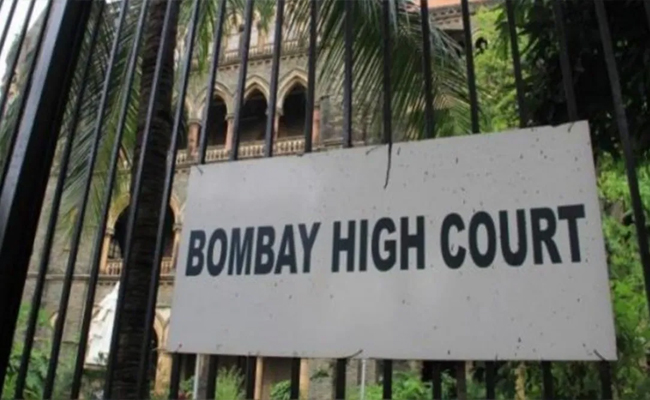
Mumbai (PTI): The Bombay High Court has said transfer of proceedings from a judicial officer cannot be done on mere allegation by one party, and dismissed a petition of the Lilavati Hospital's trust founder alleging bias against the Charity Commissioner.
A single bench of Justice Sharmila Deshmukh last month refused to transfer the proceedings pertaining to a dispute between the trustees from the Charity Commissioner to any other judicial officer, noting there was no reasonable apprehension of bias or prejudice.
The HC said passing of an adverse order cannot be the foundation for seeking transfer of proceedings.
"It is necessary to ensure for securing the ends of justice that a mere allegation is differentiated from an apprehension and what is required is a reasonable apprehension. An absence of congenial atmosphere cannot be a ground for transfer," it said.
The court dismissed the petition filed by the Lilavati Kirtilal Mehta Medical Trust founder Charu Mehta and permanent trustees Rajesh Mehta and Prashant Mehta, seeking transfer of all proceedings pertaining to the trust from the Charity Commissioner to any other judicial officer while alleging bias.
The petitioners are embroiled in a dispute with the other trustees over control of the trust and the Lilavati Hospital.
"In my view the apprehension of the petitioners lacks foundation," the judge said.
The adverse orders passed by the Charity Commissioner against the petitioners cannot be said to be the result of a "pre-judged mind and cannot form the basis for reasonable apprehension that justice will not be done by the Charity Commissioner while adjudicating the proceedings," the HC said.
The court noted that transfer of proceedings from a court or a quasi-judicial officer is usually viewed as a suspicion being cast on the conduct of proceedings by the judicial officer and hence transfer cannot be based on mere allegation.
Earlier this year, the Charity Commissioner provisionally accepted certain change reports of the trust and initiated suo motu (on its own) inquiry against the trustees including the petitioners and pending inquiry suspended the trustees except Charu Mehta.
Mehta and the two other trustees filed a petition in the HC, challenging the Charity Commissioner's order.
The HC in September stayed the order, noting the Charity Commissioner had acted contrary to the provisions of law.
The petitioners claimed the Charity Commissioner initiated suo motu inquiry even when there was no such prayer from the other side.
The plea alleged the Charity Commissioner had held a private meeting with lawyers of the other side, which casts a serious doubt about impartiality.
The respondent trustees claimed the petitioners habitually file transfer applications when faced with adverse orders and those applications have been rejected in the past.
The HC observed that even if the orders passed are not in accordance with law, at the most it can be said to be a perverse order capable of being corrected by the higher forum.
"However, the passing of such an order itself cannot be said to be the result of a predetermined and prejudiced mind," the court said.
The allegations levelled by the petitioners, if viewed, in isolation would not indicate any basis for apprehension of bias and even if viewed cumulatively it would at the most amount to passing of adverse orders, the HC said.
"The judicial orders passed by the authorities legitimately, though may or may not be corrected by the higher forums, cannot lead to an inference of pre-judged and/or pre-determined and/or biased mind against the litigant," it said.
Let the Truth be known. If you read VB and like VB, please be a VB Supporter and Help us deliver the Truth to one and all.
No 'bacterial infection' found in bodies of 4 Mumbai family members who died after eating watermelon
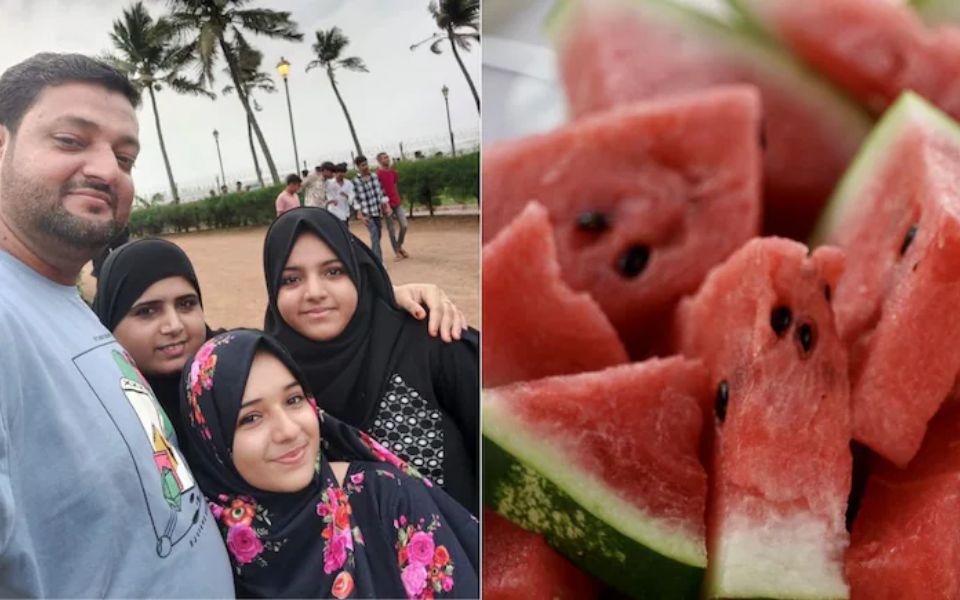
Mumbai (PTI): The initial report submitted by the microbiology department of a Mumbai-based state-run hospital has said no "bacterial infection" was detected in the bodies of four family members, who died after consuming watermelon recently, officials said on Wednesday.
The Dokadia family, residents of Ghari Mohalla on Ismail Kurte Road, had hosted a get-together of relatives on the night of April 25. At around 1 am (on April 26), hours after the guests had left, Abdullah Dokadia (40), his wife Nasreen (35), and daughters Ayesha (16) and Zaineb (13) ate pieces of a watermelon.
They suffered severe bouts of vomiting and diarrhoea in the early hours of April 26 and were rushed to a local hospital before being referred to the government-run J J Hospital where all four died during treatment.
After the incident, Mumbai police, forensic experts and Food and Drug Administration (FDA) officials visited the house and had collected samples of every food item that constituted the family's last meal, including 'chicken pulav', watermelon, water, and other foodstuffs, and sent them to the Forensic Science Laboratory for analysis.
After the post-mortem of the deceased, their viscera was preserved for chemical analysis.
As the probe is underway, the microbiology department of the state-run J J Hospital has submitted its initial report to the police.
"As per the report, no bacterial infection has been detected so far in the bodies of the victims. No bacteria was found in their blood," the official said.
The exact cause of the death will be known once the forensic science lab submits its report, he said.
"The report will also clarify whether any food items consumed by the family members during the day contained anything poisonous," the official said.