Trouble ‘Miyas’ everywhere only then they will leave Assam: Himanta Biswa Sarma
Says “Himanta Biswa Sarma, BJP are openly against them, we are saying it openly
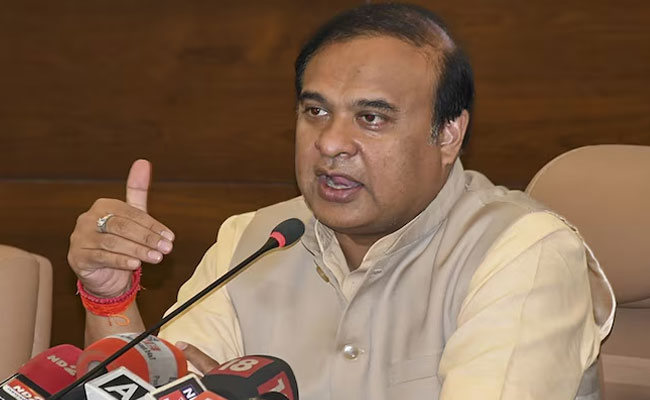
New Delhi: Assam Chief Minister Himanta Biswa Sarma on Tuesday said that four to five lakh “Miya voters” would be removed from the electoral rolls in the state once the Special Intensive Revision (SIR) of voter lists is carried out. He also made a series of controversial remarks openly targeting the Miya community, a term commonly used in Assam in a derogatory sense to refer to Bengali-speaking Muslims.
Speaking to reporters on the sidelines of an official programme in Digboi in Tinsukia district, Sarma said it was his responsibility to create difficulties for the Miya community and claimed that both he and the BJP were “directly against Miyas”.
“Four to five lakh Miya votes will have to be deleted in Assam when the SIR happens,” Sarma said, adding that such voters “should ideally not be allowed to vote in Assam, but in Bangladesh”. He asserted that the government was ensuring that they would not be able to vote in the state.
The chief minister was responding to questions about notices issued to thousands of Bengali-speaking Muslims during the claims and objections phase of the ongoing Special Revision (SR) of electoral rolls in Assam. While the Election Commission is conducting SIR exercises in 12 states and Union Territories, Assam is currently undergoing an SR, which is usually meant for routine updates.
Calling the current SR “preliminary”, Sarma said that a full-fledged SIR in Assam would lead to large-scale deletion of Miya voters. He said he was unconcerned about criticism from opposition parties over the issue.
“Let the Congress abuse me as much as they want. My job is to make the Miya people suffer,” Sarma said. He claimed that complaints filed against members of the community were done on his instructions and that he had encouraged BJP workers to keep filing complaints.
“I have told people wherever possible they should fill Form 7 so that they have to run around a little and are troubled,” he said, adding that such actions were meant to send a message that “the Assamese people are still living”.
In remarks that drew further outrage, Sarma urged people to trouble members of the Miya community in everyday life, claiming that “only if they face troubles will they leave Assam”. He also accused the media of sympathising with the community and warned journalists against such coverage.
“So you all should also trouble, and you should not do news that sympathise with them. There will be love jihad in your own house.” He said.
The comments triggered reactions from opposition leaders. Raijor Dal president and MLA Akhil Gogoi said the people of Assam had not elected Sarma to keep one community under constant pressure. Congress leader Aman Wadud accused the chief minister of rendering the Constitution meaningless in the state, saying his remarks showed a complete disregard for constitutional values.
According to the draft electoral rolls published on December 27, Assam currently has 2.51 crore voters. Election officials said 4.78 lakh names were marked as deceased, 5.23 lakh as having shifted, and 53,619 duplicate entries were removed during the revision process. Authorities also claimed that verification had been completed for over 61 lakh households.
On January 25, six opposition parties the Congress, Raijor Dal, Assam Jatiya Parishad, CPI, CPI(M) and CPI(M-L) submitted a memorandum to the state’s chief electoral officer. They alleged widespread legal violations, political interference and selective targeting of genuine voters during the SR exercise, describing it as arbitrary, unlawful and unconstitutional.
Let the Truth be known. If you read VB and like VB, please be a VB Supporter and Help us deliver the Truth to one and all.
Ladakh a living land of dharma for centuries: Amit Shah
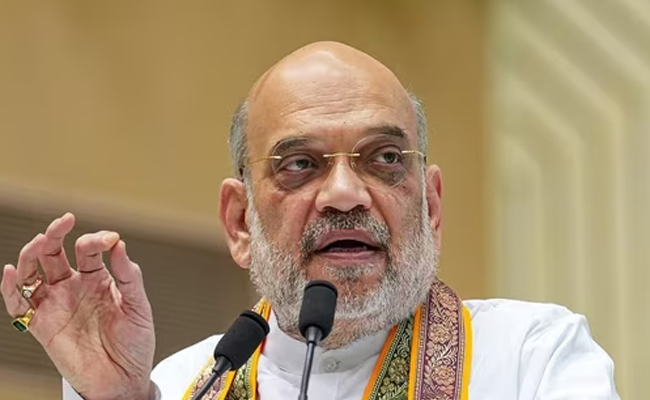
Leh/Jammu (PTI): Union Home Minister Amit Shah on Friday described the return of sacred relics of Lord Buddha to Ladakh after 75 years as a "historic reunion" and said that the Union Territory has remained a "living land of dharma", preserving and nurturing Buddhist knowledge for centuries.
Stressing the relevance of Buddha's teachings in modern times, Shah said the message of peace, compassion and the middle path was even more important today than it was 2,500 years ago.
"Ladakh has been a living land of dharma for centuries. When the Dalai Lama comes here, he says this land is not merely a geographical land but a living laboratory of Buddhist culture and compassion," Shah said, speaking after the inauguration of the sacred holy relics exposition of Tathagata Buddha and the 2569th Buddha Purnima celebrations at Jivetsal in Leh during his two-day visit to Ladakh.
Calling Ladakh a land of compassion, he said this land has preserved and nurtured knowledge. "Whenever Buddhism faced crises, this land worked to protect the teachings of Buddha. And when peace returned, it helped to expand and carry forward that preserved wisdom," he added.
"Unless one internalises knowledge and makes it a part of oneself, liberation is not possible. Knowledge is incomplete without spiritual practice, while spiritual practice without knowledge is blind. Therefore, the union of spiritual practice and knowledge is the right path. Even after all this, if there is no moral discipline, one cannot lead a truly wise life. The basis of a life of wisdom is moral discipline," he said.
Shah said it was through Ladakh and adjoining routes that the teachings of Tathagata Buddha, which originated in India, spread to China and several other countries.
"The message that emerged from the land of Ladakh has become a guiding force for many people around the world to take their lives forward. The presence of these sacred relics in Ladakh reminds us that India's civilisation has, for thousands of years, given the message of peace and coexistence," he said.
He said that in a diverse region like Ladakh and Kargil, this message becomes even more relevant. "This heritage still tells us today that amidst conflict and unrest, only the path of peace and compassion can provide solutions."
He said the return of the relics on Buddha Purnima had enhanced the significance of the festival for the people of Ladakh.
"These sacred relics have come to Ladakh after 75 years. It is as if Buddha himself is present here today," Shah said, adding that followers of Buddhism and people of other faiths in Ladakh and Kargil would draw spiritual energy from the relics.
Highlighting Ladakh's role in the spread of Buddhism, Shah said Kashmir was once an ancient centre of Buddhist studies, Mahayana philosophy and Buddhist art, from where Ladakh first came into close contact with Buddhism.
He said Emperor Ashoka's envoys laid the foundation of Buddhist influence in Ladakh through Kashmir and Gandhara, while Mahayana Buddhism expanded in the region during the Kushan period between the first and third centuries CE.
The Silk Route linking Kashmir, Leh, Yarkand, Khotan and Tibet became a channel not only for trade but also for ideas, monks, manuscripts and artistic traditions, Shah said.
He added that later, Tibetan influence between the seventh and tenth centuries further enriched Ladakh through Mahayana and Vajrayana traditions.
Stressing the relevance of Buddha's teachings in modern times, Shah said the message of peace, compassion and the middle path was even more important today than it was 2,500 years ago.
"Amid conflict and unrest, only the path of peace and compassion can provide solutions," he said.
Shah also appealed to the Ladakh administration to ensure complete arrangements so that followers of all faiths, especially Buddhists, could visit and pay obeisance to the relics.
#WATCH लेह, लद्दाख: केंद्रीय गृह मंत्री अमित शाह ने कहा, "जब दलाई लामा यहां आते हैं तो वे कहते हैं कि यह भूमि केवल भौगोलिक भूमि नहीं है। यह भूमि बौद्ध संस्कृति और करुणा की जीवंत प्रयोगशाला है। इस भूमि पर ज्ञान का संरक्षण हुआ है... भारत की सभ्यता हजारों वर्षों से शांति का संदेश… https://t.co/2nwG0w2CE6 pic.twitter.com/W13itRBqeX
— ANI_HindiNews (@AHindinews) May 1, 2026