Trump to put import taxes on pharmaceutical drugs, kitchen cabinets, furniture and heavy trucks
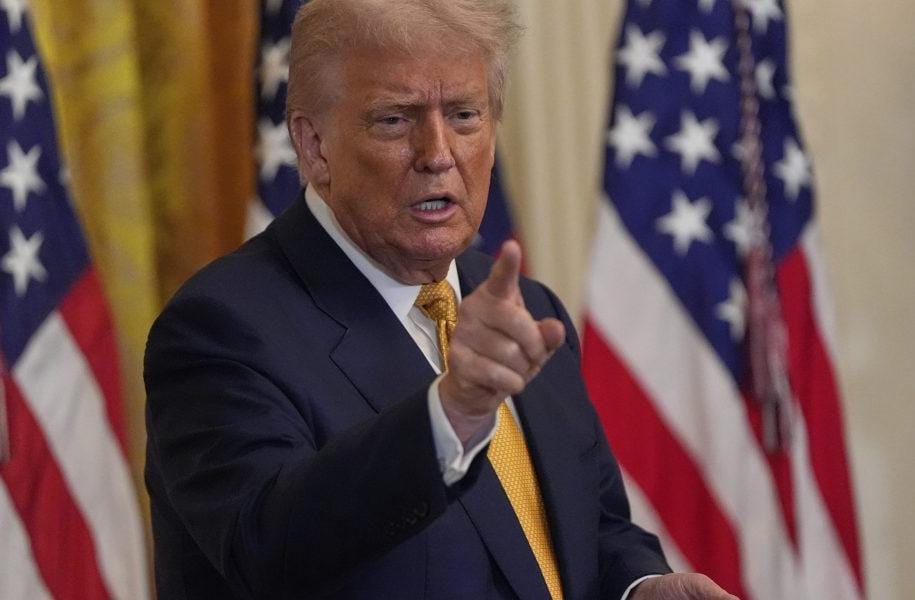
Washington (AP): President Donald Trump has said that he will put import taxes of 100 per cent on pharmaceutical drugs, 50 per cent on kitchen cabinets and bathroom vanities, 30 per cent on upholstered furniture and 25 per cent on heavy trucks starting on October 1.
The posts on his social media site on Thursday showed that Trump's devotion to tariffs did not end with the trade frameworks and import taxes that were launched in August, a reflection of the president's confidence that taxes will help to reduce the government's budget deficit while increasing domestic manufacturing.
While Trump did not provide a legal justification for the tariffs, he appeared to stretch the bounds of his role as commander-in-chief by stating on Truth Social that the taxes on imported kitchen cabinets and sofas were needed "for National Security and other reasons".
Under the Trade Expansion Act of 1962, the administration launched a Section 232 investigation in April about the impacts on national security from pharmaceutical drug and truck imports. The Commerce Department launched a 232 investigation into timber and lumber in March, though it's unclear whether the furniture tariffs stem from that.
The tariffs are another dose of uncertainty for the US economy with a solid stock market but a weakening outlook for jobs and elevated inflation. These new taxes on imports could pass through to consumers in the form of higher prices and dampen hiring, a process that economic data suggests is already underway.
"We have begun to see goods prices showing through into higher inflation," Federal Reserve Chair Jerome Powell warned in a recent news conference, adding that higher costs for goods account for "most" or potentially "all" of the increase in inflation levels this year.
The president has pressured Powell to resign, arguing that the Fed should cut its benchmark interest rates more aggressively because inflation is no longer a concern. Fed officials have stayed cautious on rate cuts because of the uncertainty created by tariffs.
Trump said on Truth Social that the pharmaceutical tariffs would not apply to companies that are building manufacturing plants in the United States, which he defined as either "breaking ground" or being "under construction". It was unclear how the tariffs would apply to companies that already have factories in the US.
In 2024, America imported nearly USD 233 billion in pharmaceutical and medicinal products, according to the Census Bureau. The prospect of prices doubling for some medicines could send shock waves to voters as health care expenses, as well as the costs of Medicare and Medicaid, potentially increase.
The pharmaceutical drug announcement was shocking as Trump has previously suggested that tariffs would be phased in over time so that companies had time to build factories and relocate production. On CNBC in August, Trump said he would start by charging a "small tariff" on pharmaceuticals and raise the rate over a year or more to 150 per cent and even 250 per cent.
According to the White House, the threat of tariffs earlier this year contributed to many major pharmaceutical companies, including Johnson & Johnson, AstraZeneca, Roche, Bristol Myers Squibb and Eli Lilly, among others, to announce investments in US production.
Pascal Chan, vice president for strategic policy and supply chains at the Canadian Chamber of Commerce, warned that the tariffs could harm Americans' health with "immediate price hikes, strained insurance systems, hospital shortages, and the real risk of patients rationing or foregoing essential medicines".
The new tariffs on cabinetry could further increase the costs for homebuilders at a time when many people seeking to buy a house feel priced out by the mix of housing shortages and high mortgage rates. The National Association of Realtors on Thursday said there were signs of price pressures easing as sales listings increased 11.7 per cent in August from a year ago, but the median price for an existing home was USD 422,600.
Trump said that foreign-made heavy trucks and parts are hurting domestic producers that need to be defended.
"Large Truck Company Manufacturers, such as Peterbilt, Kenworth, Freightliner, Mack Trucks, and others, will be protected from the onslaught of outside interruptions," Trump posted.
Trump has long maintained that tariffs are the key to forcing companies to invest more in domestic factories. He has dismissed fears that importers would simply pass along much of the cost of the taxes to consumers and businesses in the form of higher prices.
His broader country-by-country tariffs relied on declaring an economic emergency based on a 1977 law, a drastic tax hike that two federal courts said exceeded Trump's authority as president. The Supreme Court is set to hear the case in November.
The president continues to claim that inflation is no longer a challenge for the US economy, despite evidence to the contrary. The consumer price index has increased 2.9 per cent over the past 12 months, up from an annual pace of 2.3 per cent in April, when Trump first launched a sweeping set of import taxes.
Nor is there evidence that the tariffs are creating factory jobs or more construction of manufacturing facilities. Since April, the Bureau of Labor Statistics has reported that manufacturers cut 42,000 jobs and builders have downsized by 8,000.
"There's no inflation," Trump told reporters Thursday. "We're having unbelievable success."
Still, Trump also acknowledged that his tariffs against China had hurt American farmers, who lost out on sales of soybeans. The president separately promised on Thursday to divert tariff revenues to the farmers hurt by the conflict, just as he did during his first term in 2018 and 2019 when his tariffs led to retaliation against the agricultural sector.
Let the Truth be known. If you read VB and like VB, please be a VB Supporter and Help us deliver the Truth to one and all.
Putin meets Iran's FM Araghchi, says Russia ready to do its best to help bring peace to West Asia
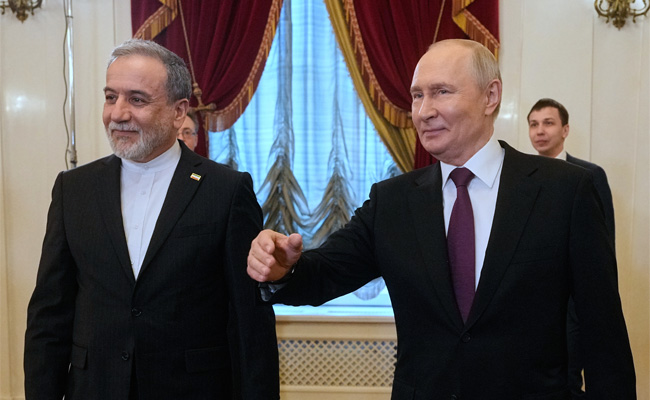
Moscow (PTI): Iran's Foreign Minister Abbas Araghchi on Monday met Russian President Vladimir Putin, who hailed the Iranian people for fighting bravely and heroically for their sovereignty and said Moscow is ready to do its best to help bring peace to West Asia as soon as possible.
Araghchi, who held talks with Omani and Pakistani leadership before arriving in Russia, met Putin in St. Petersburg and thanked him for supporting Iran, state-owned TASS news agency reported.
"Russia is ready to do everything in its power to ensure that peace in the Middle East is achieved as soon as possible," Putin said during his meeting with Araghchi, which was also attended by Russian Foreign Minister Sergey Lavrov.
Revealing that he received a message from Iranian Supreme Leader Mojtaba Khamenei last week, Putin asked Araghchi to convey his "gratitude for this message and best wishes for his health and well-being."
He praised the Iranian people for fighting "bravely and heroically" for their sovereignty, Iran's state-run PRESS TV reported.
"We really hope that, based on the courage and desire for independence, the Iranian people, under the guidance of the new leader, will weather this difficult period of trials and peace will come,” Putin said.
He also stressed that Russia “intends to maintain” its strategic relations with Iran.
Araghchi said that the world witnessed Iran’s strength in countering the US during the recent war, and that the Islamic Republic is a "stable and powerful establishment."
"With their courage, the Iranian people succeeded in resisting the US aggression and will be able to endure it,” he said.
He said that it became clear that Iran has “great friends and allies” like Russia, and conveyed “warmest greetings” from Supreme Leader Mojtaba Khamenei and President Masoud Pezeshkian to the Russian leader.
Araghchi said relations between Moscow and Tehran represent a “strategic partnership at the highest level” and will continue to develop "regardless of circumstances."
"We are grateful to you for the solid and strong positions in support of the Islamic Republic of Iran," he said.
Foreign Minister Lavrov said that the talks between President Putin and the Iranian Foreign Minister were "useful and constructive."
Kremlin Spokesman Dmitry Peskov later said that Russia is "ready to provide any good offices, any mediation services that are acceptable to the parties."
"We will be ready to do everything so that ultimately peace ensues, guaranteed peace, and that there is no return to hostilities," Peskov was quoted as saying by TASS.
He was asked how Moscow can assist in future negotiations on the Iranian settlement.
Araghchi arrived in Russia after his whirlwind trip to Islamabad, which, according to him, was “very productive” and involved “good consultations" with Pakistan's Army Chief Field Marshal Asim Munir, amid uncertainty over the second round of peace talks to resolve the war in West Asia.
"We held good consultations with our friends in Pakistan. The trip was successful. We assessed the outcome of our recent (meetings) and discussed in what direction and under what conditions talks can move on,” Araghchi said in a video posted on his Telegram channel upon his arrival in St Petersburg.
Referring to the second round of talks between the US and Iran to resolve the conflict in West Asia, Araghchi said: "Developments have taken place in the negotiations."
"Despite some progress in earlier rounds, the talks failed to reach their objectives due to the Americans' approach, the excessive demands they made, and the wrong approaches they adopted. Therefore, it was necessary to consult with our friends in Pakistan to review the latest situation,” Iran's official news agency IRNA quoted him as saying.
He said that the trip to Pakistan was a good opportunity to review developments related to the US-Israeli war against Iran, expressing confidence that “these consultations and coordination between the two countries will be highly significant.”
Araghchi arrived at St. Petersburg's Pulkovo Airport early Monday, where he was welcomed by Russian officials and Iran’s ambassador to Russia, Kazem Jalali, the report said.
The first round of peace talks between Iran and the US, held on April 11 and 12, failed to bring the desired result for the parties to the conflict.
The Iranian minister arrived in Islamabad for the second time on Sunday after a short visit to Oman, where he held talks with Sultan Haitham bin Tariq al-Said on security in the Strait of Hormuz and diplomatic efforts to end the Iran-US conflict.
After Araghchi left Pakistan for Oman on Saturday, President Donald Trump announced that US negotiators Steve Witkoff and Jared Kushner would no longer be going to Islamabad for talks with Iran, contending that Washington held all the cards on the matter.
Trump on Sunday reiterated that the US and Iranian officials can talk by phone for a peace solution to the conflict.
On Tuesday, Trump extended the two-week ceasefire with Iran indefinitely to give Tehran more time to prepare a unified proposal to end the war, just hours before the truce was set to expire.
The war began when the US and Israel jointly attacked Iran on February 28, killing Iranian Supreme Leader Ayatollah Ali Khamenei and several top commanders. The retaliation by the Islamic Republic extended the war to the entire Gulf region.