Twitter Blue signups unavailable after raft of fake accounts
_vb_49.gif)
San Francisco (AP): Twitter's relaunched premium service which grants blue-check verification labels to anyone willing to pay 8 a month was unavailable Friday after the social media platform was flooded by a wave of imposter accounts it itself had approved.
It's the latest whiplash-inducing change to the service where uncertainty has become the norm since billionaire Elon Musk took control two weeks ago. Prior to that, the blue check was granted to government entities, corporations, celebrities and journalists verified by the platform precisely to prevent impersonation. Now, anyone can get one as long as they have a phone, a credit card and 8 a month.
An impostor account posing as pharmaceutical giant Eli Lilly & Co. and registered under the revamped Twitter Blue system tweeted that insulin was free, forcing the Indianapolis company to post an apology. Nintendo, Lockheed Martin, Musk's own companies Tesla and SpaceX were also impersonated, as well as the accounts of various professional sports and political figures.
For advertisers who have put their business with Twitter on hold, the fake accounts could be the last straw: Musk's rocky run atop the platform laying off half its workforce and triggering high-profile departures has raised questions about its survivability.
The impostors can cause big problems, even if they're taken down quickly.
They have created overwhelming reputational risk for placing advertising investments on the platform, said Lou Paskalis, longtime marketing and media executive and former Bank of America head of global media. Adding that with the fake verified brand accounts, a picture emerges of a platform in disarray that no media professional would risk their career by continuing to make advertising investments on, and no governance apparatus or senior executive would condone if they did.
Adding to the confusion, Twitter now has two categories of blue checks, and they look identical. One includes the accounts verified before Musk took helm. It notes that This account is verified because it's notable in government, news, entertainment, or another designated category. The other notes that the account subscribes to Twitter Blue.
But as of midday Friday, Twitter Blue was not available for subscription.
On Thursday, Musk tweeted that too many corrupt legacy Blue verification' checkmarks exist, so no choice but to remove legacy Blue in coming months.
An email sent to Twitter's press address went unanswered. The company's communications department was gutted in the layoffs and Twitter has not responded to queries from The Associated Press since Oct. 27 when Musk took the helm.
Thursday night, Twitter also once again began adding gray official labels to some prominent accounts. It had rolled out the labels earlier this week, only to kill them a few hours later.
They returned Thursday night, at least for some accounts including Twitter's own, as well as big companies like Amazon, Nike and Coca-Cola, before many vanished again.
Celebrities also did not appear to be getting the official label.
Twitter is heavily dependent on ads and about 90% of its revenue comes from advertisers. But each change that Musk is rolling out or rolling back makes the site less appealing for big brands.
It has become chaos, said Richard Levick, CEO of public relations firm Levick. Who buys into chaos?
A bigger issue for Musk might be the risk to his reputation as a model tech executive, since the rollout of different types of verifications and other changes have been botched, Levick added.
It's another example something not very well thought out, and that's what happens when you rush, Levick said. Musk has been known as a trusted visionary and magician he can't lose that moniker and that's what's at risk right now, Levick said.
Twitter is a small part of total ad spending for the biggest companies that advertise on the platform. Google, Amazon and Meta account for about 75% of digital ads globally, with all other platforms combined making up the other 25%. Twitter accounts for about 0.9% of global digital ad spending, according to Insider Intelligence.
For most marketers on budgets, Twitter has always been that thing that is potentially too big to totally ignore but not quite big enough to care about, said Mark DiMassimo, creative chief of marketing agency DiGo.
None of this is a forever moral or ethical stand on the point of advertisers, he added. If Musk proves to be a civilizing force in the long run advertisers will come back if Twitter is still there. It's a for now' decision why be there now?
Let the Truth be known. If you read VB and like VB, please be a VB Supporter and Help us deliver the Truth to one and all.
4 workers die after being buried under coal slurry in Jharkhand's Dhanbad
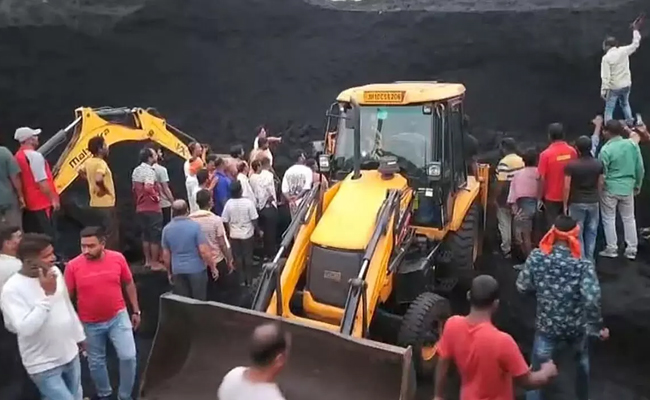
Dhanbad (Jharkhand) (PTI): At least four workers died after being buried under coal slurry in Jharkhand's Dhanbad district on Saturday, a police official said.
The incident took place at Moonidih coal washery in the command area of Bharat Coking Coal Limited (BCCL).
"Bodies of all four workers were dug out of debris during a rescue operation," Putki police station in-charge Waqar Hussain told PTI.
The incident took place when coal slurry was being loaded into trucks by workers, during which a large chunk of slurry fell and trapped several workers underneath, officials said.
The deceased have been identified as Manik Bauri, Dinesh Bauri, Deepak Bauri, and Hemlal Gope.
Meanwhile, the family members of the deceased and local villagers placed the bodies in front of the washery gate and began a protest.
They demanded compensation, jobs for dependents and action against those responsible for the incident.
Police and administration officials are trying to pacify the protesters, an official said.