Two Himachal brothers marry same woman adopting tribal tradition of polyandry

Nahan/Shimla (HP), Jul 20 (PTI): Two brothers of the Hatti tribe tied the knot to a woman in Shillai village of Himachal Pradesh, with hundreds of people witnessing the marriage solemnised under the anachronistic tradition of polyandry.
Bride Sunita Chauhan and grooms Pradeep and Kapil Negi said they took the decision without any pressure.
Local folk songs and dances added colour to the ceremony that began on July 12 and lasted for three days in the Trans-Giri area of Sirmaur district.
Videos of the wedding ceremony have gone viral on the internet.
Revenue laws of Himachal Pradesh recognise this tradition and named it "Jodidara". In Badhana village in Trans-Giri, five such marriages have taken place in the past six years.
Sunita, who hails from Kunhat village, said that she was aware of the tradition and made her decision without any pressure, adding she respects the bond they have formed.
Pradeep, from Shillai village, works in a government department while his younger brother Kapil has a job abroad.
"We followed the tradition publicly as we are proud of it and it was a joint decision," said Pradeep.
Kapil said he may live abroad, but through this marriage, "we're ensuring support, stability and love for our wife as a united family".
"We've always believed in transparency," he added.
Hatti is a closed-knit community in the Himachal Pradesh-Uttarakhand border and was declared as Scheduled Tribe three years ago. In this tribe, polyandry was in vogue for centuries, but due to rising literacy among women and economic uplift of communities in the region, cases of polyandry were not reported.
Such marriages are being solemnised in a clandestine manner and accepted by the society but instances are fewer, elders in the village said.
According to experts, one of the main considerations behind the tradition was to ensure that the ancestral land was not divided while the share of tribal women in the ancestral property is still a main issue.
There are nearly three lakh people of the Hatti community who live in about 450 villages in the Trans Giri area of Sirmaur district and polyandry is still a practising tradition in some villages. It was also prevalent in Jaunsar Babar, tribal area of Uttarakhand and Kinnaur, a tribal district of Himachal Pradesh.
Kundan Singh Shastri, general secretary of Kendriya Hatti Samiti, the prime body of the Hatti community, said this tradition was invented thousands of years ago to save a family's agricultural land from further division.
Another reason is to promote brotherhood and mutual understanding in a joint family by marrying even two or more brothers born from different mothers with a single bride, he told PTI.
The third reason is a feeling of security "if you have bigger family, more men, you are more secure in a tribal society", he said, adding it also helps in managing scattered agriculture lands in far-flung hard hilly areas which requires a family for a long time for care and cultivation.
These requirements of tribal families have kept the polyandry system for thousands of years, in practice, though these traditions are slowly dying, Shastri added.
In this unique tribal tradition of marriage known as "Jajda", the bride comes to the village of the groom in a procession and the ritual known as "Seenj" is performed at the residence of the groom.
The pandit chant mantras in local language with sprinkling holy water on the bride and groom and offer them jaggery in the end, with blessings that their Kul Devta may bring sweetness in their married life.
Let the Truth be known. If you read VB and like VB, please be a VB Supporter and Help us deliver the Truth to one and all.
Counting for Bagalkot, Davanagere South bypolls on May 4 amid tight security
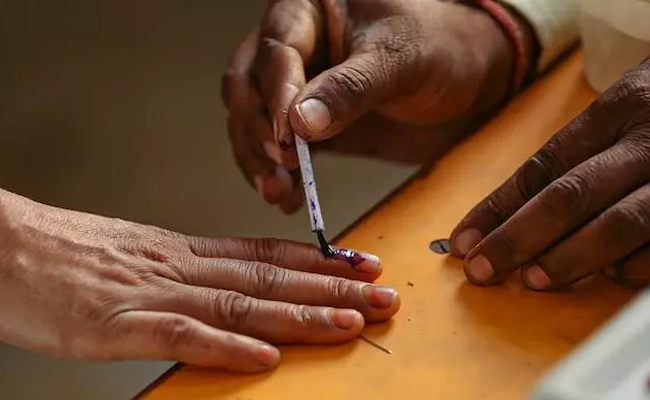
Bengaluru (PTI): Counting of votes for bypolls to two assembly constituencies in Karnataka -- Bagalkot and Davanagere South -- will be held on May 4, amid tight security, election officials said Sunday.
The by-elections were held on April 9.
The bypolls were necessitated by the deaths of senior Congress MLAs H Y Meti (Bagalkot) and Shamanur Shivashankarappa (Davanagere South).
Although the outcome of these by-elections is unlikely to have an immediate impact on state politics, the contest is seen as a matter of prestige for both the ruling Congress and the opposition BJP.
While the Congress faces the challenge of retaining both seats, the BJP aims to wrest them and deliver a setback to the ruling party, which is currently witnessing an "internal power struggle" over leadership.
There has been speculation that a decision on leadership change and the much-awaited cabinet reshuffle is likely after the May 4 results.
According to the Election Commission, the voter turnout in Bagalkot was 68.74 per cent, and it was 68.43 per cent in Davanagere South.
Poll officials said the counting of votes would begin at 8 am, and the clear picture may emerge by mid day.
Adequate security arrangements have been made for the smooth conduct of the counting and to ensure that no untoward incidents happen during or after the declaration of results, according to top police officials.
Preparations have been completed at the University of Horticultural Sciences in Bagalkot and DRR School at Davanagere for counting of votes.
According to election officials, 14 tables each have been set for vote counting on EVMs at counting centres both in Bagalkot and Davanagere South assembly segments, where nine and 25 candidates were in the fray respectively.
The BJP fielded former MLA and 2023 defeated candidate Veerabhadrayya Charantimath from Bagalkot, and a fresh face, Srinivas T Dasakariyappa, from Davanagere South.
The Congress gave tickets to family members of the late legislators in both constituencies. Bagalkot candidate Umesh Meti is the son of H Y Meti, while Samarth Mallikarjun from Davanagere South is the grandson of Shamanur Shivashankarappa.
Samarth's father, S S Mallikarjun, is a minister in the Siddaramaiah-led Cabinet and in charge of Davanagere district, while his mother, Prabha Mallikarjun, is a Member of Parliament from the region.
The BJP is looking to make gains in the bypolls and energise its cadre ahead of the 2028 Assembly elections. For the Congress, retaining both seats is crucial, as a loss could be seen as a negative verdict on the performance of the Siddaramaiah-led government.
Muslim disgruntlement appears to be a concern for the Congress in Davanagere South. With 14 of the 25 candidates in the fray belonging to the community, there are apprehensions within the party about a split in votes, which could benefit the BJP.
Given its significant presence in the constituency, the Muslim community strongly demanded the Congress ticket for Davanagere South. However, the party fielded late MLA Shivashankarappa's grandson Samarth. This is said to have caused disgruntlement among the community and Muslim leaders within Congress.
Although the Congress persuaded a rebel candidate Sadiq Pailwan to withdraw, he remained in the fray as the move came after the deadline for withdrawal of nominations.
The Congress, after the polls, even took action against some Muslim leaders of the party following allegations of "internal conspiracy" to defeat the candidate in Davanagere South. The action included MLC K Abdul Jabbar being suspended from primary membership and Chief Minister Siddaramaiah relieving another MLC, Naseer Ahmed, from the post of CM's political secretary.
Speculation are rife that Housing Minister B Z Zameer Ahmed Khan may also face disciplinary measures during the next cabinet reshuffle. So, the Davanagere South results are crucial for Khan as well.
Following these actions, some Muslim clerics and leaders had openly warned the grand old party.
In Bagalkot too, the Congress faced initial dissidence, with other members of Meti's family seeking the ticket. However, Siddaramaiah's intervention helped resolve differences to an extent, and they campaigned together.
The BJP, in contrast, saw little dissidence over candidate selection, with its leaders campaigning in unity.
Leaders of Congress and the BJP have expressed confidence about their parties winning both the seats.
In the 2023 Assembly elections, H Y Meti defeated BJP's Charantimath by a margin of 5,878 votes in Bagalkot, while Shivashankarappa defeated BJP's B G Ajay Kumar by 27,888 votes in Davanagere South.